



Political Analysis| BJD's Machiavellian Gamble: Naveen Patnaik Backs CJP Leaders Despite Delhi HC Warning on Jantar Mantar
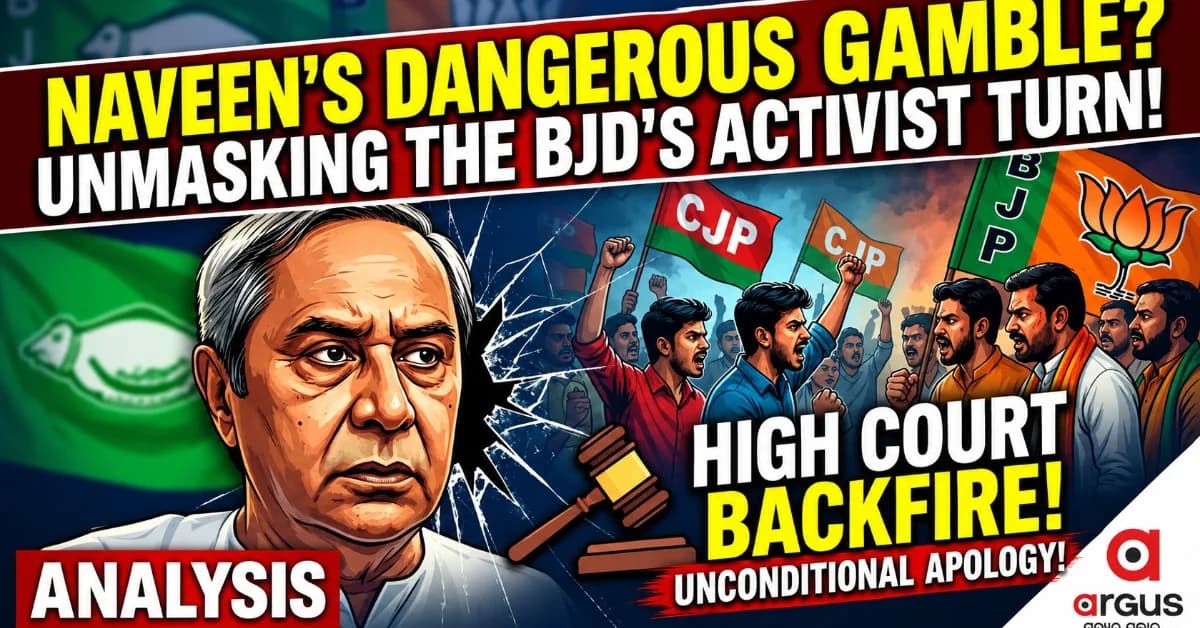
Key Points
From Autonomy to Activism: Driven by recent campus election defeats and a rising BJP threat, Naveen Patnaik has pivoted from his 2011 "isolationist" stance to openly backing activist-led national movements.
Machiavellian Pragmatism: BJD strategists are adopting raw political survival tactics—weaponizing the combative, chaotic energy of outside youth groups like CJP to disrupt governance and challenge the ruling BJP.
The High Court Backfire: Despite Patnaik's vocal support on X, the Delhi High Court sharply criticized the CJP leaders over repeat peace-bond violations and "regime change" rhetoric before they tendered an unconditional apology.
Bhubaneswar: Out of Power, BJD political strategists seem fine tuning the Machiavelli politics in State.
Niccolò Machiavelli had once said: "A prince must be shrewd enough to avoid the public disgrace of those vices that would lose him his state... he must not mind incurring the scandal of those vices without which it would be difficult to save the state."
The open X post by former CM Naveen Patnaik supporting the AAP members turned CJP placard holders hint all about BJD practicing Machiavellian politics.
The Machiavellian insight from The Prince perfectly captures the raw pragmatism that governs political survival. The insight shows how in the theater of power, rigid consistency is a luxury only the secure can afford. And this exactly fits into the BJD scheme of things in Odisha.

📱 Get Argus News App
✨For nearly a quarter of a century, Biju Janata Dal (BJD) president and former Odisha Chief Minister Naveen Patnaik operated as an ideological island – aloof, self-sufficient, and entirely secure within the borders of his regional fortress.
Yet, his recent public intervention demanding the immediate release of Cockroach Janta Party (CJP) youth leaders Saurav Das and Ashutosh Ranka signals a fundamental shift.
The veteran leader, who once viewed national activist movements with detached institutional indifference, has performed what critics describe as 180-degree political gymnastics.
This shift highlights a striking new reality for the regional party: the realization that the BJD alone may no longer be sufficient to defeat a rising Bharatiya Janata Party (BJP).
The Fortress of 2011: Absolute Autonomy and the Anna Movement
To understand the magnitude of Patnaik’s 2026 political shift, one must return to the political landscape of 2011.
During the height of the Anna Hazare Anti-Corruption Movement, Patnaik was the unchallenged architect of Odisha’s political destiny. Having summarily severed ties with the BJP in 2009, he had just secured a resounding mandate based on an unassailable personal brand: "Mr. Clean."
When the India Against Corruption (IAC) crusade swept the nation’s middle class, Patnaik’s response was characterized by measured, institutional detachment.
He offered passive endorsement to the principle of a strong Lokpal Bill and politely urged Hazare to end his fast, but he kept the actual movement at arm's length.
The political logic of 2011 was simple: Patnaik possessed absolute political capital. He did not need to piggyback on national agitations, nor did he require the validation of outside firebrands to secure his domestic stock. The BJD operated under a strict doctrine of maintaining an equal distance from both national coalitions, secure in the knowledge that Patnaik's localized welfare model and clean image were entirely sufficient to neutralize any opposition in Odisha.
The Vulnerability of 2026: The Campus Loss and the CJP Alliance
Fast forward to October 2026, and the structural foundations of Odisha politics have undergone a dramatic realignment.
Following unprecedented setbacks in the 2024 elections and subsequent bypolls, Rajya Sabha elections et al to a subsequent string of losses in student union and campus polls, the BJD finds itself in the unaccustomed role of a vulnerable opposition party. The institutional machinery that once guaranteed seamless electoral victories faces a formidable, highly motivated BJP adversary that now holds the levers of state power.
It is against this backdrop of institutional anxiety that Patnaik took to social media on October 20 to passionately defend Saurav Das and Ashutosh Ranka. The two CJP leaders had been remanded to judicial custody following a high-profile incident at Delhi's Jantar Mantar, where they scaled a locked gate to hoist the National Flag in a denotified zone.
Rather than ignoring a distant, localized dispute in New Delhi, Patnaik chose to elevate it, arguing that hoisting the Tricolour should not warrant prolonged detention and urging the judiciary and executive to protect the youth’s faith in the rule of law.
The Political Logic: A Shift Born of Strategic Necessity
Political science theory suggests that when an established hegemon faces a structural threat it cannot independently neutralize, its strategic behavior shifts from isolation to coalition-building. Patnaik’s defense of the CJP elites fits this framework.
For years, the BJD’s strategy relied on a quiet, transactional relationship with central authorities – often supporting the ruling dispensation on key federal legislation in exchange for state packages.
However, with the BJP now aggressively expanding its footprint into the BJD's traditional urban, rural, and youth demographics, that quiet arrangement has collapsed. The loss in recent campus polls was particularly alarming for BJD strategists, signaling that the state's younger voter base was drifting toward more assertive, ideological alternatives.
By openly aligning with the CJP – a chaotic, activist-driven political entity – Patnaik is attempting a calculated tactical pivot. BJD strategists appear to recognize that Patnaik’s traditional style of governance needs to be supplemented by the chaotic, combative energy of contemporary youth movements.
The logic is clear: the BJD strategists think they now require the support of outside political forces to rejuvenate its brand, with unison disrupt the BJP's narrative, and build a broader anti-establishment front to reclaim the power seat.
BJD knows chaotic, combative agitations will derail governance, and it can easily mount an offensive against BJP government, for which, BJD strategists deemed it fit to join to make the BJP road to governance bumpy.
Why Naveen’s Open Support Raise Eyebrows?
During the hearing on October 21, 2026, the Delhi HC raised tough questions and expressed serious concerns regarding the conduct of CJP leaders Saurav Das and Ashutosh Ranka before they ultimately withdrew their plea.
Presiding over the case, Justice Subramonium Prasad made several sharp observations:
· Stricter Proof for Repeat Violations: The court noted that because the duo was accused of breaching a previously signed peace bond (from a prior detention on October 10), authorities had a valid reason to insist on stricter enforcement.]
· Risk of Escalation: Justice Prasad strongly questioned their actions of scaling the locked gates of Jantar Mantar – a site that has been legally denotified for protests.
· The judge remarked, "When you go there and you break a barricade... the chances of 10 or 20 more people in violation of Section 163 BNSS is very bright."
· Warning Against "Regime Change" Rhetoric: The bench flagged dangerous escalations in protest rhetoric, noting that peaceful student agitations can quickly turn into looting, arson, and violence once organisers lose control.
· Justice Prasad remarked, "We suddenly hear something like a regime change..." emphasizing that political changes must happen through the ballot box rather than chaotic public disruptions.]
· Alternative Remedies Available: The High Court ultimately expressed its disinclination to interfere with the judicial custody writ petition directly, noting that the statutory legal code already provided alternative avenues of appeal. The judge stated, "Liberty is sacrosanct. But if the Code provides for remedy… when there is already provision available," advising them to let the Special Executive Magistrate (SEM) system run its course.
· Unconditional apology: Following these firm observations from the High Court, the CJP leaders withdrew their petition from the high court. Later that same afternoon, they were produced before the SEM court at Mandir Marg, which accepted their sureties and ordered their immediate release after they tendered an unconditional apology and signed an undertaking not to hold protests at Jantar Mantar while it remains restricted.
In the above context, political observers, therefore, view Patnaik's intervention as an admission of political weakness and a sign of dwindling confidence.
Observers, therefore, ultimately see the transition from the passive detachment of 2011 to the proactive intervention of 2026 as an illustration of the evolving nature of political survival.
Facing an opponent that threatens its core survival, the BJD has been forced to abandon its isolationist doctrine. Machiavelli's calculus reminds us that a leader must be willing to endure the "scandal" of a drastic tactical pivot if it means preserving the state.
The political gymnastics
observed today are the direct result of a calculated realization: in the
altered realities of 2026, standing alone is no longer an option, as the party
has lost its political confidence to rebound.
Also Read: Special Analysis|58 Years of the Kotia Conflict: Inside the Political Opportunism of BJD and Congress
Related Topics
Explore more stories