



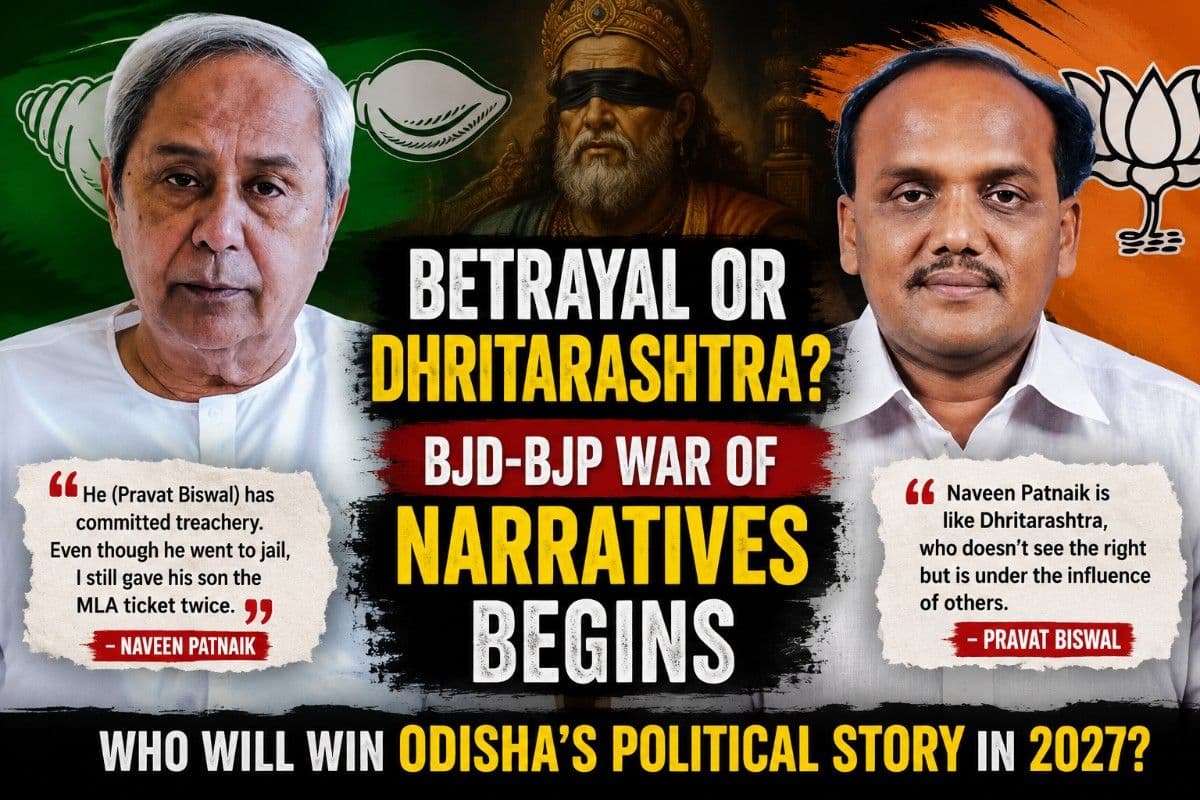
“One Cries ‘Betrayal’, the Other Sees ‘Dhritarashtra’: How Naveen Patnaik, Pravat Biswal Fighting 1st Narrative Battle Before Odisha’s 2027 Polls
Key Points
Narrative Clash: Naveen Patnaik frames the recent high-profile defections as acts of personal "betrayal" by opportunistic leaders, aiming to preserve the party's moral image.
Symbolic Rebuttal: Pravat Biswal counters by branding Patnaik as "Dhritarashtra," the blind king, suggesting the BJD’s decline stems from leadership detachment and external influence.
The 2027 Stakes: Both leaders are aggressively competing to shape public perception, knowing that winning the "narrative battle" is crucial for voter morale ahead of the 2027 Panchayat elections.
“One Cries ‘Betrayal’, the Other Sees ‘Dhritarashtra’: How Naveen Patnaik and Pravat Biswal Are Fighting the First Narrative Battle Before Odisha’s 2027 Polls | Political Analysis”
Bhubaneswar: "In politics, the first battle is rarely fought at the ballot box. It is fought in the minds of voters through stories – one leader paints himself as the betrayed patriarch, while the other casts him as the blind king who could not see his own kingdom collapsing."
That battle has now begun in Odisha.
A day after senior leader Pravat Ranjan Biswal formally joined the BJP, BJD president and former Chief Minister Naveen Patnaik abandoned his characteristic restraint to deliver one of his sharpest political attacks in recent years.

📱 Get Argus News App
✨“He has committed treachery. Even though he went to jail, I still gave his son the MLA ticket twice.”
The statement was more than an expression of personal disappointment.
It was a carefully crafted political message.
Within twenty-four hours, Biswal fired back with equal symbolism.
Comparing Naveen Patnaik to Dhritarashtra, the blind king of the Mahabharata, Biswal accused the BJD chief of refusing to see the destruction unfolding within his own party.
The exchange is not merely a war of words.
It is a battle over political narrative – who betrayed whom.
Why Naveen Chose the 'Betrayal' Narrative
In electoral politics, "betrayal" is among the most emotionally powerful accusations.
By reminding people that Biswal's family continued to enjoy political patronage despite legal troubles, Naveen Patnaik was not speaking only to Pravat Biswal.
He was speaking to three different audiences simultaneously.
First, to BJD workers, especially in Cuttack district, the message was unmistakable: the party never abandoned Biswal, but Biswal abandoned the party.
Second, to leaders contemplating switching sides, the warning was equally clear. The BJP may offer immediate political opportunities, but history will remember defectors as vishwasghatis – betrayers.
Third, and perhaps most importantly, Naveen was addressing ordinary BJD supporters increasingly worried by the steady stream of senior leaders joining the BJP.
Instead of allowing the narrative to become "BJD is weakening because leaders are leaving," Naveen seeks to replace it with another explanation:
Leaders are leaving not because the party is collapsing, but because individuals are betraying the party that nurtured them.
That distinction is politically crucial.
Political organisations often survive electoral defeats if they retain the emotional loyalty of their cadre.
The "betrayal" narrative attempts precisely that.
Damage Control Through Political Optics
Every major regional party facing defections eventually confronts the same challenge.
Do repeated exits indicate organisational decline?
Or individual ambition?
Naveen Patnaik's remarks suggest he wants the latter interpretation to dominate public discourse.
For nearly twenty-five years, his political brand rested on personal integrity, simplicity and trust.
Therefore, portraying himself as the leader whose generosity was repaid with betrayal reinforces that long-built image rather than allowing attention to shift toward questions about internal dissatisfaction.
It transforms organisational weakness into moral victimhood.
In politics, that is often an effective defensive strategy.
Why Biswal Chose Dhritarashtra
Pravat Biswal's response was equally calculated.
Calling Naveen Patnaik "Dhritarashtra" was not simply invoking mythology.
It carried layered political meaning.
In the Mahabharata, Dhritarashtra is physically blind.
But political interpretations focus less on his eyesight and more on his inability – or unwillingness – to recognise the destruction unfolding before him.
He remained under the overwhelming influence of others while his kingdom gradually descended into conflict.
That symbolism is difficult to miss.
Biswal's comparison appears aimed at reinforcing an allegation that has quietly circulated in Odisha politics over the past few years – that crucial political decisions within the BJD increasingly came under the influence of trusted aides rather than the party's supreme leader himself.
Without naming anyone directly, the remark inevitably revives speculation surrounding former bureaucrat-turned-political aide V.K. Pandian, whose growing influence became one of the BJP's principal political attack lines during the 2024 Assembly elections.
Biswal's message therefore extends beyond one individual.
It suggests that BJD's decline was not caused by disloyal leaders but by a leadership unwilling – or unable – to recognise what was happening inside its own organisation.
The Battle Is About Ownership of BJD's Decline
Both narratives attempt to answer one central political question.
Why are senior leaders leaving the BJD?
Naveen's answer:
Because ambitious politicians are betraying the party after enjoying its goodwill.
Biswal's answer:
Because the party leadership became disconnected from reality and ignored warning signs until it was too late.
Each explanation seeks to shape public memory.
One absolves the leadership.
The other indicts it.
Emotion Wins Elections as Much as Arithmetic
Modern elections are rarely decided by organisational strength alone.
They are increasingly influenced by emotional storytelling.
"Betrayal" evokes sympathy.
"Dhritarashtra" evokes frustration.
Both are emotionally loaded political metaphors familiar to Indian voters.
Neither requires lengthy explanations.
The language itself carries decades of cultural memory.
That is precisely why experienced politicians use such symbols.
They simplify complicated political developments into emotionally understandable stories.
The Stakes Are Bigger Than One Defection
For the BJP, every prominent BJD entrant strengthens the perception that Odisha's political centre of gravity has shifted decisively.
For the BJD, every defection risks creating a domino effect if workers begin believing the party's best days are behind it.
Consequently, controlling the narrative becomes almost as important as controlling the organisation.
If workers believe leaders are deserting a sinking ship, morale declines rapidly.
If they instead believe those leaving are opportunists betraying the party's legacy, organisational cohesion can still survive.
That explains why Naveen Patnaik chose unusually blunt language.
And why Biswal responded with an equally powerful mythological metaphor.
Bottom Line
Politics often begins with perception long before it ends with votes.
Naveen Patnaik wants Odisha to believe that trusted colleagues deserted a leader who stood by them in difficult times.
Pravat Biswal wants Odisha to believe that BJD's troubles stem not from betrayal but from a leadership that, like Dhritarashtra, failed to see what was unfolding within its own ranks while remaining under the influence of those around it.
Both leaders are playing their narratives to the hilt – each seeking to absolve himself while placing the other on the wrong side of Odisha's political story.
The real
verdict, however, will not be delivered in television studios or press
conferences. As Odisha heads toward the 2027 Panchayat elections, the
state's first major electoral test after the 2024 power shift, voters will
decide which narrative carries greater conviction – and whether the politics of
"betrayal" or the symbolism of "Dhritarashtra" ultimately
proves more persuasive.
Also Read: From 2012 to 2026: How Cuttack Strongman Prabhat Biswal Completed His 14-Year Political Circle| Political Analysis
Related Topics
Explore more stories