



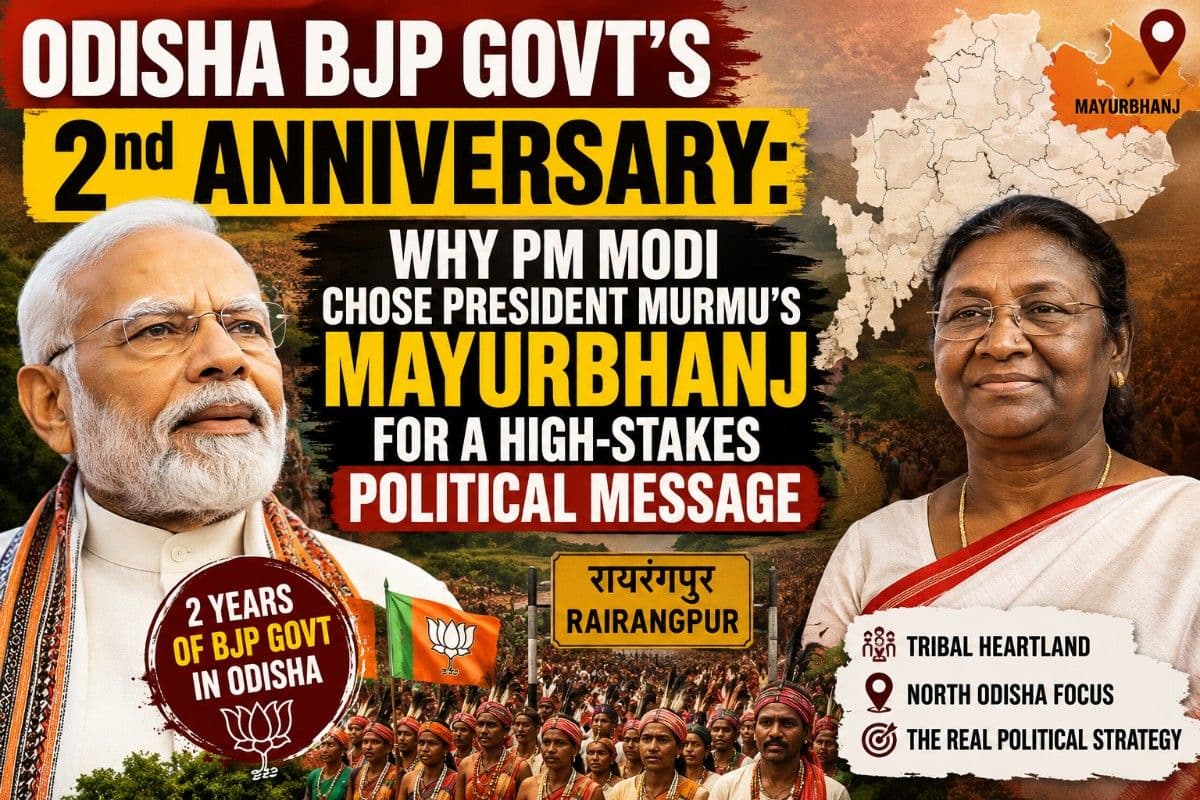
Odisha BJP Govt’s 2nd Anniversary: Why PM Modi Chose President Murmu’s Mayurbhanj for a High-Stakes Political Message| Special Story
Key Points
* The choice of President Droupadi Murmu’s hometown reflects BJP’s effort to consolidate the tribal support that helped it win power in 2024.
* From Bhubaneswar to Jharsuguda and now Mayurbhanj, Modi’s Odisha visits trace the regions that fueled the BJP’s historic rise.
Bhubaneswar: Officially, Prime Minister Narendra Modi's June 20 visit to Odisha has a simple and heartwarming purpose. He will travel to Pahadpur in Mayurbhanj district to pay respects at the SLS Memorial Residential School, an institution founded by President Droupadi Murmu in memory of her late husband Shyam Charan Murmu and their two sons. Later, PM will address a major public gathering at Rairangpur marking the second anniversary of the BJP government led by Chief Minister Mohan Charan Majhi.
But politics rarely operates on symbolism alone.
As the old political adage goes: every event is planned, and every location is chosen for a reason.
Look beyond the official itinerary, and Modi's Mayurbhanj visit begins to reveal a deeper political message – one aimed at two of the most decisive electoral constituencies in Odisha today: tribal voters and Northern Odisha.

📱 Get Argus News App
✨A Carefully Chosen Political Geography
The BJP's rise to power in Odisha in 2024 was not driven by a single region. It was built through successive breakthroughs across different parts of the state.
When Modi came to Bhubaneswar on June 20, 2025, for the first anniversary of the BJP government, the focus was on Coastal Odisha and urban voters. The capital city symbolized the region where the BJP had made unprecedented inroads into the BJD's traditional stronghold.
Three months later, in September 2025, Modi landed in Jharsuguda. The message shifted westward – to the industrial belt and Western Odisha, a region that delivered some of the BJP's strongest performances and helped turn the electoral tide against the BJD.
Now, on the second anniversary of the BJP government, the Prime Minister is moving further north – to Mayurbhanj, the state's largest tribal district.
The progression is striking.
Year One: Coastal Odisha.
Later in 2025: Western Odisha.
Year Two: Northern Tribal Odisha.
It is a
political map tracing the very regions that powered the BJP's historic victory.
Moreover, in a boost to BJP pro-poor and pro- tribal strategy, the Odisha BJP govt has very recently taken two path-breaking decisions that will have salutary impact on poor and tribals in the State.
* Free education from Kindegarten (KG) to Post Graduate (PG).
* Free 5Kg per person in addition to 5kg/person under Pradhan Mantri Garib Kalyan Yojana.
Why
Mayurbhanj Matters
Mayurbhanj is not just another district.
It is the homeland of President Droupadi Murmu, the largest tribal district in Odisha, and one of the most politically significant regions in eastern India.
More than 58% of the district's population belongs to Scheduled Tribes, primarily Santhal, Ho and Munda communities. The district is overwhelmingly rural, with villages spread across forests, hills and mineral-rich terrain.
In electoral terms, Mayurbhanj represents something even more valuable.
It sits at the heart of Northern Odisha – a region that emerged as one of the BJP's biggest engines of victory in the 2024 Assembly elections.
Out of Northern Odisha's 28 Assembly seats, the BJP won 17. The party swept through much of Mayurbhanj and neighbouring Keonjhar, transforming what was once considered difficult political terrain into one of its strongest support bases.
The message of holding the anniversary celebration here is unmistakable: the BJP is returning to thank the constituency that helped bring it to power – and to ensure that support remains intact.
The Tribal Vote: Odisha's Ultimate Kingmaker
The political importance of tribal voters in Odisha cannot be overstated.
Scheduled Tribes account for nearly 23% of the state's population and approximately 75-76 lakh voters. The Odisha Assembly has 34 seats reserved for Scheduled Tribes, representing more than 23% of the entire legislature.
But their influence extends far beyond those reserved constituencies.
In at least 15-20 general seats, tribal communities hold enough numbers to decisively influence outcomes. High voter turnout rates – often exceeding 75% - make the community one of the most consequential electoral blocs in the state.
The 2024 election demonstrated this dramatically.
The BJP captured 19 of Odisha's 34 ST-reserved seats, while the BJD's tally collapsed from 18 tribal seats in 2019 to just five. That shift shattered one of the pillars of Naveen Patnaik's long-standing political dominance.
Without the tribal swing, the BJP's path to government would have been significantly more difficult.
With it, the party crossed the majority mark and formed its first-ever government in Odisha.
Symbolism of Sharing a Stage With President Murmu
The June 20 event carries another layer of significance.
For the first time, the Prime Minister and President Droupadi Murmu will share a public platform in this remote corner of Odisha.
In purely constitutional terms, it is a ceremonial moment.
Politically, it reinforces one of the BJP's strongest narratives among tribal communities – that the rise of Droupadi Murmu from Rairangpur to Rashtrapati Bhavan represents a historic moment of tribal empowerment.
Murmu remains an immensely respected figure across large sections of Odisha's tribal belt. Her personal story resonates far beyond party lines.
By choosing her hometown as the centrepiece of the government's second anniversary celebrations, the BJP is effectively connecting governance, symbolism and electoral messaging in a single event.
A Contrast With 2018
Interestingly, this is not the first time Modi has used Odisha to mark an important political milestone.
In May 2018, he chose Cuttack to celebrate four years of the NDA government at the Centre.
At the time, the BJP was still attempting to establish itself as a serious challenger to the BJD. The rally served as a declaration that Odisha was central to the party's long-term eastern expansion strategy.
Six years later, the political equation has changed dramatically.
The BJP is no longer challenging for power in Odisha – it governs the state.
The question now is not how to win Odisha, but how to consolidate and expand the coalition (societal) that delivered victory.
The Real Audience
On paper, Modi is visiting a school founded by President Murmu and celebrating two years of the state government.
In reality, the audience extends far beyond the crowd gathered in Rairangpur.
The speech will be heard across tribal districts stretching from Mayurbhanj and Keonjhar to Sundargarh, Kandhamal, Nabarangpur and Malkangiri.
It will be watched closely in Northern Odisha, where the BJP hopes to deepen its dominance.
And it will serve as a reminder that the party views tribal voters not as a peripheral constituency, but as a central pillar of its Odisha strategy.
That may ultimately explain why the Prime Minister is travelling to Mayurbhanj this year.
The school visit provides the occasion.
The anniversary provides the platform.
But the politics lies in the geography.
Because in
modern electoral politics, locations are rarely accidental – and Mayurbhanj may
be the most politically significant destination PM Modi could have chosen in
Odisha in 2026.
Also Read: Odisha’s Biggest Education Reform Yet: How Free KG-to-PG Scheme Drives NEP 2020 Goals for 4 Lakh Vulnerable Students in State| Special Story