



Odisha’s Biggest Education Reform Yet: How Free KG-to-PG Scheme Drives NEP 2020 Goals for 4 Lakh Vulnerable Students in State| Special Story
Key Points
* Nearly 1.53 lakh students are lost annually between Class 10 and Plus-II, a key challenge the new policy aims to address.
* The reform aligns with NEP 2020 by promoting equitable access, higher enrollment, and greater participation in postgraduate education.
Bhubaneswar: As the first BJP govt in State completes two eventful years, marking the occasion, Chief Minister Mohan Charan Majhi Friday announced a trailblazing decision to introduce zero-fee education from Kindergarten to the Postgraduate level.
By wiping out tuition, registration, and admission fees across all state-run institutions, this bold policy creates a direct legislative bridge to meet the core access and equity goals of India's National Education Policy (NEP 2020).
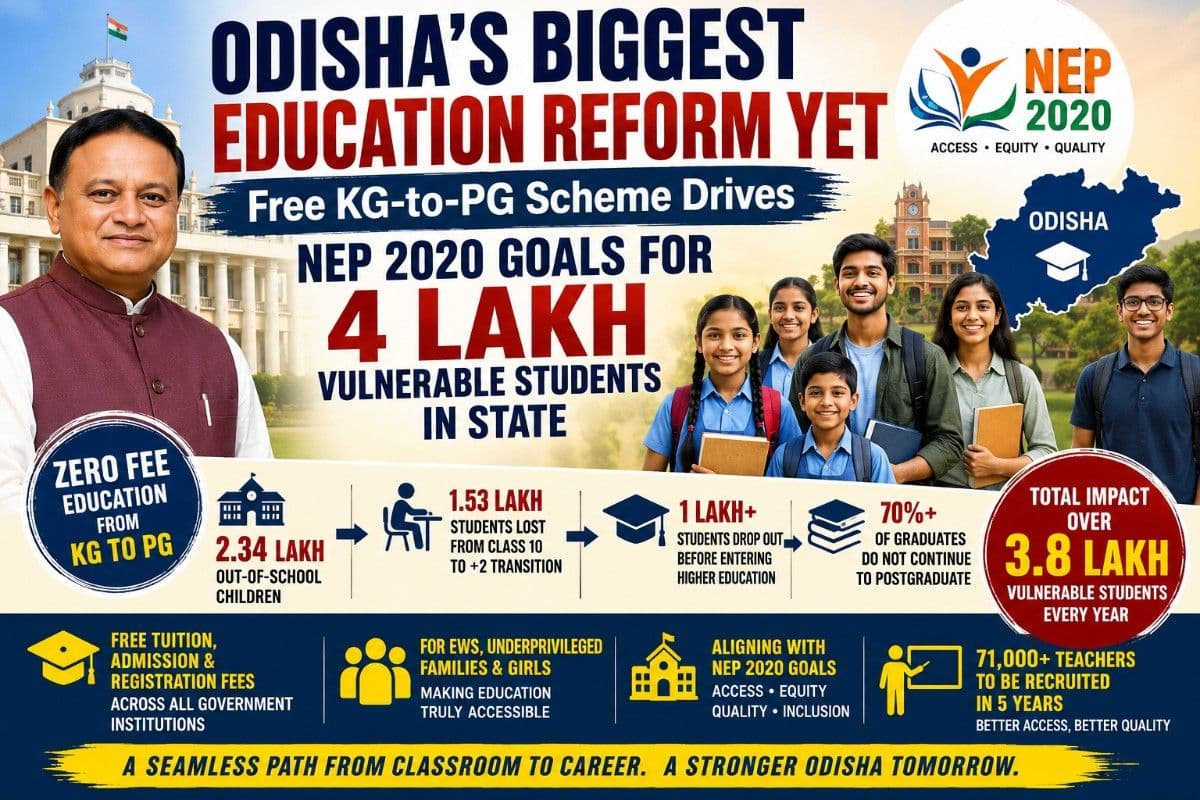
Estimates show that a whopping 3.8 lakh students annually have been out of the formal education system in the State -through school dropouts, transition failures and higher education exits.
The newly announced KG-to-PG scheme, applicable across government schools, colleges and universities, seeks to remove financial barriers for students from Economically Weaker Sections (EWS), underprivileged families and girls and fulfil the NEP 2020 bigger mandate.

📱 Get Argus News App
✨2.34 Lakh Out-of-School Children Challenge
The starting point of Odisha's educational crisis is already visible at the school level.
The state's Odisha Shiksha Survekhyan, a door-to-door child tracking exercise, identified 2.34 lakh Out-of-School Children (OoSC) in the 7-18 age group. These are children who have either never enrolled or dropped out before completing schooling.
Official records further reveal that out of nearly 5.47 lakh children entering Class I, approximately 1.5 lakh discontinue their education before completing school, highlighting a persistent retention challenge despite improvements in primary education enrollment.
The burden is disproportionately borne by vulnerable communities. Scheduled Tribe students continue to record the highest dropout rates among all social categories, reflecting the combined impact of poverty, remoteness and educational access deficits.
From Class 10 to +2 Disappearance
The most alarming educational leakage occurs immediately after matriculation.
This year, more than 5.19 lakh students passed the Class 10 examination. However, audit findings presented before the Odisha Legislative Assembly indicate that the state's Secondary-to-Higher Secondary transition rate remains only about 70.3 percent.
The implication is stark.
Nearly 1.53 lakh students who clear Class 10 fail to enter + 2 or discontinue their studies during the transition phase.
Educational experts have repeatedly identified admission costs, transportation expenses, hostel charges and household financial distress as major reasons behind this exodus.
The government's new fee-waiver model is expected to directly target this transition gap, which accounts for one of the largest annual losses in Odisha's education system.
Higher Education Enrolment Narrows Further
The dropout crisis intensifies beyond Plus-II.
Although Odisha produces over 3.4 lakh Plus-II pass-outs annually, only around 2 lakh to 2.2 lakh students secure fresh undergraduate admissions each year, indicating another significant reduction in participation.
The situation becomes even more severe at the postgraduate level.
AISHE-based enrollment trends show that more than 70 percent of degree holders do not transition into postgraduate education. Financial pressure, early entry into the labour market and rising educational costs force many graduates to abandon formal studies after obtaining a bachelor's degree.
As a result, Odisha's higher education ecosystem continues to struggle with low enrollment density despite an increase in the number of colleges and universities.
Who Stands to Benefit?
When the numbers are combined, the scale of potential beneficiaries becomes evident.
The scheme directly addresses:
- 2.34 lakh out-of-school children identified by state surveys.
- About 1.53 lakh students annually lost during the Class 10 to Plus-II transition.
- Over 1 lakh students each year who fail to continue into higher education after school.
- Thousands of graduates who abandon postgraduate aspirations because of financial constraints.
Taken together, the policy seeks to influence the educational trajectory of more than 3.8 lakh vulnerable students every year, while creating opportunities for lakhs more already enrolled in government educational institutions.
Why Odisha Needs the Scheme
The urgency is reflected in broader educational indicators.
While school-level retention has improved considerably over the last decade, Odisha's higher education participation remains below the national average.
The state's Gross Enrolment Ratio (GER) in higher education has hovered around 20.7 percent, significantly lower than the national average of 27.3 percent.
This means a large share of Odisha's youth still do not enter colleges and universities despite completing school education.
Officials believe the KG-to-PG initiative can reverse this trend by ensuring that a student's educational journey is not interrupted by tuition fees, admission charges or recurring academic expenses.
Beyond Free Education
The scheme is being rolled out alongside broader education reforms under the National Education Policy (NEP 2020).
The state plans to establish Godabarish Mishra Ideal Primary Schools at the panchayat level and recruit over 71,000 teachers within five years, strengthening both access and quality.
Combined
with free education, policymakers hope these measures will create a seamless
pathway from early schooling to postgraduate education.
Also Read: How Odisha's New Rs12,000 Crore Model Primary Schools Are Rewriting the NEP, STEM Roadmap| Special Story
Related Topics
Explore more stories