



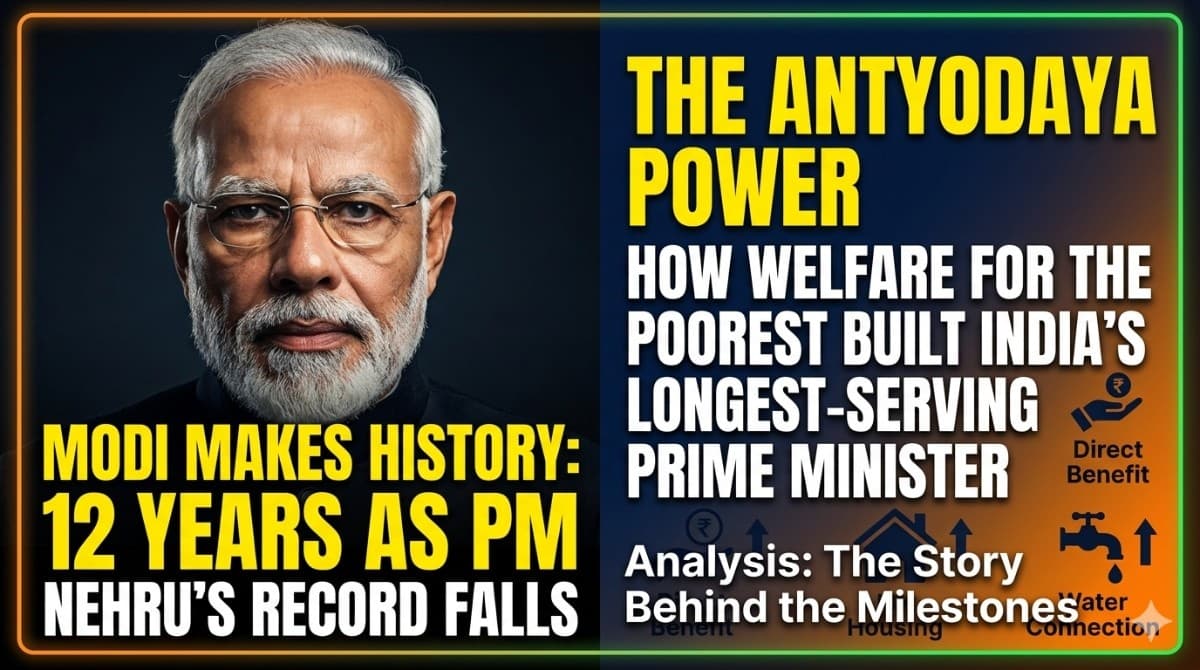
Nehru's 62-Year Record Falls: How Antyodaya Made Narendra Modi India's Longest-Serving Prime Minister| Analysis
Key Points
* The Modi government's Antyodaya-driven welfare model claims to have lifted 25 crore Indians out of multidimensional poverty through housing, sanitation, banking and water access.
* From Jan Dhan to MUDRA and Direct Benefit Transfers, welfare delivery evolved into a large-scale empowerment framework that reshaped India's political landscape.
Bhubaneswar: Tuesday (June 9) will record a major milestone for Prime Minister Narendra Modi, as he will complete 12 years in Office as it was the very day in 2024, when he took PM oath during his third tenure.
And on Wednesday, June 10, 2026, Prime Minister Narendra Modi will cross another mega political milestone that had stood untouched for more than six decades.
By completing 4,399 consecutive days in office, Modi surpassed Jawaharlal Nehru's uninterrupted tenure as Prime Minister, becoming the longest-serving head of government in India's democratic history without a break in office.
But beyond the symbolism of records and longevity lies a more consequential political story.

📱 Get Argus News App
✨When Nehru's tenure was defined by institution-building in a newly independent nation, political observers see Modi's twelve-year political endurance has been built on a different foundation altogether: Antyodaya, the principle that governance must begin with the welfare of the poorest, the weakest and the last citizen in the queue.
From opening bank accounts for the unbanked and delivering welfare directly into beneficiaries' accounts to building homes, toilets and tap-water connections at unprecedented scale, the Modi government has sought to transform welfare from a system of patronage into a platform for empowerment.
As Modi enters the record books on June 10, the question is no longer simply how long he has remained in office. The bigger question is what governance model enabled him to build and sustain such a durable political coalition across three successive general election victories.
The government's answer is clear: Antyodaya.
An examination of the Centre's twelve-year performance data reveals how the welfare of the poor and downtrodden evolved from a political slogan into the defining framework of governance – one that the administration believes has laid the foundation for a Viksit Bharat by 2047.
As the Modi government completed twelve years in office on June 9, 2026, the Centre released an extensive fact sheet highlighting what it describes as the transformation of governance through the philosophy of Antyodaya – the upliftment of the last person standing at the end of the development queue.
From financial inclusion and housing to sanitation, drinking water, entrepreneurship and social justice, the government's welfare architecture over the past decade has been built around a central proposition of saturation: development must reach every household, every village and every vulnerable citizen.
Guided by the vision of "Sabka Saath, Sabka Vikas, Sabka Vishwas, Sabka Prayas," the Modi administration argues that welfare should not remain a system of subsidies alone, but evolve into a framework of empowerment, dignity and opportunity.
Antyodaya as the Core Governance Model
For decades, poverty alleviation in India largely revolved around fragmented schemes and periodic relief measures. The Modi government's approach sought to replace this model with what it calls saturation-based delivery—ensuring that every eligible beneficiary receives access to essential services and state support.
At the heart of this approach lies the conviction that poverty is multidimensional. It is not merely a lack of income but also the absence of housing, sanitation, clean water, healthcare access, banking services and economic opportunity.
Over the past twelve years, the government's welfare strategy has therefore focused on attacking deprivation from multiple fronts simultaneously.
The results, according to official data, indicate a significant transformation.
India's Poverty Landscape: A Decade of Change
The government's fact sheet highlights a sharp decline in rural poverty and a substantial rise in income levels.
|
Indicator |
2014 |
2026 |
|
Rural Poverty Rate |
26% |
5% |
|
Citizens Lifted Out of Multidimensional Poverty |
— |
25 Crore |
|
Annual Per Capita Income |
Rs86,000 |
Over Rs2 Lakh |
The figures suggest that nearly 25 crore Indians have moved out of multidimensional poverty, aided by expanded access to basic services, welfare support and economic opportunities.
At the same time, India's annual per-capita income has more than doubled, reflecting broader improvements in economic participation and household earning capacity.
Jan Dhan to JAM: Financial Inclusion as Social Justice
One of the earliest pillars of the Modi government's Antyodaya agenda was financial inclusion.
Prior to 2014, millions of Indians remained outside the formal banking system, dependent on informal lenders and vulnerable to exploitation. The launch of the Pradhan Mantri Jan-Dhan Yojana (PMJDY) sought to change that reality.
More than 58 crore Jan Dhan accounts have since been opened, bringing previously excluded citizens into the formal financial ecosystem.
The significance of this initiative extended beyond banking. Through the integration of **Jan Dhan accounts, Aadhaar and mobile connectivity—the JAM Trinity—**the government created a direct welfare delivery network that enabled benefits to reach citizens without intermediaries.
According to the government, Direct Benefit Transfer (DBT) has significantly reduced leakages, improved transparency and strengthened trust between citizens and the state.
Dignity Through Housing, Sanitation and Water
The Modi government's welfare narrative repeatedly emphasizes that development is not only about economic indicators but also about human dignity.
A Home of One's Own
Under the Pradhan Mantri Awas Yojana (PMAY), more than three crore houses have been sanctioned or constructed for poor families across rural and urban India.
A notable feature of the programme has been the emphasis on registering homes in the name of women or through joint ownership, thereby strengthening women's economic security and social status.
Swachh Bharat: Turning Sanitation into a Mass Movement
When the Swachh Bharat Mission was launched, sanitation was often viewed as a routine administrative issue. Over the last decade, it evolved into one of India's largest behavioural and public health campaigns.
The construction of 11.72 crore household toilets has improved sanitation access, enhanced safety for women and contributed to reductions in water-borne diseases and associated health risks.
Jal Jeevan Mission: Bringing Water to Every Household
For millions of rural families, especially women, securing drinking water was once a daily challenge.
The Jal Jeevan Mission has provided functional tap-water connections to 11.88 crore households, significantly reducing the burden of water collection and improving quality of life across rural India.
From Welfare Recipients to Wealth Creators
Perhaps the most distinctive aspect of the Modi government's Antyodaya framework has been its effort to move beneficiaries beyond welfare dependency and towards economic self-reliance.
MUDRA: Democratising Entrepreneurship
Through the Pradhan Mantri MUDRA Yojana, over 39.65 crore collateral-free loans have been extended to micro and nano entrepreneurs.
Many beneficiaries belong to traditionally underrepresented groups, including women, Scheduled Castes, Scheduled Tribes and Other Backward Classes.
The programme has expanded access to credit for small businesses that historically struggled to secure institutional financing.
PM SVANidhi: Supporting India's Street Vendors
Street vendors form a critical part of India's informal economy but have often remained outside formal financial systems.
The PM SVANidhi scheme has extended working capital loans to 34.45 lakh vendors, helping them access affordable credit and strengthen their livelihoods.
Stand Up India: Expanding Entrepreneurial Opportunity
To encourage entrepreneurship among marginalized communities, the Stand Up India initiative has facilitated more than ₹7,351 crore in loans to SC and ST entrepreneurs.
The objective has been to create not just employment seekers, but employment generators capable of driving local economic growth.
Social Justice Through Representation and Reform
The government's welfare agenda has also been accompanied by institutional measures aimed at expanding representation and strengthening social justice mechanisms.
According to official data, nearly 60 percent of the Union Council of Ministers come from SC, ST or OBC communities.
The government also granted constitutional status to the National Commission for Backward Classes (NCBC), a long-standing demand aimed at enhancing safeguards for backward communities.
Simultaneously, the Aspirational Districts Programme targeted 117 historically underdeveloped districts through data-driven governance and continuous monitoring.
Many of these districts have recorded significant improvements in healthcare, education, nutrition and infrastructure indicators, narrowing developmental gaps with more advanced regions.
Antyodaya and the Road to Viksit Bharat
Viewed collectively, the government's twelve-year record reflects an attempt to redefine welfare as a platform for empowerment rather than mere assistance.
Housing, toilets, tap water, bank accounts, direct transfers and entrepreneurship schemes have been positioned as interconnected pillars of a broader developmental architecture.
The central idea remains Antyodaya: that national progress becomes sustainable only when it begins with those who have historically been left behind.
As India advances toward the goal of becoming a Viksit Bharat by 2047, the Modi government's welfare model presents a clear governing philosophy—economic growth and social justice are not competing priorities; they are mutually reinforcing objectives.
For the
administration, the last twelve years have been an effort to demonstrate that
when the poorest citizen gains dignity, opportunity and access, the nation
itself becomes stronger. In that sense, Antyodaya has not merely been a welfare
doctrine; it has emerged as the
defining foundation of governance in the Modi era.
Also Read: PM Modi's 'Travel in India' Appeal Gets Data Backing: 33 Mn Indians Went Abroad in 2025 vs 9Mn Foreign Tourist Arrivals| Exclusive
Related Topics
Explore more stories