



PM Modi's 'Travel in India' Appeal Gets Data Backing: 33 Mn Indians Went Abroad in 2025 vs 9Mn Foreign Tourist Arrivals| Exclusive
Key Points
* Foreign tourist arrivals to India declined 9.4% to 9.02 million.
* Growing gap between outbound and inbound tourism is fueling concerns over foreign exchange outflows.
Bhubaneswar: When Prime Minister Narendra Modi recently urged Indians to explore domestic destinations before planning foreign vacations, the appeal came amid concerns over rising global uncertainties and their potential impact on India's foreign exchange reserves.
Fresh data from the Ministry of Tourism now reveals why the message carries significant economic weight.
The figures show that while foreign tourist arrivals to India fell sharply in 2025, outbound travel by Indian nationals continued to surge, widening a tourism imbalance that economists say contributes to growing foreign exchange outflows.
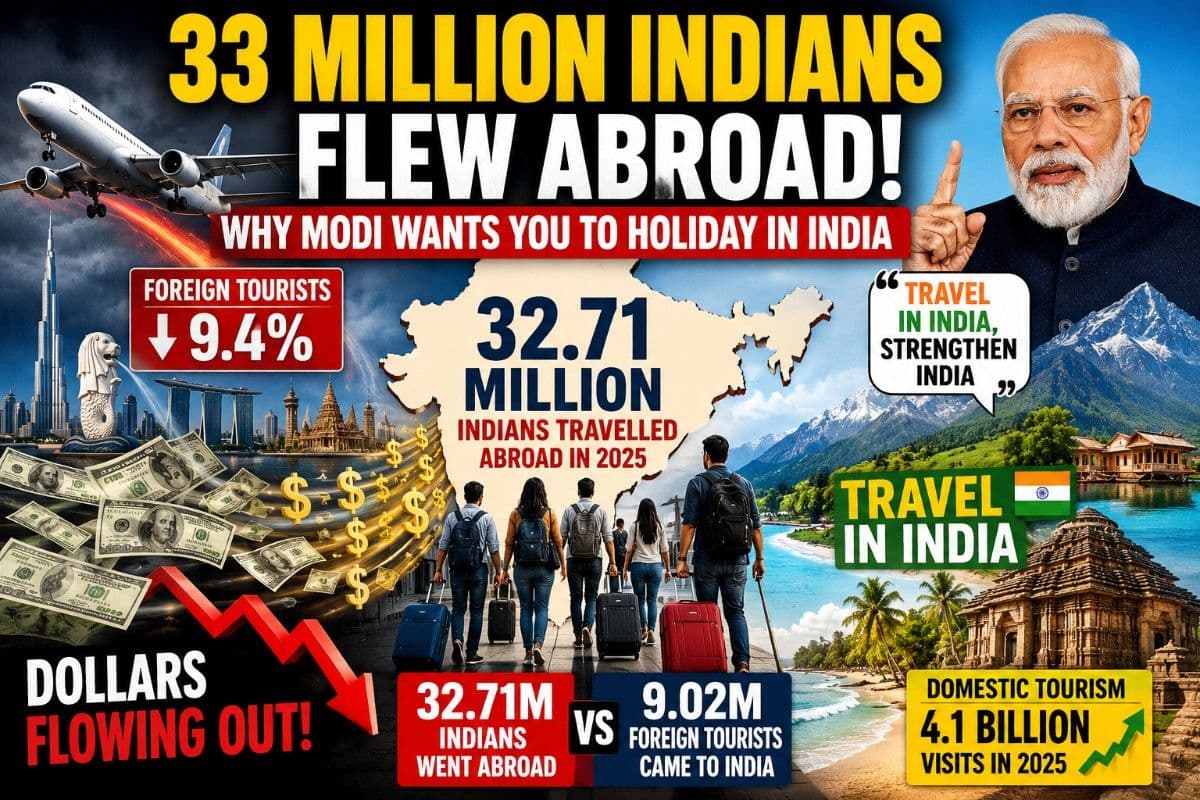
The numbers reveal a widening gap between the number of Indians traveling abroad and foreign tourists visiting India. While outbound travel by Indian nationals surged 5.9 percent to a record 32.71 million departures in 2025, foreign tourist arrivals (FTAs) fell 9.4 percent to 9.02 million.

📱 Get Argus News App
✨The divergence is more than a tourism trend. Economists say it reflects a growing tourism-related foreign exchange imbalance, where billions of dollars are spent by Indians overseas while fewer foreign visitors are bringing foreign currency into India.
The latest figures provide a statistical backdrop to PM Modi's repeated calls for citizens to "travel in India" and support domestic destinations.
The argument is straightforward: every rupee spent on an Indian holiday largely remains within the domestic economy, while money spent abroad contributes to foreign economies and increases demand for foreign currency.
Indians Keep Flying Out
According to the latest tourism statistics, Indian National Departures (INDs) reached 32.71 million in 2025, registering a 5.9 percent increase compared to the previous year.
The figure means that for every foreign tourist arriving in India, more than three Indians traveled abroad.
Popular destinations across Southeast Asia, the Middle East, Europe and emerging visa-friendly markets continued to attract Indian travelers, supported by rising incomes, improved international connectivity and a growing appetite for overseas holidays.
Foreign Tourist Arrivals Fall Sharply
In contrast, Foreign Tourist Arrivals (FTAs) to India dropped to 9.02 million in 2025, representing a 9.4 percent decline from 2024 levels.
The decline comes despite India's expanding aviation network, aggressive tourism promotion campaigns and the country's rich cultural and natural attractions.
The gap between inbound and outbound travel has therefore widened considerably, creating what analysts describe as a growing "tourism deficit."
Domestic Tourism Remains India's Biggest Strength
The picture, however, is markedly different within the country.
India continued to witness robust domestic travel activity, recording an impressive 4,132.8 million domestic tourist visits during the year. In addition, states and Union Territories collectively recorded 24.01 million foreign tourist visits, indicating that domestic tourism remains the backbone of India's travel economy.
Industry experts note that domestic tourism has helped cushion the impact of weaker international arrivals and remains a major contributor to employment and local economic activity.
Growing Tourism Deficit
With nearly 33 million Indians traveling abroad compared to just 9 million foreign tourists arriving in India, the country is witnessing a substantial imbalance in tourism-related foreign exchange flows.
Simply put, more money is leaving India through overseas travel than is being brought in by international visitors.
The Dollar Outflow Equation
The tourism data highlights a simple but significant economic reality.
When a foreign tourist visits India, money flows into the country through spending on hotels, transport, food, shopping and entertainment. These expenditures bring valuable foreign exchange earnings.
The opposite happens when Indians travel abroad. International airfares, hotel bills, shopping expenses and local transportation costs are largely paid in foreign currencies. As outbound travel rises, more Indian money flows overseas.
This gap helps explain why policymakers are increasingly emphasizing domestic tourism. If even a small share of outbound spending can be redirected toward destinations within India, the economic gains would stay with Indian airlines, hotels, restaurants, tour operators and local communities instead of benefiting foreign economies.
The 2025 data therefore offers a tangible economic context to Modi's appeal. Beyond promoting tourism, the message is also about retaining spending power within the country and reducing avoidable foreign exchange leakage at a time when nations are seeking to strengthen domestic growth engines.
The Final
Word: With the
message from the numbers clear that Indians are traveling more than ever before,
choosing to spend those travel dollars outside the country, India's challenge
is no longer merely attracting more foreign visitors. It is also about
convincing a growing class of Indian travelers that the next holiday can be
spent at home.
Also Read: RBI Monetary Policy / India GDP Surges 7.7% in FY 26, RBI Holds Rates: What Does It Mean for Your EMI, FDs, Fuel Bill and Daily Expenses?| EXPLAINER
Related Topics
Explore more stories