



Modi Cabinet's Anti-Leak Bill Takes the Sting Out of Opposition's NEET Bogey: Why Parliament's Political Battle Has Suddenly Changed| Exclusive Analysis
Key Points
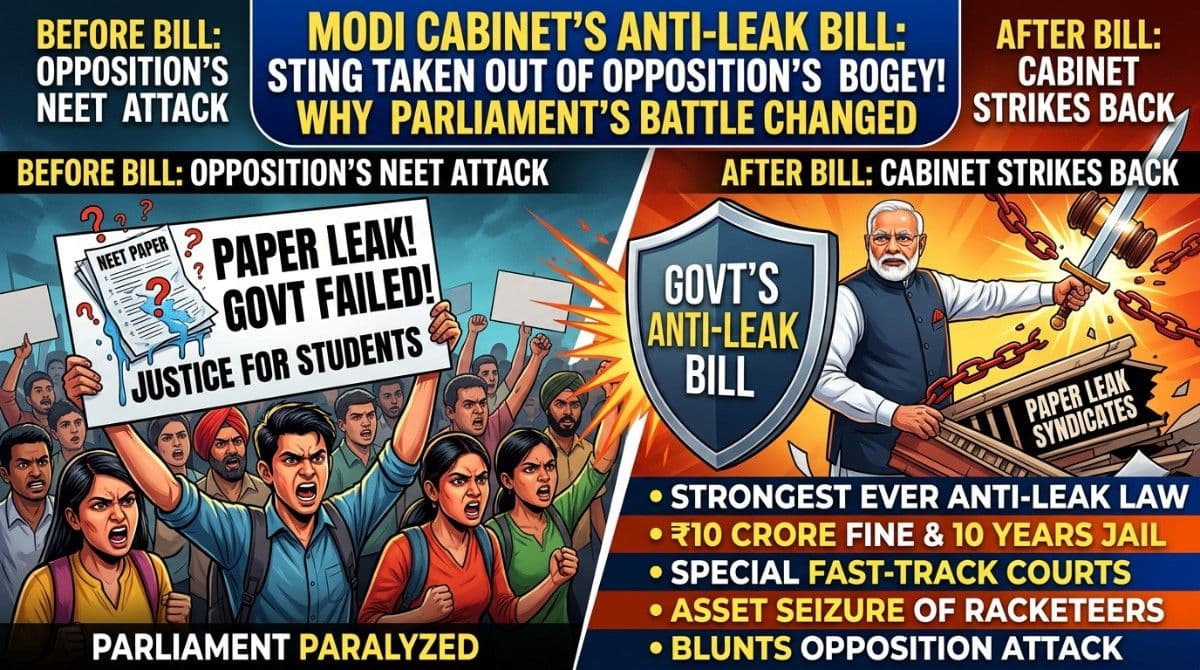
Bhubaneswar: For almost a week, Parliament remained paralysed as the Congress-led Opposition demanded accountability over the NEET paper leak controversy, seeking to corner the Narendra Modi government.
But the Union Cabinet's decision to clear a sweeping amendment to India's anti-paper leak law – scheduled to be introduced in the Lok Sabha on Monday – has dramatically altered the political equations.
For the first time since Independence, India is poised to have perhaps its toughest anti-paper leak regime, combining stringent prison terms, crippling financial penalties running into crores, mandatory fast-track trials and institutional accountability.
The legislation does not merely respond to the NEET controversy. It seeks to fundamentally rewrite India's legal approach towards examination fraud – an issue that has haunted governments of every political colour for decades.

📱 Get Argus News App
✨Historic First: From Lenient Cheating Laws to India's Toughest Anti-Leak Regime
Until 2024, India never had a dedicated central law dealing specifically with question paper leaks. Such offences were prosecuted under general cheating and forgery provisions of the IPC, leaving organised paper leak syndicates to exploit legal loopholes.
The proposed amendment marks the third stage in India's anti-leak legal evolution.
|
Feature |
Before 2024 |
Public Examinations Act, 2024 |
New Cabinet Amendment
Dedicated anti-paper leak law
No
Yes
Strengthened
Jail term
Up to 3-7 years under general laws
3-10 years
Minimum 5 years, up to 10 years
Fine
Judicial discretion
Up to ₹10 lakh (individual); ₹1 crore (institutions)
Up to ₹10 crore
Nature of offence
Often bailable
Cognizable, non-bailable
Continues non-bailable with faster prosecution
Trial
Regular courts
Regular judicial process
Special Fast-Track Courts with 90-day disposal target
Institutional liability
Minimal
Recovery of exam costs; 4-year debarment
Asset seizure and enhanced financial liability
The transition is significant.
For nearly seven decades after Independence, paper leak cases largely remained "cheating cases." The 2024 law made them cognizable and non-bailable. The proposed amendment now adds what many legal experts describe as the missing deterrent – speedy justice backed by crippling economic punishment.
Beyond Delhi: Why States, Including Odisha, Cannot Ignore the New Law
Although the legislation directly governs central public examinations, its impact is expected to extend well beyond Delhi.
Paper leak syndicates rarely operate within one jurisdiction. The same coaching networks, digital intermediaries, printing operators and organised rackets often function across multiple states.
Odisha itself has witnessed repeated controversies involving recruitment examinations, teacher eligibility tests and other competitive recruitment processes over the years.
With organised rackets now facing investigations by senior police officers, asset attachment and penalties running into crores, the economics of the paper leak industry could change dramatically.
The amendment also signals the Centre's intent to push states towards adopting similarly stringent legal frameworks for examinations under their respective jurisdictions.
Zero Mercy: Which Examinations and Offences Come Under the Scanner
The law covers virtually every major central competitive examination conducted for recruitment or admissions, including:
- UPSC Civil Services and other UPSC examinations
- NEET
- JEE
- CUET
- UGC-NET
- SSC examinations
- Railway Recruitment Board examinations
- IBPS banking recruitment
- Recruitment examinations conducted by Central Ministries
The law identifies 15 categories of organised malpractice, including:
- Question paper leaks
- Distribution of answer keys before examinations
- OMR manipulation
- Digital server hacking
- Computer-based examination tampering
- Candidate impersonation
- Fake examination centres
- Forged merit lists
- Biometric manipulation
- Threatening examination staff
- Organised cheating syndicates
- Infrastructure support to leak networks
Importantly, the law continues to distinguish between organised crime and ordinary candidates. Honest students remain outside the criminal framework, while the focus remains squarely on racketeers, insiders, technical service providers and organised criminal networks.
Fast-Track Justice: The Biggest Structural Reform
Perhaps the most consequential feature of the amendment is the creation of Special Fast-Track Courts.
Unlike conventional criminal trials that often stretch for years, these courts are expected to conclude proceedings within approximately 90 days.
The first such specialised court has already been designated at Delhi's Rouse Avenue Court Complex, where Judge Anu Grover Baliga, a senior member of the Delhi Higher Judicial Service, has been appointed to handle such specialised matters.
Only experienced officers of the Higher Judicial Service – typically District Judges or Additional Sessions Judges – will preside over these courts.
The appellate structure is equally streamlined:
Special Fast-Track Court → High Court → Supreme Court
Appeals would move directly to the respective High Courts before reaching the Supreme Court through constitutional remedies, thereby reducing prolonged litigation that has historically benefited organised examination rackets.
Investigations too remain tightly controlled.
Only officers of Deputy Superintendent of Police (DySP) or Assistant Commissioner rank and above can investigate these offences, while major institutional actions require oversight by committees headed by officers of Joint Secretary rank or above.
Politics Changes Overnight
The timing of the Cabinet decision is politically significant.
The development coincides with activist Sonam Wangchuk ending his fast, while the government has simultaneously announced that the Bill will be introduced in Parliament on Monday.
This substantially changes the optics of the Opposition's parliamentary strategy.
For nearly a week, the Congress-led Opposition tried to project the NEET controversy as evidence of governmental inaction.
However, once Parliament begins debating India's toughest-ever anti-paper leak legislation, continued disruption risks creating a different public perception – that Parliament is being stalled not to protect students but to deny legislative action on the very issue around which protests were organised.
That political risk becomes particularly acute because the government can now argue that it is moving beyond rhetoric and introducing structural reforms.
No Education Minister Has Ever Resigned Over Paper Leaks
The Opposition's central demand has been ministerial accountability.
Historically, however, no Union Education Minister has resigned over paper leak controversies despite repeated examination scandals under successive governments since Independence.
National-level examination irregularities are hardly new.
Paper leaks have periodically surfaced for decades under different political dispensations. What remained largely unchanged was the legal framework – general cheating provisions, lengthy trials, relatively modest penalties and easy opportunities for accused persons to secure bail.
The first major shift came in 2024 when organised examination fraud became a cognizable and non-bailable offence.
The proposed amendment now attempts to complete that architecture through:
- mandatory fast-track adjudication,
- higher minimum imprisonment,
- penalties extending up to ₹10 crore,
- asset attachment,
- institutional accountability,
- and quicker convictions.
Collectively, these measures allow the government to argue that it is attacking the structural weaknesses that enabled examination mafias to flourish rather than merely responding to one controversy.
While how far this tougher law will deter the paper leak mafias, only the time will tell. But, politically, however, the Cabinet has already achieved one immediate objective.
By placing before Parliament the strongest anti-paper leak legislation in independent India's history, the government has significantly blunted the Opposition's most potent parliamentary weapon over the NEET controversy.
From
Monday onwards, the debate may no longer be about whether the government is
acting – it may instead shift to whether Parliament will allow that action to
proceed.
Also Read: Look Who's Calling Kettle Black! Why Congress Stalls NEET Debate, Only to Face Mirror of Its Own Sordid Record| Special Report
Related Topics
Explore more stories