



Lakshmi Purana to Every Home: How Odisha BJP's 1-Crore Cultural Outreach Could Become Its Biggest Political Mobilisation Before 2027 Panchayat Polls | Exclusive
Key Points
* The initiative seamlessly merges the economic goodwill of the Subhadra Yojana with deep emotional and domestic ownership through a revered household ritual.
* Utilizing Balaram Das's anti-hierarchical, reformist text allows the party to bypass micro-caste divisions and unify rural women under a singular, pan-Odia identity before the 2027 polls.
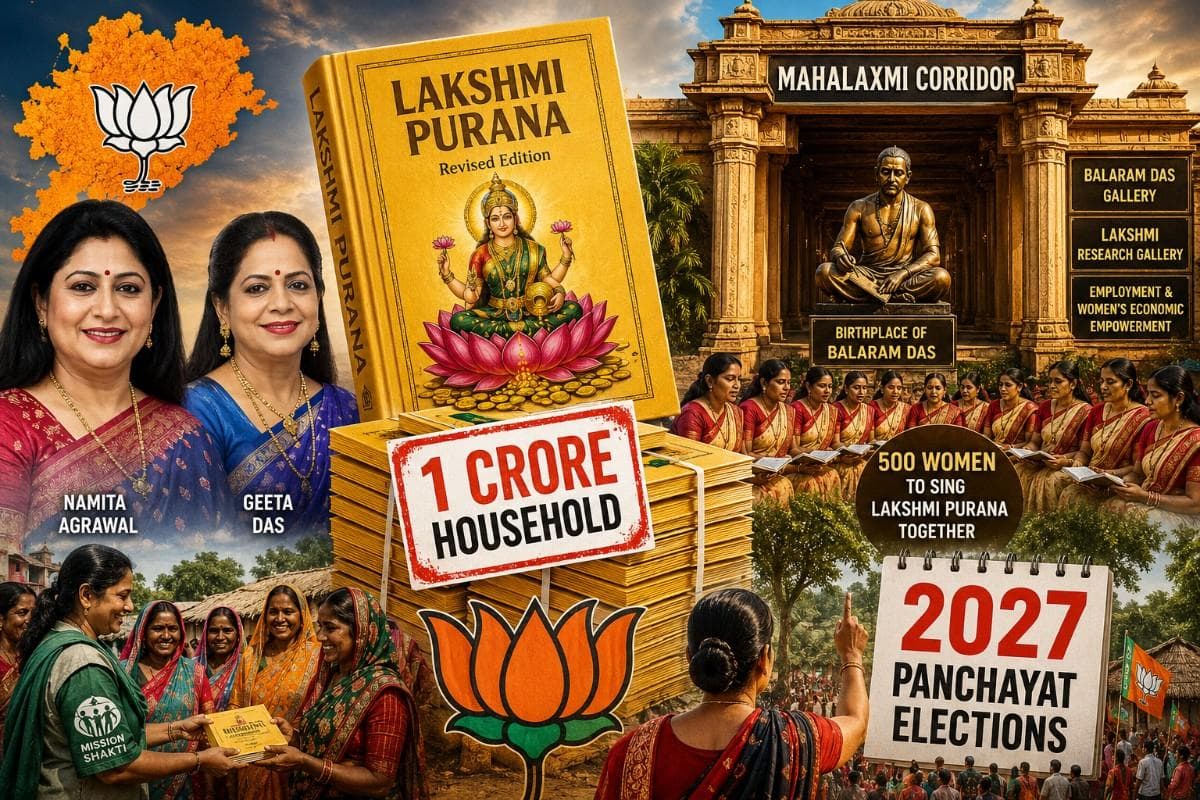
Bhubaneswar: In one of the biggest cultural announcements made by the Odisha government since the BJP assumed office in June 2024, the state has unveiled an ambitious plan to distribute one crore revised copies of the Lakshmi Purana across Odisha, while simultaneously developing a Mahalaxmi Corridor at the birthplace of 15th-century saint-poet Balaram Das, complete with a dedicated Balaram Das Gallery, Lakshmi Research Gallery and a unique space where 500 women can collectively recite the Lakshmi Purana.
Adding emotional resonance to the initiative, Odisha's two most recognisable devotional voices – Namita Agrawal and Geeta Das – will record the revised audio version of the text, which has echoed through Odia households every Manabasa Gurubara for more than three decades.
At one level, the announcement fulfils another key 'Odia Asmita' promise made by the BJP in its 2024 election manifesto – honouring one of Odisha's greatest literary icons while preserving the state's cultural heritage.
But when the announcement is examined beyond its cultural appeal and viewed through the prism of electoral strategy, it reveals something far more significant.

📱 Get Argus News App
✨Politics, as the old maxim goes, is won not merely by occupying the corridors of power but by entering the courtyards of people's homes.
And that is perhaps exactly what the Odisha BJP government has attempted.
A Cultural Announcement with a Political Calendar
The timing of the decision is difficult to ignore.
The BJP government has just completed two years in office.
The next major electoral test will be the Panchayat elections expected in late 2026 or early 2027, where rural women, Self-Help Groups (SHGs) and village-level networks will once again determine political fortunes.
Thursday – the day dedicated to Goddess Lakshmi – was chosen for the announcement.
The rollout itself is expected before Margasira, when Lakshmi Purana becomes an inseparable part of household rituals across Odisha.
In politics, an event is unlikely to have accidental coincidences.
They fit into what appears to be a carefully layered political strategy.
Beyond Odia Asmita
The BJP had repeatedly promised to restore Odisha's cultural icons to the centre of public life.
Whether it was celebrating Odia language, reviving heritage sites, honouring legendary personalities or reclaiming forgotten symbols of state identity, Odia Asmita formed one of the central pillars of the party's 2024 campaign.
The decision to establish a Mahalaxmi Corridor at Balaram Das' birthplace therefore fulfils a clear manifesto commitment.
Balaram Das occupies a unique place in Odisha's cultural consciousness.
His Lakshmi Purana is not merely a devotional text.
Political historians and literary scholars have long described it as one of India's earliest social reform narratives.
Centuries before social equality entered political vocabulary, the text challenged untouchability, questioned caste hierarchy and placed the devotion of Sriya Chandaluni – a woman from a marginalised community – above ritual purity.
That alone makes the choice of Lakshmi Purana politically significant.
But Why One Crore Copies?
This is where the story moves beyond culture.
The government has not announced distribution in lakhs.
It has chosen one crore copies.
The number appears remarkably precise.
According to Census data, Odisha had approximately 96.6 lakh households in 2011.
With population growth over the last decade, the number has comfortably crossed the one-crore mark today.
That means the government's target is effectively one copy for nearly every household.
This changes the nature of the programme entirely.
The objective is no longer cultural dissemination.
It becomes household saturation.
Every home becomes a touchpoint.
Every doorstep becomes an interface.
Every Thursday ritual becomes a recurring reminder of a government-sponsored cultural initiative.
The Chessboard Strategy
Viewed politically, the initiative resembles a carefully planned chessboard rather than a standalone cultural announcement.
Each move appears designed to reinforce another.
Subhadra Yojana had already created financial engagement with women voters through annual direct benefit transfers.
Now comes Lakshmi Purana.
One strengthens economic goodwill.
The other builds emotional and cultural connection.
One reaches women as beneficiaries.
The other reaches them as custodians of family tradition.
Together, they create what political strategists often seek but rarely achieve – a combination of material benefit and emotional ownership.
The Odisha BJP appears to be attempting exactly that.
From the Purse to the Hearth
Political campaigns generally operate through two routes.
The first is economic.
The second is cultural.
Subhadra Yojana represents the economic pillar.
Lakshmi Purana strengthens the cultural pillar.
Women receive financial assistance individually through Subhadra Yojana.
Their households receive a sacred text associated with prosperity, dignity and family well-being.
The symbolism is difficult to miss.
The government is no longer communicating only through schemes.
It is communicating through rituals.
That transforms voter engagement from transactional to emotional.
Why Mission Shakti Could Become the Real Story
Perhaps the most politically significant aspect is not the printing.
It is the distribution.
The revised Lakshmi Purana will reportedly be delivered through Odisha's vast SHG network.
Mission Shakti today remains one of the largest organised grassroots women's networks in the country.
Deploying SHGs for distribution means millions of direct household interactions over several weeks.
Every delivery becomes a face-to-face engagement.
Every village witnesses collective participation.
Every household receives not merely a book but a government initiative carried by local women themselves.
This creates an organisational exercise whose political value extends far beyond cultural preservation.
Large-scale grassroots mobilisation months before rural elections has historically helped parties strengthen booth-level visibility.
Whether intended politically or not, the organisational benefits are undeniable.
Why Lakshmi Purana Instead of Any Other Religious Text?
The choice of Lakshmi Purana, besides Odia Asmita, has another significant layer.
Lakshmi Purana carries a very different social message.
Its central narrative rejects caste discrimination.
The story revolves around Goddess Lakshmi blessing Sriya Chandaluni despite opposition rooted in untouchability.
The divine brothers (Lord Jagannath and Elder Sibling Lord Balabhadra) themselves are punished for practising social exclusion.
That gives the text an unusually inclusive philosophical foundation.
For a party preparing for Panchayat elections – where caste arithmetic may dominate village politics – the symbolism is particularly powerful.
Rather than speaking to one caste group, the text appeals across caste identities through a shared domestic tradition.
It allows the government to project social harmony without abandoning cultural identity.
A Corridor That Extends Beyond Pilgrimage
The proposed Mahalaxmi Corridor is also more than an infrastructure project.
Alongside galleries dedicated to Balaram Das and Lakshmi research, the complex proposes a dedicated space where 500 women can collectively sing Lakshmi Purana.
Such programming transforms the corridor into a living cultural centre rather than a static monument.
The government has also indicated that the project could generate local employment and strengthen women's economic participation through tourism and cultural activities.
In political terms, the corridor links heritage conservation with livelihood generation—another combination that carries electoral value.
The BJP's Rural Equation
The BJP's spectacular breakthrough in Odisha in 2024 rested significantly on women voters.
Subhadra Yojana reinforced that support.
The Lakshmi Purana initiative appears designed to deepen it.
Instead of treating women only as welfare beneficiaries, the government is recognising their central role in preserving household traditions.
That creates a relationship based not merely on assistance but on cultural respect.
Political strategists often describe successful electoral coalitions as those that combine aspiration with identity.
The Odisha BJP now appears to be attempting exactly that.
The Real Political Message
When viewed in isolation, distributing one crore copies of Lakshmi Purana is a major cultural initiative.
When examined alongside Subhadra Yojana, Mission Shakti, Odia Asmita, the Mahalaxmi Corridor and the approaching Panchayat elections, the initiative assumes a much broader political dimension.
It reflects an effort to connect governance with everyday domestic life.
In electoral politics, that is often the most enduring form of communication.
The BJP's strategy appears to be moving simultaneously along two tracks – winning confidence through welfare and reinforcing loyalty through culture.
If Subhadra strengthened the purse, Lakshmi Purana may well be intended to strengthen the hearth.
And in
Odisha's rural politics, where women increasingly shape electoral outcomes,
that combination could become one of the defining political experiments before
the 2027 Panchayat elections.
Also Read: Odisha becomes 1st BJP Govt to join southern states in extending MDM to Class IX & X students; Cabinet clears ₹4,224-crore anti-dropout mission | Special Report
Related Topics
Explore more stories