



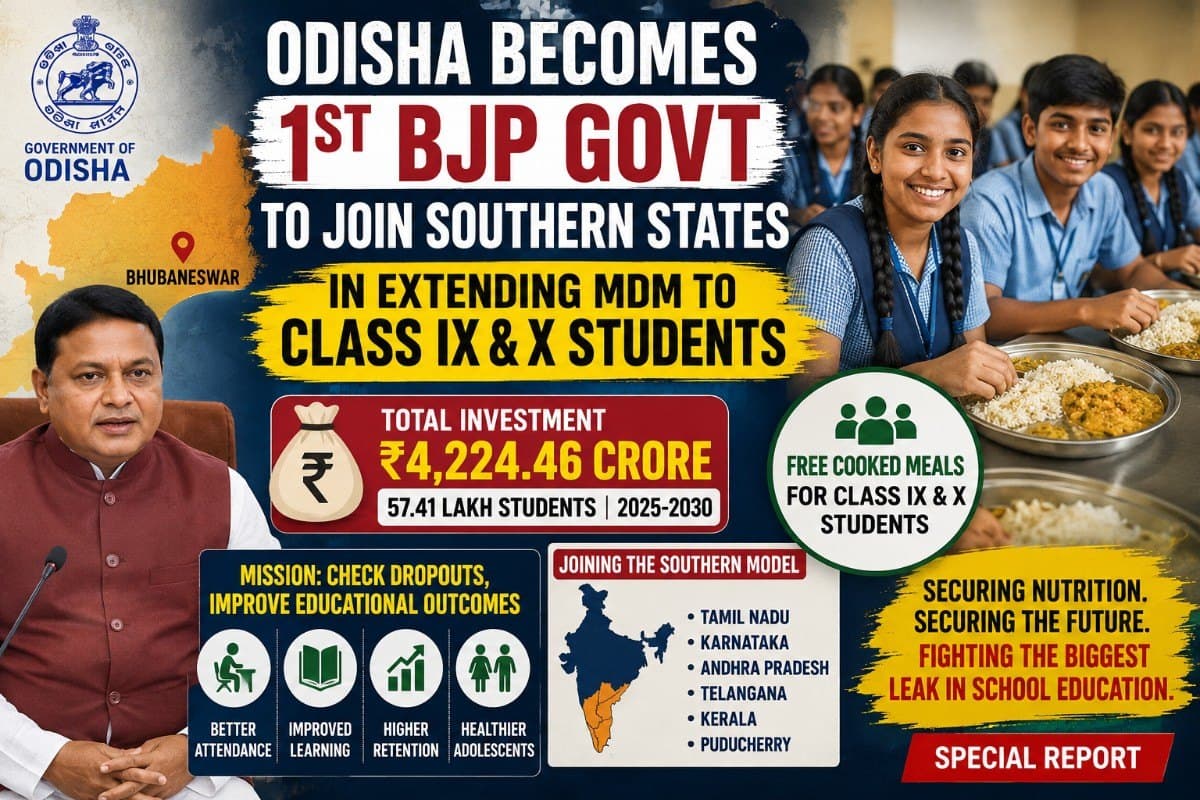
Odisha becomes 1st BJP Govt to join southern states in extending MDM to Class IX & X students; Cabinet clears ₹4,224-crore anti-dropout mission | Special Report
Key Points
* The Cabinet approved a 5-year anti-dropout mission covering nearly 57.41 lakh student-beneficiaries across 8,962 schools.
* The expansion directly addresses high adolescent dropout rates in tribal and southern pockets like Rayagada, Nabarangpur, and Mayurbhanj.
Bhubaneswar: In a landmark policy decision with far-reaching implications for secondary education, the Odisha Cabinet on Wednesday approved the expansion of the state's flagship Mukhyamantri Poshan Yojana (MMPY) to provide free cooked Mid-Day Meals (MDM) to Class IX and X students studying in government and government-aided secondary schools.
The move institutionalises a programme that was launched on April 1, 2025, with the objective of improving adolescent nutrition, attendance, retention and learning outcomes.
The Cabinet granted ex-post-facto approval for the Rs665.36 crore already spent during 2025-26, under which 11,23,536 students across 8,962 schools have been receiving nutritious meals.
It also approved an additional Rs3,506.99 crore for the next four years, taking the total outlay of the five-year programme (2025-2030) to Rs4,224.46 crore.

📱 Get Argus News App
✨Official estimates indicate that nearly 57.41 lakh student-beneficiaries will be covered during the five-year implementation period, making it one of the largest state-funded school nutrition interventions in the country.
Odisha becomes First BJP-ruled State to Join Southern Model
Beyond its financial magnitude, the Cabinet decision marks a significant policy shift in India's school education landscape. Odisha has become the first BJP-ruled state to extend free cooked Mid-Day Meals to students of Classes IX and X, joining a small group of southern states – Tamil Nadu, Puduchery, Karnataka, Kerala, Andhra Pradesh and Telangana – which have long recognised that nutritional support must continue beyond elementary education.
The Centre's PM POSHAN programme (earlier the Mid-Day Meal Scheme) is restricted to Classes I to VIII. Once students complete Class VIII, central support for cooked meals ends.
Recognising that the transition to secondary school is the most vulnerable stage for dropouts, a handful of southern states chose to continue the programme using their own resources.
Tamil Nadu pioneered the concept decades ago and later strengthened it with breakfast and nutrition supplements.
Andhra Pradesh and Telangana expanded cooked meals to Classes IX and X to improve transition rates into higher secondary education, while Karnataka has relied on a combination of state funding and partnerships with organisations such as the Akshaya Patra Foundation to ensure secondary students do not study on an empty stomach.
Odisha's decision therefore represents not merely an expansion of a welfare scheme but a conscious adoption of a proven southern education model, making it the first BJP government to formally bridge the nutritional gap that begins after Class VIII.
Targeting Biggest Leak in School Education: The Class VIII to IX transition
The government's primary objective is straightforward: reduce secondary school dropouts by ensuring that nutrition support does not abruptly end after Class VIII.
Education experts have long identified the transition from Class VIII to Class IX as the weakest link in India's public schooling system. Adolescents between 14 and 16 years, experience rapid physical growth, substantially increasing their nutritional requirements. At the same time, children from economically weaker households become more likely to enter the workforce or shoulder household responsibilities, making continued schooling financially difficult.
The result is what education researchers describe as a "transition crisis" – where the withdrawal of school meals coincides with rising household expenditure and increasing pressure on teenagers to earn or contribute at home.
The ASER Measurements
Odisha's own education indicators underline this challenge. Recent state education assessments and ASER 2024 estimate that around 15% of students drop out during secondary schooling, while among rural children aged 15-16 years, nearly 6.5% are completely out of school. Boys record a marginally higher dropout rate (7.2%) than girls (5.9%), reflecting the growing economic pressure on adolescent boys to enter the labour market.
The above data shows a whopping around 21% school going children in Odisha failed to make it into schools on the indices of affordability.
The problem is particularly acute in Odisha's tribal and southern districts. Rayagada records the highest proportion of out-of-school adolescents at 7.5%, followed by Nabarangpur (4.1%), Mayurbhanj (2.9%), and Malkangiri and Sundargarh (2.6% each). These districts also have historically high levels of poverty, food insecurity and educational disadvantage.
More than a meal: An investment in learning outcomes
The expansion is expected to produce benefits extending far beyond nutrition.
Evidence from India's three-decade-old school feeding programme consistently shows that regular cooked meals improve attendance, classroom concentration, memory retention and cognitive performance. By eliminating classroom hunger, students are better able to participate in afternoon lessons, leading to improved academic achievement and higher pass percentages in the crucial Class X Board examinations.
Studies across states have also demonstrated that school meal programmes substantially improve attendance rates, with many schools witnessing attendance rising from nearly 65-70% to close to 90% after the introduction of regular meals.
For girls, the intervention could prove even more transformative. Adolescence coincides with menstruation and a high prevalence of iron-deficiency anaemia. A nutritious daily meal not only improves health but also acts as an economic incentive for families to continue educating daughters, delaying early marriages and reducing school discontinuation.
The programme also carries wider social dividends. Better nutrition during adolescence contributes to healthier adulthood, improved workforce productivity and stronger human capital formation. Girls who remain in school longer tend to marry later, experience better maternal health and contribute to breaking the intergenerational cycle of poverty and malnutrition.
Protecting Odisha's investment in education
For years, Odisha has invested heavily in achieving near-universal enrolment in primary education through Mid-Day Meals up to Class VIII. However, once students entered secondary school, that nutritional support disappeared precisely when educational costs and nutritional requirements increased.
The new Cabinet decision plugs that policy gap.
Viewed through this lens, the Rs4,224.46-crore investment is not merely a welfare expenditure but a strategic investment in retaining teenagers within the education system until they complete secondary schooling.
By ensuring that the nutritional safety net extends into Classes IX and X, the Mohan Charan Majhi government hopes to protect its earlier investments in elementary education while building a healthier, better educated and more employable future workforce.
If
effectively implemented across Odisha's nearly 9,000 government and
government-aided secondary schools, the programme could emerge as one of the
state's most consequential education reforms – one that treats nutrition not as
a welfare entitlement, but as a foundational pillar of educational success and
long-term economic development.
Also Read: Odisha Leads India in Health Spending at Nearly 2% of GSDP: SBI Study Suggests Health Investment Paying Off for Children| Special Story
Related Topics
Explore more stories