



Jual Oram’s Open War: Who Is the BJP Veteran’s Political Arrow Aimed At?| Political Analysis
Key Points
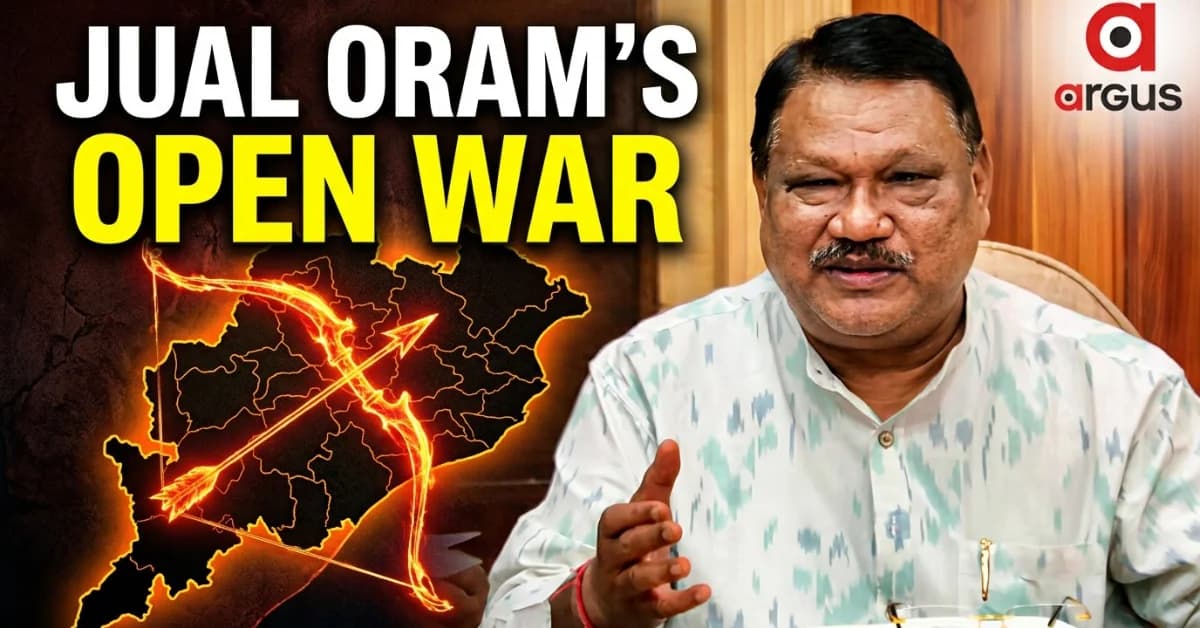
Bhubaneswar: Union Tribal Affairs Minister and BJP veteran Jual Oram’s recent political outburst was not merely an expression of anger; it was an unusually open declaration of war.
Oram publicly warned that he would not spare those trying to defame him. He boldly asserted that he had built the BJP through years of toil and sacrifice, alleging that certain leaders who entered the party recently were spending money to tarnish his image and create space for themselves in the Union Cabinet.
The statement was striking for another distinct reason: Oram named no one.
That silence has now opened a critical political question within the Odisha BJP: Who exactly is the veteran aiming his political arrow at?

📱 Get Argus News App
✨Since Oram himself has not publicly named any leader, it would be premature to attach his allegations to any specific individual. However, the clues embedded in his statement allow for a fascinating political scanning of the changing power equations around him.
Why Did Jual Oram Choose an Open War?
The open warfare was triggered by a recent controversial incident in Rourkela. The Steel City police recently arrested Prakash (Rakesh) Paswan – a close aide and the Rourkela representative of Jual Oram – for allegedly sheltering a criminal gang inside the government Circuit House. Following the major criminal controversy, the Odisha BJP swiftly suspended Paswan from the primary membership of the party.
Believing that internal party rivals actively funded a targeted media campaign around this arrest to destroy his reputation, a cornered Oram launched his aggressive, scorched-earth "chop off hands" counter-offensive.
What Oram's Body Language Signals
In fact, the conventional political response to a controversy involving a close associate would have been entirely different.
A senior leader typically would have distanced himself from the episode, allowed the legal process to take its course, and quietly waited for the political dust to settle.
But Oram did not choose that safe route.
His response follows a classic pattern of old-school political counter-attacks: when a veteran leader believes silence will be interpreted as weakness, the best defence becomes a loud public offensive.
The BJP veteran appears to have calculated that this was no longer merely a localized controversy around his political ecosystem.
His sharp reaction suggested that he saw a larger, orchestrated attempt to damage his political standing, weaken his control over his traditional turf, and create a narrative that could eventually reduce his relevance in the party’s primary power structure.
In such a volatile situation, silence would have allowed his rivals to completely dominate the media narrative.
Therefore, Oram chose to strike before the political narrative could settle around him.
His message was unmistakable: he is not ready to quietly watch the political ground he helped build slip away to newer power centres. The outburst reflected his firm view that the episode was part of a wider political trap rather than an isolated legal controversy.
Oram’s Three Political Hints
The most intriguing part of Oram’s statement lies in the clues he himself provided.
If the veteran BJP leader is indeed alluding to a specific challenger without naming them, his statement leaves behind three unmistakable political markers.
Hint 1: A Leader Who Joined BJP Relatively Recently
Oram drew a sharp distinction between those who had built the party through decades of struggle and those who had entered later from other political backgrounds.This distinction is highly significant.
It narrows the field away from the old BJP organizational guard and firmly toward leaders whose political relevance inside the party has risen rapidly after joining or rejoining the saffron fold. The emphasis was not merely on an opponent, but on a newer entrant into the BJP ecosystem.
Hint 2: A Resourceful Political Heavyweight
Oram also alleged that immense money was being spent to discredit his image.This again serves as a major political clue.
If taken literally in the context of his statement, the arrow is not aimed at an ordinary organizational rival. It points toward someone with considerable resources and the unique ability to build corporate and political influence well beyond traditional grassroots politics.
While that does not establish a legal allegation against any individual, it raises the distinct possibility that Oram sees his challenger as a highly resourceful political heavyweight capable of creating a parallel power structure.
Hint 3: The Union Cabinet Factor
The third clue is perhaps the most politically telling.Oram spoke of deliberate efforts by these elements to create an opportunity for themselves in the Union Cabinet. That naturally brings the political search much closer to a leader with access to the parliamentary arena – or one whose sudden political rise could potentially place them in direct competition for influence in New Delhi.
Taken together, the three clues create a very specific political profile: a relatively recent entrant or returnee to the BJP, a highly resourceful heavyweight, and a parliamentarian positioned for greater influence in the Union power structure.
Scanning Oram’s Arrow: Why Western Odisha Comes Into Focus
There is an equally vital geographical clue to consider. Oram is not just any senior BJP leader; he is one of the party’s most recognizable tribal faces and has spent decades building his political identity around the Sundargarh-Western Odisha region.
Therefore, when he speaks of having built the party with his own toil, blood, and sacrifice, the political context naturally draws attention toward the exact turf where his local influence has historically been absolute. That makes the Sundargarh-Rourkela-Western Odisha political axis particularly relevant to any attempt to decode his remarks.
The question, therefore, is not necessarily who is powerful in the BJP across the length of Odisha. The more relevant question is: Who has emerged as a new or revived power centre directly inside Oram’s traditional political territory?
The 2024-2026 Political Turn
Against the backdrop of these dropped hints, a glance at the recent timeline offers an interesting political context.
In 2024, Odisha witnessed a major political churn ahead of the simultaneous Assembly and Lok Sabha elections. Leaders and workers from rival political formations entered or returned to the BJP, bringing with them their own heavy political networks and local support bases.
In the Rourkela-Sundargarh belt, such shifts were particularly critical because the BJP was no longer dealing only with its traditional organizational structure. It was increasingly accommodating leaders with independent political bases and their own loyalists.
Then came 2026.
The emergence of fresh parliamentary representation and the elevation of new power centres altered the equation further.
In March 2026, a political development occurred that created a brand new parliamentary power equation, substantially increasing the competition for influence from Western Odisha in New Delhi.
For a veteran like Oram, who has long represented a particular style of grassroots, tribal, and organizational politics, the arrival of newer, powerful players could inevitably change the internal balance of power. This is where his outburst acquires its true political meaning.
Exploring Oram's Aim
As Jual Oram has not publicly named any leader, it is improper to engage in outright speculation. However, Oram’s own words provide more than enough material for a broader exploration.
He spoke explicitly of leaders who joined the BJP later; leaders allegedly using vast money and resources to damage his image; intense efforts to create an opportunity in the Union Cabinet; and his own decades-long role in building the BJP through struggle and sacrifice.
Put those clues together with the specific geography of his political base and the power shifts between 2024 and 2026, and the search naturally narrows toward the rapidly changing political ecosystem of Western Odisha.
Who exactly fits every single clue? Oram has deliberately not said.
And
perhaps that is the true political power of his statement. The
BJP veteran has fired an arrow, but has intentionally left the target
unnamed – leaving it entirely to the readers to draw their own
logical conclusions from the timelines and geography
outlined above.
Also Read: Subhadra Show, Mission Nayagarh: CM Majhi Sugar Mill Revival Plan to Sweeten BJP's 2027, 2029 Clean Sweep| Political Analysis
Related Topics
Explore more stories