



Har Ghar Tiranga 2026: Odisha BJP’s Mega Statewide Outreach, From Gen Z To Poll-Bound Panchayats| Special Report
Key Points
Bhubaneswar: The Tricolour is back on the streets of Odisha, but this year’s Har Ghar Tiranga campaign carries a distinctly larger political and organisational footprint.
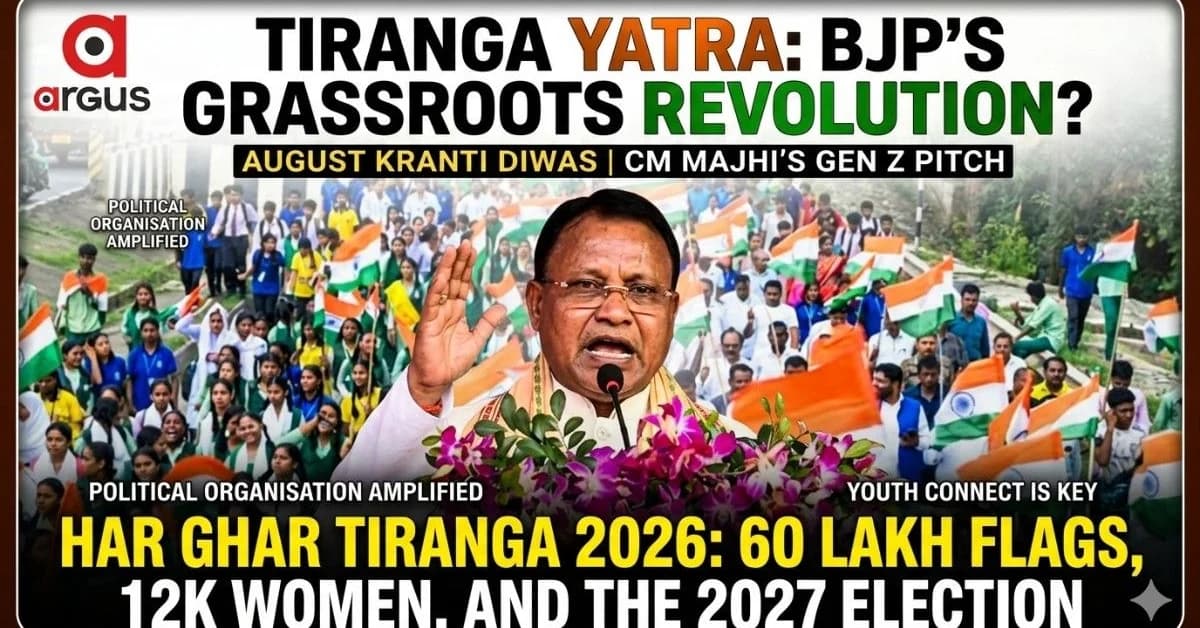
Chief Minister Mohan Charan Majhi on Sunday launched the statewide campaign from Bhubaneswar on August Kranti Diwas, making a pointed appeal to the youth to connect patriotism with their everyday responsibilities.
His message to Gen Z – that the “voice of youth power” would determine the country’s future and that young people must remain alert to digital threats and drugs – gave the 2026 campaign an unmistakable youth-facing dimension.
While student participation, Tiranga rallies, flag selfies and public flag-hoisting are not new to Har Ghar Tiranga, the Odisha edition of 2026 stands out in its scale, institutional mobilisation and timing.

📱 Get Argus News App
✨The campaign comes less than a year before Odisha enters the next cycle of panchayat and urban local body elections. The State Election Commission has already begun preparations for the 2027 polls, including booth-wise electoral-roll work, with elections expected around April-June 2027.
The result is a campaign that can simultaneously be viewed through two lenses: a national patriotic programme and a massive grassroots outreach exercise for the ruling BJP government.
60 lakh flags, 12,000 women: The 2026 scale
The most visible indicator of the expansion is the flag supply chain.
The 2026 campaign targets 60 lakh national flags, with the Odisha government's Mission Shakti network playing a major role in manufacturing them. According to the campaign inputs, the Odia Language, Literature and Culture Department has transferred Rs15 crore to Mission Shakti for the exercise.
By noon on August 8, around 45.40 lakh flags had reportedly been stitched and quality-checked.
The production has involved more than 12,000 rural women belonging to 1,053 SHGs, turning what is essentially a patriotic campaign into a livelihood-linked exercise as well.
This is not the first time Mission Shakti has been used for flag production. The state's own Mission Shakti records show that SHGs and producer groups were entrusted with manufacturing 30 lakh national flags in 2025 edition of Har Ghar Tiranga.
The difference in 2026 is therefore not the involvement of women SHGs itself, but the doubling of the stated flag target to 60 lakh and the scale of the financial and logistical mobilisation.
District-wise architecture: From high-density belts to remote tribal pockets
The campaign's distribution strategy has been structured around population density, local-body spread and logistical requirements.
The available district-wise deployment plan broadly puts districts into three categories:
|
Category |
Districts |
Indicative flag deployment |
|
High-density |
Ganjam, Cuttack, Mayurbhanj, Balasore, Khordha |
~2.5–3.5 lakh each |
|
Mid-density |
Puri, Sambalpur, Bhadrak, Jajpur, Balangir, Sundargarh |
~1.5–2.2 lakh each |
|
Tribal/low-density |
Malkangiri, Deogarh, Boudh, Gajapati, Jharsuguda |
~80,000–1.2 lakh each |
The significance of the distribution model is that the campaign is not confined to major towns.
In high-density districts such as Ganjam, Cuttack, Mayurbhanj, Balasore and Khordha, the larger allocation is intended to cater to both dense urban settlements and extensive rural networks.
The second group – Puri, Sambalpur, Bhadrak, Jajpur, Balangir and Sundargarh – combines sizeable urban centres with large rural blocks, making block-level distribution important.
The third group – Malkangiri, Deogarh, Boudh, Gajapati and Jharsuguda – puts the emphasis on reaching remote and interior locations.
Additionally, Rs10 lakh has been allocated to each district administration for IEC and transportation-related logistics, according to the official information available.
Why the Gen Z pitch matters
Perhaps the biggest change in the 2026 political messaging is the deliberate attempt to take the Tiranga campaign into the youth and student space.
CM Majhi's launch-day message was not restricted to asking people to hoist the national flag. He specifically spoke to young people about their role in protecting the nation's future, including the dangers posed by digital threats and drugs.
That dovetails with another major theme of 2026 –the 150th anniversary of Vande Mataram.
Odisha has already used educational institutions for the commemoration. Schools, colleges and universities were directed to participate in collective renditions of Vande Mataram and related programmes in January 2026, with student competitions and other activities also planned.
Consequently, this year's Har Ghar Tiranga is reaching young citizens through a combination of:
- campus-based patriotic programmes;
- Vande Mataram-linked activities;
- Tiranga rallies;
- student participation;
- digital flag/selfie campaigns;
- youth-centric messaging from the Chief Minister; and
- direct interaction with local BJP organisational structures.
That makes Gen Z one of the most important new constituencies of the 2026 campaign, even though the underlying Har Ghar Tiranga format itself remains a national initiative.
2025 versus 2026: What really changed?
The contrast is more meaningful if 2024 is kept aside. The BJP had only recently formed the government in June 2024, making that year's campaign more of a transition-period exercise.
By 2025, the government had settled into the administrative system. The national campaign also expanded into the “Har Ghar Tiranga, Har Ghar Swachhata” framework, linking patriotism with cleanliness and civic responsibility. Nationally, the 2025 edition recorded 7.5 crore flag selfies and more than 9 lakh Tiranga volunteers, underlining how the campaign had already evolved into a large participatory movement
But 2026 adds another layer.
|
Dimension |
2025 |
2026 |
|
Core theme |
Tiranga + Swachhata |
Tiranga + Vande Mataram + youth |
|
Flag production |
Large-scale SHG participation |
60 lakh target |
|
Women SHGs |
Livelihood-linked production |
1,053 SHGs / 12,000+ women |
|
Government funding |
Administrative campaign support |
₹15 crore cited for flag production |
|
Youth strategy |
Broad participation |
Explicit Gen Z/student outreach |
|
Political timing |
Mid-term governance |
Ahead of 2027 local-body polls |
|
Organisational value |
Public participation |
Wider grassroots mobilisation and outreach |
The distinction is important: the activities themselves are not new; their political and organisational utility in Odisha is becoming broader.
From Tiranga rally to grassroots contact programme
For the Odisha BJP, this is where the 2026 campaign becomes particularly significant.
MLAs and MPs leading local rallies is not a new feature of Har Ghar Tiranga. But when every elected representative is simultaneously taking the Tricolour into blocks, panchayats, towns, educational institutions and neighbourhoods, the campaign creates something that ordinary political meetings often cannot – a state-wide contact opportunity without the formal appearance of an election campaign.
It allows the BJP organisation to reach:
Students → first-time voters → women SHGs → rural households → urban residents → tribal communities → local influencers → party workers → booth-level networks.
And the timing is critical.
The State Election Commission has already commenced preparations for the 2027 Panchayati Raj Institution and ULB elections, including electoral-roll work and consultations with district administrations. The current three-tier rural local bodies, elected in 2022, are due to complete their tenure in March 2027.
That gives the 2026 Har Ghar Tiranga campaign a much wider political context.
The 365-day BJP organisation
The BJP's larger organisational challenge in Odisha after the 2024 Assembly victory has been to convert an election-winning machinery into a permanent grassroots organisation.
The 2026 Tiranga exercise fits into that objective.
A rally is temporary. A flag-distribution network is temporary. But if the exercise simultaneously activates MLAs, MPs, district units, mandal/block workers, SHGs, students, local bodies and digital volunteers, it creates multiple points of contact with voters.
That is particularly relevant for a party that is now preparing for its first major statewide local-body electoral test in government.
The 2024 Assembly election established the BJP as the ruling party. The 2027 panchayat and ULB elections will test whether that electoral breakthrough has translated into a durable organisation at the grassroots.
Not just rural Odisha: The urban voter is also in the frame
The campaign's significance also lies in its ability to cut across Odisha's sharply differentiated voter geography.
In villages, the Tiranga reaches households through local networks and Mission Shakti groups.
In tribal and remote districts, the emphasis is on physical distribution and mobilisation.
In towns, it comes through rallies, public events and local representatives.
And among students and younger urban voters, the campaign moves into campuses and social media.
That makes the 2026 exercise unusually broad in demographic terms.
The BJP's big outreach window before 2027
There is, therefore, a larger political reading to this year's grand Har Ghar Tiranga campaign.
The BJP is not merely trying to increase the number of houses displaying the national flag. It is attempting to occupy multiple social spaces simultaneously – the household, the SHG, the campus, the village, the town, the digital space and the political constituency.
The patriotism component is unquestionably the formal objective of Har Ghar Tiranga, a campaign launched nationally under Azadi Ka Amrit Mahotsav.
But in Odisha in 2026, its organisational implications are difficult to miss.
With 60 lakh flags, more than 12,000 women involved in production, a statewide distribution network, youth-focused messaging, MLA/MP-led mobilisation and the 2027 local polls approaching, the campaign has become much more than an Independence Day event.
For the
Odisha BJP, the 2026 Tiranga Yatra is emerging as its biggest non-electoral
public-contact exercise before the panchayat and urban civic elections – a campaign designed to touch virtually every
section of Odisha's electorate while keeping patriotism, youth engagement and
grassroots organisation at its core.
Also Read: Lakshmi Purana to Every Home: How Odisha BJP's 1-Crore Cultural Outreach Could Become Its Biggest Political Mobilisation Before 2027 Panchayat Polls | Exclusive
Related Topics
Explore more stories