



From Street Fighter to Strategic Survivor! Why Buzz Around Mamata Banerjee Joining Congress Reflects a Deeper Political Shift| Analysis
Key Points
* Critics see the move as strategic survival amid electoral setbacks, internal dissent, and questions over TMC's future direction.
* A SWOT analysis suggests Congress may gain a high-profile leader, but could also inherit TMC's political baggage and factional tensions.
Bhubaneswar: For the woman who once rewrote the political history of West Bengal, 2026 may be shaping up as the most defining year of her career.
For decades, Mamata Banerjee was the ultimate disruptor of Indian politics – a street fighter who challenged entrenched power, dismantled a 34-year-old Left regime, and built an entire political movement around her own personality. But politics is often unforgiving to leaders who stop reinventing themselves.
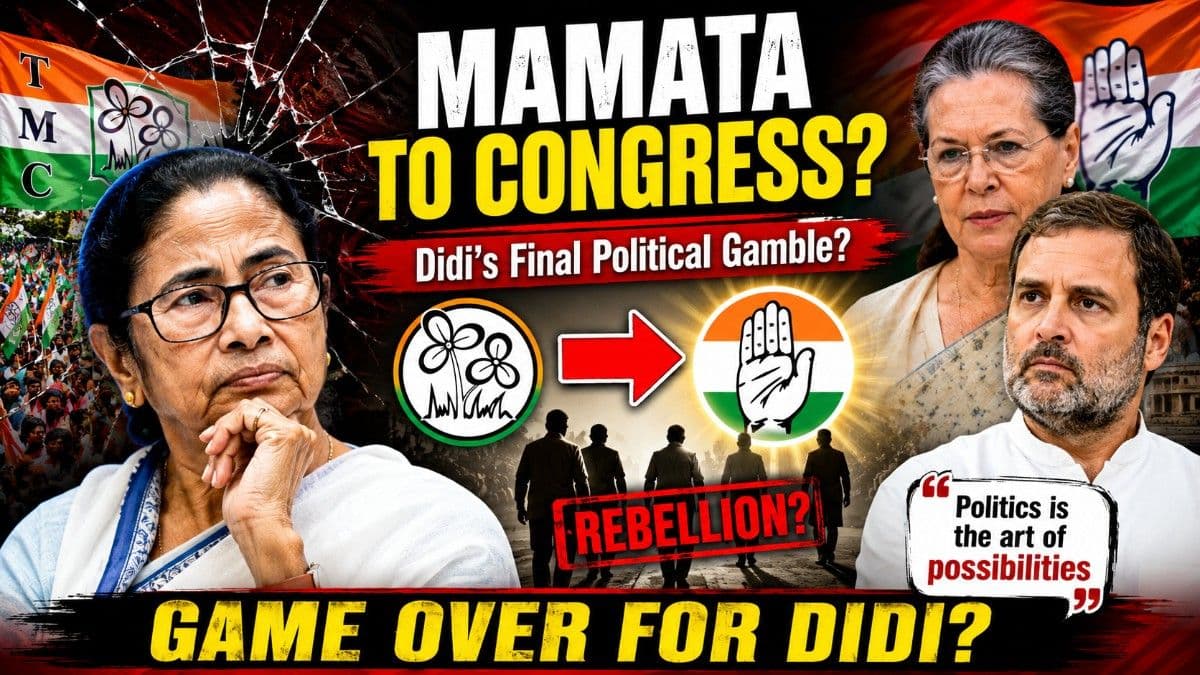
If the growing buzz in political circles about Mamata Banerjee moving closer to Congress – and potentially even joining the party – contains a grain of truth, it would represent one of the most remarkable political reversals in contemporary India.
The irony would be difficult to miss.

📱 Get Argus News App
✨The same leader who walked out of Congress to create the Trinamool Congress, who repeatedly questioned Congress leadership, and who projected herself as the natural nucleus of a non-Congress opposition front, may now be contemplating shelter under the very political umbrella she once abandoned.
The Personality Behind the Politics
To understand why such speculation has gained traction, one must first understand Mamata Banerjee herself.
Few politicians embody contradictions as vividly as she does.
Her rise was powered by an almost unmatched fighter instinct. She challenged political giants long before she possessed institutional power. From defeating CPI(M) stalwart Somnath Chatterjee in 1984 to leading the Singur and Nandigram agitations that ultimately toppled the Left Front government, Mamata built her reputation on relentless confrontation.
She was never a consensus builder.
She was a combatant.
Her politics relied less on organization and more on personal energy, emotional connection, and direct confrontation with opponents.
Yet the very traits that fueled her rise have increasingly become liabilities.
Her mercurial temperament, intolerance toward criticism, tendency to personalize governance, and concentration of authority within a narrow inner circle have alienated many within her own party. Critics argue that over time, Trinamool Congress evolved from a mass movement into a highly centralized political structure revolving around Mamata and her nephew Abhishek Banerjee.
As electoral setbacks mounted and public controversies accumulated, many party workers reportedly began questioning whether the leadership was willing to undertake a genuine SWOT analysis of its failures.
Instead of introspection, they saw denial.
Instead of course correction, they saw blame shifting.
The Opportunist Argument
Supporters describe Mamata Banerjee as politically pragmatic.
Her critics call her opportunistic.
The evidence cited by both sides is often the same.
She has aligned with Congress, broken away from Congress, partnered with the BJP-led NDA, returned to anti-BJP politics, advocated a federal front, and later sought opposition unity under broader coalitions.
Her political career has demonstrated remarkable flexibility but limited ideological rigidity.
Perhaps no issue illustrates this better than her evolving relationship with Congress leadership.
Then
As a UPA ally, Mamata frequently praised Sonia Gandhi and treated her as a central pillar of national politics.
Later
After withdrawing support from the UPA, she became sharply critical of Congress policies and leadership.
In subsequent years, she dismissed Rahul Gandhi's political effectiveness, famously calling him a "seasonal bird" in Bengal politics and later describing him as the opposition's biggest liability.
At various points, she sought to position herself as the face of a non-Congress opposition alternative.
Now
Following the political turbulence of 2026, the tone appears to have softened dramatically.
Recent interactions with Sonia Gandhi and Rahul Gandhi, coupled with renewed coordination inside the opposition camp, have fuelled speculation that political necessity is replacing old rivalries.
For critics, this is classic Mamata Banerjee – politics guided less by ideology and more by circumstance.
Why Congress Might Welcome Her
From Congress's perspective, the attraction is obvious.
West Bengal was once among the party's strongest bastions.
Much of that traditional Congress support eventually migrated to Mamata Banerjee after her departure from the party.
Bringing a leader of her stature back into the fold would allow Congress to reclaim political relevance in a state where it has struggled for decades.
Congress would also gain a nationally recognized mass leader capable of energizing opposition politics.
With the Left reduced to a shadow of its former self in Bengal, Congress strategists may view Mamata as the quickest route back into a bipolar contest against the BJP.
The symbolism alone would be powerful.
The leader who once broke away from Congress returning home would allow the party to project itself as the natural anchor of anti-BJP politics.
Why the Equation May Not Be So Simple
Yet a SWOT analysis suggests the move may not deliver the benefits either side expects.
Weaknesses
Age is no longer on Mamata Banerjee's side.
More importantly, critics argue that the fighter instinct that once defined her politics appears diminished.
For a leader whose identity was built around political combat, seeking organizational shelter rather than leading a fresh political battle may be interpreted as an admission of declining political momentum.
Threats
Abhishek Banerjee remains a polarizing figure.
While supporters view him as Mamata's political heir, critics increasingly see him as a liability.
If Congress absorbs Mamata politically, it may also inherit the factional tensions surrounding her succession plans.
Additionally, many traditional Congress workers spent years opposing Trinamool Congress on the ground.
Their resistance could produce internal friction rather than organizational revival.
Opportunities
A Congress-Mamata alignment could consolidate anti-BJP votes in certain regions and temporarily stabilize opposition politics in Bengal.
It may also provide Mamata a national platform at a time when her state-level dominance appears under pressure.
Strengths
Mamata remains one of India's most recognizable regional leaders.
Even her fiercest opponents acknowledge her political resilience, communication skills, and ability to connect with ordinary voters.
Those assets do not disappear overnight.
The Final Question
Politics often rewards reinvention.
But it can also punish leaders who abandon the very instincts that made them successful.
Mamata Banerjee's story has always been one of defiance – against political establishments, against conventional wisdom, and against seemingly impossible odds.
If she ultimately chooses a path closer to Congress, supporters may describe it as strategic realism.
Critics will call it political surrender.
Either way, the speculation itself reveals something important.
For the first time in decades, the conversation around Mamata Banerjee is no longer about how she will reshape Bengal politics.
It is increasingly about how Bengal politics is reshaping her.
And for a
leader who built her legacy as the state's ultimate political fighter, that may
be the most significant shift of all.
Also Read: TMC on the Brink: Why Mamata's Trusted Lieutenant Kakoli Ghosh Dastidar Has Turned Rebel| Analysis
Related Topics
Explore more stories