



From Firebrand BJP Critic to Suvendu Nostalgia: Is Mahua Moitra Reading Bengal's New Political Reality? | Political Analysis
Key Points
* The remarks come at a critical juncture as the TMC grapples with mass defections, internal rebellion, and the upending of Mamata Banerjee’s absolute dominance.
* Political analysts view Moitra’s beautifully timed trip down memory lane as a subtle gesture to keep future political options open without explicitly crossing party lines.
Bhubaneswar: Politics has a peculiar way of humbling even its most uncompromising warriors.
For nearly a decade, Mahua Moitra built her national political identity on fierce attacks against Prime Minister Narendra Modi, Home Minister Amit Shah and the Bharatiya Janata Party. In Parliament, television studios and public rallies, she emerged as one of the most aggressive faces of the opposition ecosystem, earning admiration among anti-BJP supporters and becoming one of the most recognisable parliamentary voices of the Trinamool Congress (TMC).
Her political persona was crafted around confrontation.
Whether it was the Modi government, BJP leadership or what she frequently described as threats to democratic institutions, Moitra rarely missed an opportunity to launch sharp, often personal, political attacks. Within opposition ranks, she came to be viewed as one of Mamata Banerjee's most dependable political combatants in New Delhi.

📱 Get Argus News App
✨That is precisely why her recent public recollection of her warm personal relationship with West Bengal Chief Minister Suvendu Adhikari has generated political curiosity far beyond the immediate remarks themselves.
A Nostalgic Turn
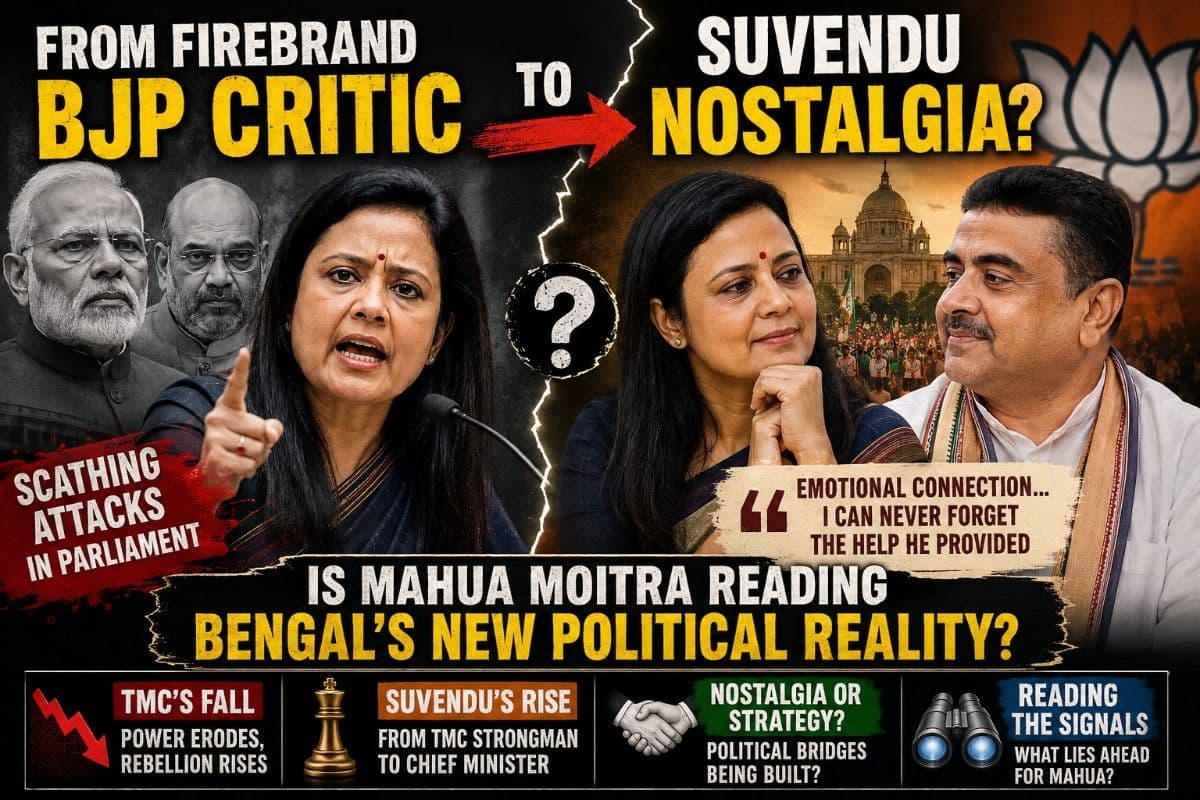
In a recent interview, Moitra spoke emotionally about Adhikari, recalling how he stood beside her during some of the most difficult moments of her early political career.
She recounted being devastated after being denied a Lok Sabha ticket in 2014 and said Adhikari was among the few leaders who comforted her. She also remembered her maiden Assembly election campaign in Karimpur in 2016, saying that while many senior leaders stayed away, Adhikari personally campaigned for her and organised her first major political rally.
Most strikingly, she described sharing an "emotional connection" with him and publicly acknowledged that she could never forget the support he had extended to her.
Under normal circumstances, such remarks may have been dismissed as a politician reminiscing about old friendships.
But these are not normal political circumstances in West Bengal.
Bengal Political Order Has Been Upended
The comments come at a time when the political landscape that once appeared firmly under Mamata Banerjee's control has undergone a dramatic transformation.
For years, Mamata was regarded as perhaps the most formidable regional leader in India. She challenged the BJP's national leadership directly and repeatedly. Her electoral victories reinforced an image of invincibility, while nephew Abhishek Banerjee emerged as the undisputed second power centre within the party.
Today, that aura has been significantly weakened.
The TMC's electoral setback and the subsequent rise of Suvendu Adhikari to the Chief Minister's office have altered Bengal's political power equations. Simultaneously, reports of rebellion, defections and growing dissatisfaction within TMC ranks have fuelled perceptions that the party is undergoing its most serious internal crisis since inception.
The very leaders who once projected absolute confidence are now confronting questions about succession, authority and political survival.
It is against this backdrop that Moitra's remarks are being examined.
More Than Personal Memories?
Political observers argue that the significance of the interview lies not in what Moitra said about the past, but when she chose to say it.
According to several analysts, her comments may represent an attempt to publicly acknowledge a channel of goodwill with the state's new power centre without explicitly crossing political lines.
The challenge before Moitra is unique.
Unlike many second-rung leaders who can quietly shift political loyalties, she has spent years constructing a national image around uncompromising opposition to the BJP. Any abrupt political realignment would immediately invite accusations of hypocrisy and opportunism from both supporters and critics.
Consequently, analysts believe that if future political equations are to evolve, they are more likely to begin with softer gestures rather than dramatic declarations.
Publicly invoking personal bonds, recalling old loyalties and emphasising respect despite political differences could be one such method of keeping future options open.
Suvendu Factor
The irony is impossible to miss.
The same Suvendu Adhikari who was once a trusted lieutenant of Mamata Banerjee became one of her fiercest political adversaries after joining the BJP. His rise from TMC strongman to BJP strategist and ultimately Chief Minister represents one of the most remarkable political journeys in contemporary Indian politics.
For many former TMC leaders now navigating a transformed political environment, Adhikari is no longer merely an opponent. He is the principal centre of political power in Bengal.
That reality inevitably influences political calculations across party lines.
Observers note that politicians are often among the first to recognise changing power structures. Expressions of personal warmth towards a political rival may therefore carry meanings beyond friendship, particularly when made during periods of political transition.
Reading the Signals
None of this proves that Moitra is contemplating a political shift. Nor does her interview contain any indication of ideological reconsideration or dissatisfaction with her party.
However, politics is rarely judged solely by words. Timing often matters as much as content.
Had these comments been made when Mamata Banerjee was at the peak of her political dominance, they might have attracted little attention.
Made today, amid the TMC's struggles and Suvendu Adhikari's ascendancy, they inevitably invite deeper scrutiny.
For now, Moitra's remarks remain a personal tribute to a former colleague who helped her during crucial moments of her political journey.
Yet in a state where political loyalties are being tested and new equations are emerging almost daily, many observers believe the interview may also offer a glimpse into how some leaders are quietly adjusting to Bengal's changing political realities.
Whether it
was simply nostalgia – or the first subtle acknowledgement of a new political
order – is a question that only time can answer.
Also Read: From Street Fighter to Strategic Survivor! Why Buzz Around Mamata Banerjee Joining Congress Reflects a Deeper Political Shift| Analysis
Related Topics
Explore more stories