



EXCLUSIVE | Odisha College Elections 2026: BJD MLAs Punch Below Their Weight, BJP Machine Scores, Congress Disastrous
Key Points
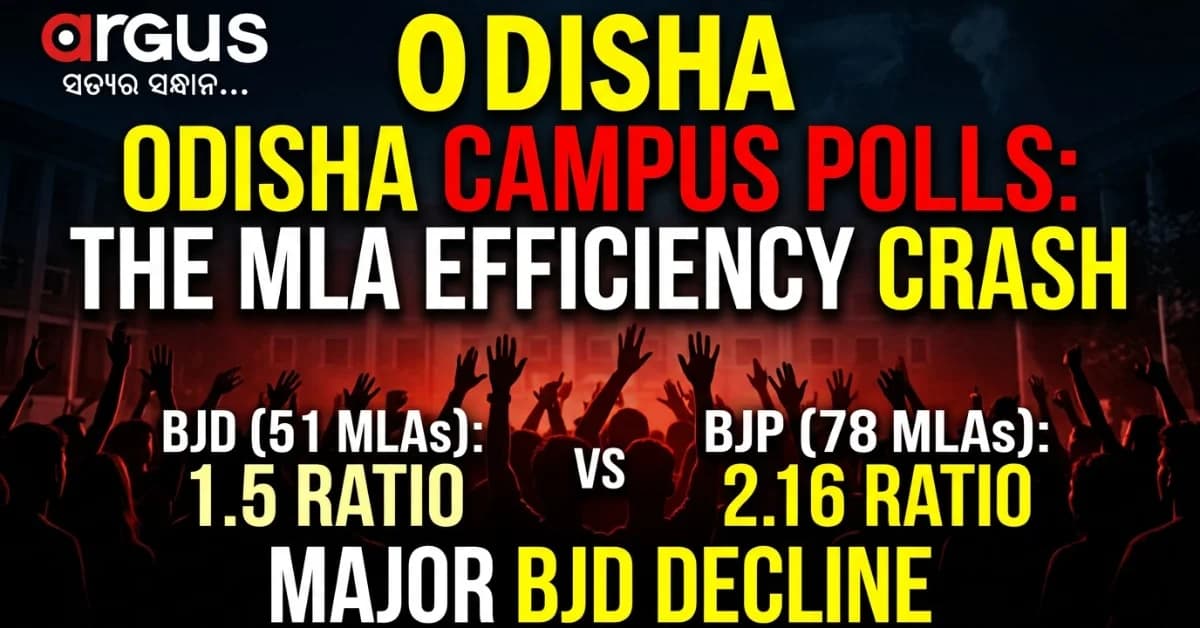
Efficiency Deficit: ABVP scored a 2.16 success ratio per BJP MLA, while BJD stalled at 1.5 despite holding 51 Assembly seats.
Unopposed Landslide: BJP’s youth wing captured 60 colleges completely unopposed due to BJD’s ground-level nomination failures.
Coastal & Southern Shifts: Traditional BJD strongholds like Kendrapara and Ganjam flipped to ABVP in major regional realignments.
Bhubaneswar: Student union elections across higher education campuses in Odisha have historically served as a direct indicator of ground-level legislative dominance.
When the final, hard data from the 15 October 2026 college elections trickled out of the counting centers after an intense eight-year hiatus, it did not merely declare winners for campus unions –it delivered a striking statement on the efficiency of institutional power in the state.
For the regional opposition, the Biju Janata Dal (BJD), the metrics uncover a significant structural failure.
Operating as a robust legislative block with 51 sitting MLAs in the Odisha Legislative Assembly, the party's student wing, the Biju Chhatra Janata Dal (BCJD), managed only 61 live contested victories.

📱 Get Argus News App
✨When placed directly against the 2017 baseline election cycle, where a supreme BJD machinery converted 117 MLAs into a near-95% absolute campus sweep, the 2026 data reveals a key trend: BJD MLAs punched heavily below their expected weight, failing to translate their numerical assembly power into campus control.
Conversely, the ruling Bharatiya Janata Party (BJP), riding on the momentum of its 2024 state government victory, demonstrated remarkable structural conversion.
Leveraging 78 sitting MLAs, the BJP's student wing, the Akhil Bharatiya Vidyarthi Parishad (ABVP), captured 109 live contested colleges and executed a highly effective ground strategy to clear out opposition nominations entirely, winning 60 entire institutions completely unopposed before a single ballot was cast.
This is a comprehensive, data-backed election analysis of how the historic link between legislative power and campus dominance fractured, identifying the key swing districts where the institutional map was redrawn.
The Conversion Matrix: The MLA Efficiency Deficit
To evaluate the structural underperformance of the BJD, the live 2026 results must be broken down through a strict mathematical lens: The MLA-to-Campus Success Ratio.
When measuring total institutional footprint—combining live contested victories with completely uncontested campus-wide sweeps—the mathematical gap between the ruling party and the opposition becomes clear.
The 2026 Legislative-to-Campus Scoreboard (so far)
|
Student Wing (Political Affiliation) |
Contested College Wins (Live Score) |
Colleges Swept Unopposed |
Total Institutional Footprint |
State Assembly Seats (MLAs) |
True MLA Success Ratio (Total Colleges / MLAs) |
|
ABVP (BJP) |
109 |
60 |
152 |
78 MLAs |
2.16 |
|
BCJD (BJD) |
61 |
15 |
85 |
51 MLAs |
1.5 |
|
NSUI (Congress) |
02 |
0 |
02 |
14 MLAs |
0.14 |
2026 vs 2017: The Core Statistical Anomaly
In 2017, the BJP possessed a small legislative footprint of just 10 MLAs in the state assembly. Yet, operating from a position of minimal resources, the ABVP maintained an 8% statewide campus footprint – representing a nearly clean 0.80 conversion efficiency per MLA against a dominant ruling regime.
Fast forward to 2026. The BJD stands as a massive opposition force with 51 MLAs – more than five times the legislative strength the BJP held in 2017.
Backed by veteran regional lawmakers with deeply entrenched local funding and patronage networks, the BJD possessed the structural weight to comfortably claim at least 35% to 40% of the state's 359 higher educational institutions.
Instead, their true success ratio stalled at 1.5 institutions per MLA, with the party suffering total organizational failures across hundreds of regional panels.
The fact that the BJD allowed the ABVP to claim 60 entire colleges completely uncontested proves that having a sitting MLA on paper did not guarantee the presence of a functional youth mobilization network on the ground.
The Swing Districts: Redefining the Geography of Power
The defining story of the 2026 cycle lies in the macro-geographical shifts. By analyzing districts based on majority institutional sweeps—looking past isolated single-college results to observe where the weight of a district's campuses shifted—we locate the key battlegrounds where BJD fortresses folded.
Odisha Campus Power Shifts (2026 Institutional Control)
Coastal Belt (Traditional BJD Bastion)
| Kendrapara District: 🔴 SHIFT TO BJP (ABVP majorities in Marshaghai/Antei)
│ *Khordha/Cuttack (Bhubaneswar): SPLIT (ABVP takes BJB/Utkal; BCJD retains Sailabala)
| Western Belt (BJP Stronghold)
│ *Sambalpur & Jharsuguda: 🔴 BJP DOMINANCE (ABVP sweeps GMU/Industrial hubs)
| Southern Belt (Transition Zone)
| Ganjam District: 🔴 SHIFT TO BJP (ABVP captures Berhampur University)
1. The Kendrapara Collapse (The Ultimate Coastal Swing)
· Legislative Context: BJD Majority. Kendrapara is a historic coastal stronghold for the BJD. The regional party controls the local legislative seats, backed by senior party heavyweights.
· The Campus Reality: Majority ABVP Control. In a significant blow to the local opposition, the ABVP successfully bypassed the BJD's local MLA machinery. The student wing of BJP cleanly swept Marshaghai Degree College and Antei Biju Patnaik College.
· While the BJD managed defensive saves at Pattamundai College and Sri Sri Jagannath Mahavidyalaya, the district's primary higher education hubs shifted out of their control.
· The Turf Verdict: BJD MLAs in this coastal belt punched significantly below their weight, failing to protect their home turf despite having the local administrative networks to do so.
2. The Ganjam Retreat (The Southern Shift)
· Legislative Context: Strong BJP Presence. Ganjam district, historically the ultimate BJD fortress, saw deep structural changes during the recent general elections.
· The Campus Reality: ABVP Landslide. The premier regional center, Berhampur University, saw a decisive ABVP victory for the executive panel. The BJD’s local leaders failed to stage an opposition comeback here, allowing the ABVP to leverage the state government's momentum and lock down the southern hub.
· The Turf Verdict: BJD’s local ground networks in the south completely folded under pressure from the ruling party's apparatus.
3. The Khordha/Bhubaneswar/Cuttack Split (The Battle for the Capital)
· Legislative Context: BJP MLA Dominance. The capital city constituencies are strongly represented by the ruling BJP.
· The Campus Reality: Highly Fractured Split. The capital city saw an intense turf war. The BJP's MLAs successfully delivered prestigious standalone institutions, with the ABVP sweeping BJB Autonomous College and Rajdhani College.
· However, the BJD's legislative machinery concentrated its remaining strength on a high-profile defense of Ravenshaw University, successfully steering the BCJD to victory on that flagship campus.
· The Turf Verdict: This district represents a true swing zone. While the BJP won the overall institutional volume, the BJD proved that a highly focused legislative defense could still halt a total ruling-party sweep.
4. The Industrial Lockdown (Angul and Sambalpur Belts)
· Legislative Context: BJP Absolute Dominance. Strongly represented by senior BJP lawmakers and state ministers.
· The Campus Reality: Total ABVP Sweep. Across Talcher Autonomous College and Gangadhar Meher University (GMU), the ruling party's MLAs ran a highly synchronized campaign. They smoothly converted their legislative dominance into clean sweeps, capturing dozens of panel seats entirely unopposed.
· The Turf Verdict: BJD lawmakers in the western and industrial belts completely retreated, failing to mount any meaningful resistance against the ruling party’s student wing.
The 2017 vs. 2026 Realignment: How the Rules of Turf Dominance Were Rewritten
To understand why the BJD's 51 MLAs produced a sub-par success ratio, one must contrast the operational mechanics of 2017 against the modern reality of 2026.
|
Era |
Power Base |
Results |
|
2017 REGIME
(BJD Hegemony) |
117 BJD MLAs
10 BJP MLAs |
• ~95% BJD Campus Sweep
• High BJD efficiency via state power |
|
2026 REGIME
(BJP Momentum) |
78 BJP MLAs
51 BJD MLAs |
• 152 Total BJP Campuses (109 Live + 60 Unopposed)
• 85 Total BJD Campuses (61 Live + 15 Unopposed) |
1. The Nomination Phase as a Weapon
In 2017, the BJD used its massive weight of 117 MLAs to clear out opposition candidate files long before election day.
In 2026, the BJP effectively flipped this strategy. By leveraging the state government's decision to bring back campus polls after an eight-year ban, BJP MLAs built immediate structural goodwill.
They used this momentum to outmaneuver opposition offices, leaving BJD lawmakers so disorganized that they failed to field candidates across 60 entire regional institutions.
2. The Loss of Patronage Cushions
During the 2017 cycle, a BJD MLA could easily protect a local college using the top-down patronage networks of the ruling state government.
In 2026, operating as an opposition force, these 51 MLAs had to rely purely on their independent, local ground networks. The data proves that without the cushion of state power, many of these local MLA operations collapsed, leaving their student cadres exposed to the ruling party's push.
3. The Security Sanitization Factor
Historically, campus turf wars relied heavily on external political handlers who deployed non-student muscle power to control campus gates. In 2026, the Higher Education Department imposed strict security controls – deploying dozens of police platoons, enforcing mandatory ID checks, and placing absolute bans on outsiders. This sanitization successfully neutralized the old-school muscle tactics that veteran opposition MLAs traditionally relied on, forcing a clean, localized vote that caught the BJD's old guard off guard.
The Final Scorecard: The Institutional Takeaway
The 2026 Odisha college elections leave behind a clear, numbers-driven lesson for the state’s political establishment: Legislative numbers on paper mean nothing if the ground-level youth infrastructure is allowed to decay.
The BJD’s 51 MLAs possessed the numerical strength to mount a powerful statewide counter-offensive. Instead, their inability to scale past 70 contested wins and their total absence from sixty unopposed campuses highlights a major organizational deficit. The ruling BJP, with 78 MLAs, successfully executed a high-efficiency strategy, using its state momentum to redraw the campus map.
As the dust settles across
Odisha's universities, the scoreboard stands as a stark warning to the
opposition's leadership: when the link between legislative power and local
youth mobilization breaks, even a powerful block of 51 MLAs can be
outmaneuvered on its own turf.
Also Read:EXCLUSIVE| Odisha College Elections 2026: Rama Devi to Berhampur, the Turnout Lesson for Rahul Gandhi to Naveen Patnaik as GenZ Chooses Aspiration Over Politics
Related Topics
Explore more stories