



EXCLUSIVE| Odisha College Elections 2026: Rama Devi to Berhampur, the Turnout Lesson for Rahul Gandhi to Naveen Patnaik as GenZ Chooses Aspiration Over Politics
Key Points
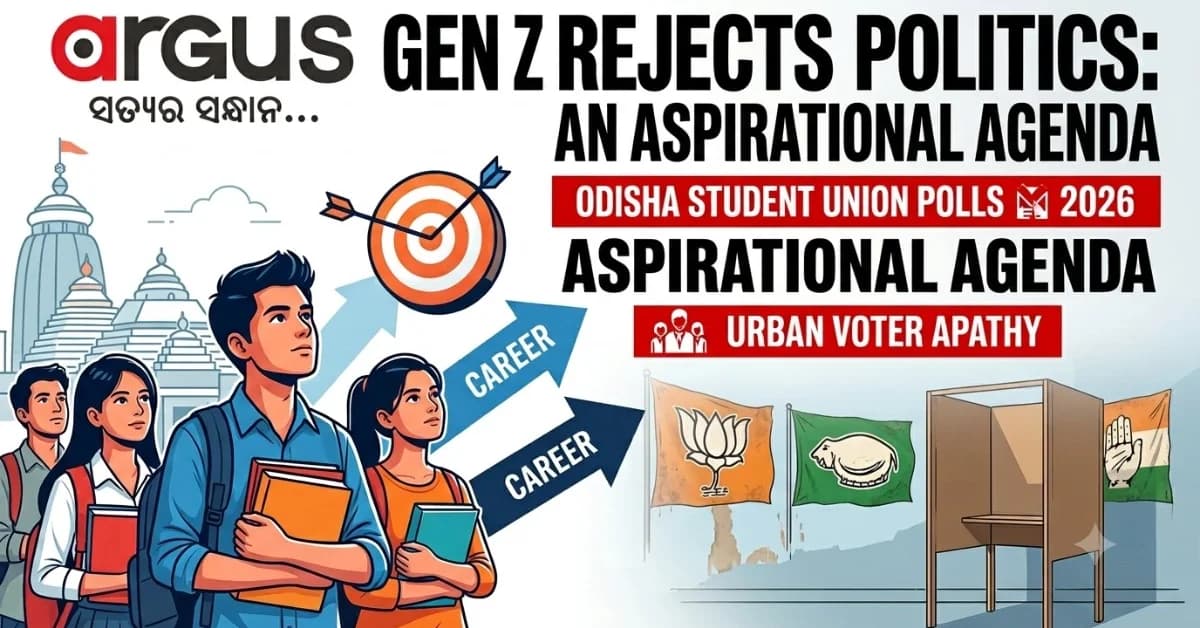
Urban Voter Apathy: Premier metro universities saw historic low turnouts—such as Berhampur University at 19.5% and Rama Devi Women's University at 30.27%—as students chose academics and career prep over campus campaigns.
Regional Demand for Infrastructure: Tier-2 and semi-urban campuses like Maa Manikeshwari University recorded surges up to 77.14%, using union elections pragmatically to demand better resources and campus placements.
National Trend Realignment: From Bhubaneswar to Delhi University, modern Gen Z across India is uncoupling higher education from partisan political warfare, favoring individual meritocracy and institutional accountability.
Bhubaneswar “The Gen Z believes that social change will come less through movements than through dispersed career choices. These careers are imagined not merely as vehicles for private advancement but as bridges between private success and public obligation.”
This definitive observation by renowned political scientist Dr. Pratap Bhanu Mehta perfectly contextualises the structural generational shift that just redefined higher education campuses across Odisha.
The Odisha Student Union Polls 2026 have delivered an unmistakable lesson to politicians who remain hell-bent on politicking over Gen Z.

📱 Get Argus News App
✨
Ironically, mainstream political leaders – from the BJP to Rahul Gandhi and INDI alliance leadership nationally, to Naveen Patnaik in Odisha – are locked in an intense, high-stakes battle to decode the minds of Generation Z.
From algorithmic social media micro-targeting to tech-savvy youth outreach campaigns, political parties treat India’s youngest voters as an ideological canvas waiting to be painted.
However, the long-awaited return of the Odisha Student Elections 2026, held on 15 October 2026 after an eight-year hiatus, has instead delivered a monumental reality check to the political establishment.
The overarching takeaway is unequivocal: Gen Z votes for aspiration, not politics.
When given the ballot, the state’s student population did not behave like the traditional, highly polarized foot soldiers of the past. Instead, a dramatic geographical divide in voter turnout metrics has revealed a generation that is transactional, career-focused, and deeply clear about its priorities.
Gen Z has effectively uncoupled campus life from partisan state politics, opting to treat higher education as a launchpad for economic mobility and self-advancement rather than an arena for ideological warfare.
The Silent Message from Big Cities: Career over Campaigns
The most telling sign of this generational shift came from Odisha’s premier metropolitan higher education hubs.
In major urban centers like Bhubaneswar, Cuttack, and Bramhapur (Berhampur) – where state political wings like the Akhil Bharatiya Vidyarthi Parishad (ABVP), Biju Chhatra Janata Dal (BCJD), and National Students' Union of India (NSUI) poured significant financial and structural resources into mobilizing voters – voter participation collapsed to historic lows.
In these large cities, elite campuses bore witness to vast swathes of empty polling booths.
Berhampur University registered the absolute lowest voter engagement in the entire state, closing its boxes with an astonishingly weak 19.5% turnout.
The story was similarly subdued in the capital city at Rama Devi Women’s University, which recorded just 30.27% turnout.
Meanwhile, Utkal University, the state’s historically volatile political bellwether, struggled to mobilize its students, recording a total of only 1,109 voters translating into a modest 38.29% turnout.
This urban "opt-out" sends a clear, powerful message to political party strategists.
In tier-1 cities, Gen Z students have widespread access to corporate internship networks, independent digital social spheres, technical boot camps, and competitive examination coaching centers.
To these students, a high-octane campus political campaign is not a vital exercise in democratic participation; it is an unwanted disruption to an academic calendar already compressed by global economic pressures.
By choosing libraries, computer labs, and off-campus internships over polling booths, big-city students delivered a quiet, collective veto against the traditional theater of student politics.
2017 vs. 2026: De-escalating the Campus Cauldron
To fully comprehend the depth of this transition, the 2026 metrics must be evaluated directly against the last baseline election cycle in 2017.
Prior to the government-imposed suspension of campus polls due to chronic student unrest, violence, and natural disasters, student elections were defined by a festive, chaotic, and often high-voltage atmosphere.
The table below illustrates the institutional realignment between the pre-hiatus era and the modern Gen Z reality:
|
University / Institution |
2017 Turnout & Political Landscape |
2026 Voter Turnout (%) |
The Shift in Gen Z Student Behavior |
|
Maa Manikeshwari University (Kalahandi) |
High Turnout / Localized: Driven by community identity and fierce regional representation. |
67.24% (with peak pockets touching 77.14%) |
Aspiration for Resources: High voter mobilization represents a pragmatic demand for placement infrastructure and institutional visibility. |
|
Madhusudan Law University (Cuttack) |
High Engagement: Elite, localized student base tightly focused on professional networking. |
78.87% |
Transactional Unionism: The highest turnout statewide reflects a niche, low-volume cohort securing immediate institutional resources. |
|
Maharaja Sriram Chandra Bhanja Deo (MSCB) University (Baripada) |
Strong Mobilization: Tribal and regional community-centric focus. |
64.03% |
Grassroots Empowerment: Strong retention of youth turnout to leverage local development from administrative authorities. |
|
Fakir Mohan University (Balasore) |
Moderate Participation: Standard partisan campaigns with street-level mobilization. |
53.30% |
Regional Baseline: Stable civic interest tied closely to immediate college welfare rather than state political mandates. |
|
Vikram Dev University (Jeypore) |
High Engagement: Deep-rooted institutional identity in South Odisha. |
50.86% |
Community Cohersion: Steady regional alignment showing that mid-tier cities prioritize regional student representation. |
|
Ravenshaw University (Cuttack) |
0% (Apex Election Cancelled): Core union dissolved; shifted to localized "School Councils" due to violence. |
47.73% |
Preference for Sanitized Order: Students returned to the booths in moderate numbers because the university environment was clean and secure. |
|
Utkal University (Bhubaneswar) |
0% (Cancelled Sine Die): Polls shut down indefinitely following pre-election cracker bombings. |
38.29% |
Apathy Toward Regulated Spaces: The heavy police presence required to maintain order drained the organic excitement out of voting. |
|
Rama Devi Women’s University (Bhubaneswar) |
High Turnout: Aggressive, multi-wing campaigns swept comprehensively by the BCJD. |
30.27% |
Depolarization: Urban female students demonstrated a distinct aversion to partisan alignment, ignoring the booths entirely. |
|
Berhampur University (Bramhapur) |
Moderate/High Turnout: Characterized by traditional, high-decibel youth rallies. |
19.50% |
Rejection of Political Intrusion: The ultimate expression of voter apathy; urban Gen Z completely decoupled education from the state's political apparatus. |
In 2017, the primary catalyst for turnout was political tribalism, often fueled by external political handlers who provided funds for campus rallies, banners, and student muscle power. This frequently backfired, causing premier universities like Utkal and BJB Autonomous College to cancel elections sine die before a single vote could be cast.
In 2026, the Higher Education Department changed the rules of engagement. Security was tightly controlled, with 20 police platoons deployed in Bhubaneswar and 18 in Cuttack. Security teams enforced mandatory identity card sweeps at the gates and placed complete bans on unauthorized outsiders or non-student political aggregators.
The resulting shift was profound.
Instead of rebelling against an intensely regulated, sanitized campus, Gen Z quietly embraced it. They prioritized academic continuity, predictable exam timetables, and on-time graduation over political theater. Where political leaders expected the long absence of polls to create an explosion of pent-up political energy, Gen Z responded by opting for peace, safety, and individual meritocracy.
Detailed District Analysis: The Regional Demand for Infrastructure
A granular look at the district-wise data reveals that while urban students expressed their aspirations through apathy, regional and smaller-town student communities did the exact opposite – they expressed their aspirations through extraordinarily high turnout.
The Kalahandi and Mayurbhanj Surges
In areas traditionally classified as economically developing or semi-urban, the election data presented a striking contrast to the coastal twin cities. Maa Manikeshwari University in Bhawanipatna (Kalahandi District) logged a robust 67.24% voter turnout, with localized campus segments recording peak voter participation where 1,811 students cast their ballots to reach a 77.14% high. Deep in the northern tribal belt, MSCB University in Baripada (Mayurbhanj District) similarly soared to a 64.03% turnout.
The South and North Coastal Belts
In the southern district of Koraput, Vikram Dev University in Jeypore comfortably crossed the median mark with a 50.86% turnout. Meanwhile, Fakir Mohan University in Balasore secured a healthy 53.30% polling sheet.
Decoding the Geographic Paradox
This regional variation is not a sign of deep ideological commitment to political parties; it is a display of transactional unionism. For a student enrolled in a regional tier-2 university or a small-town district, a well-funded, active student union is the single most effective leverage tool available.
Unlike their peers in Bhubaneswar who can bypass campus infrastructure to access external resources, small-town students rely directly on the university for basic upward mobility.
In these districts, voting in a student union election is a pragmatic attempt to secure better laboratory equipment, fully stocked libraries, stable campus Wi-Fi, functioning ladies' hostels, and corporate placement drives.
It is an act of local survival and regional pride. The high turnout in smaller towns is driven by an intense desire for development, while the low turnout in big cities reflects a generation that has already moved past campus politics to find it.
From Odisha to Delhi: A Defining National Trend
This behavioral pattern is not exclusive to the borders of Odisha. When the 2026 Odisha campus data is viewed alongside other major student union elections across the country, it reveals a structural national trend. The "metro apathy identity" has become a defining trait of urban Gen Z nationwide.
Consider the Delhi University Students’ Union (DUSU) elections.
As the crowning jewel of Indian student politics, DUSU elections receive millions of rupees in funding from national political bodies, capture prime-time television space, and feature high-decibel campaigns complete with luxury car convoys and nationalized political slogans. Yet, despite this massive expenditure and national focus, DUSU consistently struggles to cross a modest baseline, hovering around a 39.5% to 40.46% average voter turnout.
Whether at Utkal University in Bhubaneswar or Delhi University in the nation's capital, the urban Gen Z demographic behaves with remarkable consistency.
Sixty percent of the student body chooses to completely opt out of the process. This cross-country metric proves that traditional political playbooks are failing to engage the modern student.
Gen Z cannot be swayed by old-school ideological posturing or performative campus strikes.
The Bottomline: The New Rules of Youth Engagement
The definitive message of the 2026 Odisha student union polls is a clear warning to the country's political architects. Mainstream political organizations are attempting to court a generation using 20th-century political strategies, while Gen Z itself is operating on a 21st-century hyper-individualized, career-first mindset.
Gen Z's true ideology is rooted in meritocracy, institutional accountability, and self-advancement.
They do not want to be mobilized as foot soldiers for political parties.
Read: They want higher education
institutions that function efficiently as launchpads for their futures. If
political leaders want to capture the imagination of this generation, they must
stop offering them ideological or concocted battles and start offering them
pathways to their aspirations.
Also Read: EXCLUSIVE| Odisha Student Union Polls: D-day on Oct 15, Why State HQ Khordha Vs Kalahandi Hint Big
Related Topics
Explore more stories