



EXCLUSIVE | BJP State-Level Rejig: Why D. Purandeswari Is Back in Odisha, and What Her New Partner Swadesh Singh Brings to the Table
Key Points
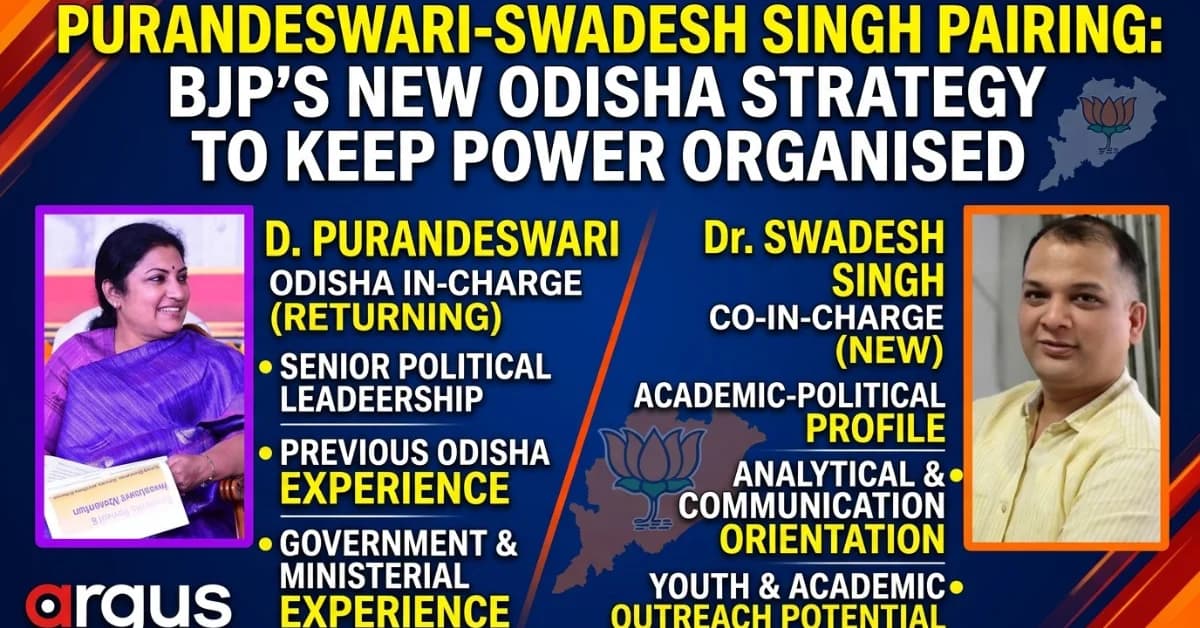
The BJP has brought back D. Purandeswari as Odisha in-charge and introduced Dr. Swadesh Singh as co-in-charge to transition from electoral mobilisation to governance consolidation.
Purandeswari's return leverages her institutional memory, government experience, and deep familiarity with Odisha's political landscape.
The appointment of Dr. Swadesh Singh - an academic, former ABVP activist, and media professional—signals a strategic push toward youth outreach and modern political communication.
Bhubaneswar: The BJP’s decision to bring D. Purandeswari back as Odisha in-charge and introduce Dr Swadesh Singh as her co-in-charge is more than a routine organisational reshuffle. It signals a change in what the party appears to want from its Odisha organisation at a time when the BJP is no longer fighting merely to capture power; rather, it is trying to consolidate power after forming the State’s government.
The appointments, announced on September 23 by BJP national president Nitin Nabin, replace Vijaypal Singh Tomar and Lata Usendi. The changes are part of a wider restructuring covering all 36 States and Union Territories.
For Odisha, however, the pairing is particularly significant.
Purandeswari is not new to Odisha. Singh is new to the state assignment. And that distinction may explain the architecture of the new team.

📱 Get Argus News App
✨One brings previous Odisha experience, seniority and national-level political exposure. The other brings an academic, youth-oriented and communication-oriented profile. Together, they suggest a BJP organisation that will have to manage three different tasks simultaneously: government-organisational coordination, grassroots consolidation and the political narratives of a younger electorate.
Why bring Purandeswari back?
Purandeswari first became Odisha BJP in-charge in November 2020, replacing Arun Singh, with Vijaypal Singh Tomar then serving as saha-prabhari.
She remained in the Odisha assignment until August 2022, when Sunil Bansal replaced her as the party prepared for the 2024 electoral cycle. The change was then widely associated with the BJP's search for a stronger organisational push ahead of the simultaneous 2024 Lok Sabha and Assembly elections.
The sequence matters.
In 2020, Purandeswari came into Odisha when the BJP was still an opposition party confronting a long-established BJD government.
In 2026, she returns to a fundamentally different political landscape:
the BJP is itself the government.
That changes the job.
The question is no longer simply how to attack the incumbent. It is how to ensure that the party organisation, legislators, ministers and government remain politically synchronised while simultaneously expanding the party's grassroots structure.
That makes her earlier Odisha experience potentially valuable.
She already knows the political terrain, the major players and the organisational fault lines. Her earlier stint also demonstrated that she was willing to take politically aggressive positions on issues involving the then BJD government. During the Pari case, for instance, she visited the victim's family and publicly demanded a CBI investigation.
The significance of her return, therefore, may lie less in nostalgia and more in institutional memory.
From attacking a government to managing a government-party ecosystem
This is arguably the biggest difference between Purandeswari's first Odisha assignment and her second.
Earlier, the organisational imperative was essentially:
Attack → mobilise → expand → convert public dissatisfaction into votes.
Now it is closer to:
Govern → communicate → correct → consolidate → prepare the next electoral layer.
The distinction is crucial.
A ruling party inevitably develops a distance between its ministers and its grassroots workers. Ministers become absorbed in administration; MLAs become occupied with constituencies; organisational workers expect access, recognition and political responsiveness.
That is where a senior prabhari becomes important – not as a constitutional authority over the government, but as a party-level coordination mechanism.
Within the BJP organisation, the in-charge can facilitate coordination between the central leadership, state president, legislators, ministers and cadre.
That distinction is important – and it makes Purandeswari's seniority particularly relevant.
Why Purandeswari, specifically, at this stage?
1. She has Odisha memory
Unlike a completely new in-charge, Purandeswari does not enter Odisha without organisational history.
She has previously dealt with the State BJP leadership and the BJD government and therefore begins with a degree of institutional familiarity.
That reduces the learning curve.
2. She has government experience
Her profile as a former Union minister gives her familiarity with the relationship between political messaging, government policy and legislation.
That could become significant when Odisha BJP has to defend complicated policy decisions rather than simply attack the Opposition.
The MMDR controversy is one example where the political argument is inseparable from questions of mining, federalism, taxation and State revenue.
A party organisation dealing with such issues needs leaders who can translate technical policy into political communication.
3. She can operate above factional equations
This is an important organisational requirement in a first-term BJP government.
Odisha now has a large group of MLAs experiencing government for the first time. Ministers, legislators, district leaders and organisational functionaries are consequently adjusting to a new balance of power.
A senior central leader can potentially function as an additional organisational channel between these competing layers.
That does not mean she will control the government.
It means she can help the central leadership read the state organisation and its political feedback more systematically.
Then why Swadesh Singh?
This is perhaps the more revealing half of the appointment.
Dr Swadesh Singh is not simply another conventional political organiser.
His available profile identifies him as an Assistant Professor of Political Science at Satyawati College, University of Delhi, with previous teaching experience at Delhi University institutions, a PhD and MPhil from JNU, and earlier experience in journalism.
The BJP's new national team announced in August also identified Singh as a national secretary and described him as a former ABVP activist at JNU and a professor at Delhi University.
That background makes the Odisha assignment interesting.
Because the party has not paired Purandeswari with another conventional electoral veteran.
It has paired her with someone whose profile is considerably more academic, analytical and communication-oriented.
That could be particularly useful to a ruling party confronting a political environment in which issues increasingly travel through television, social media, universities, professional groups and digitally connected younger voters.
The Purandeswari-Swadesh combination: two different organisational instruments
|
D. Purandeswari |
Dr Swadesh Singh |
|---|---|
|
Senior political leadership |
Academic-political profile |
|
Previous Odisha experience |
First major Odisha assignment |
|
Government and ministerial experience |
Political science and journalism background |
|
Macro political management |
Analytical and communication orientation |
|
Senior leadership coordination |
Youth/academic/professional outreach potential |
|
Institutional memory |
New-generation political vocabulary |
|
Party-government coordination |
Narrative and intellectual inputs |
Why a professor-politician in Odisha BJP?
Odisha's political contest is no longer confined to traditional rural electoral mobilisation.
The BJP government now has to communicate with:
first-time voters;
university students;
urban professionals;
digitally active voters;
aspirational middle classes;
young entrepreneurs;
social-media communities;
and politically engaged civil society groups.
These audiences consume politics differently from the traditional cadre-and-rally ecosystem.
This is where Singh's academic and communication background becomes potentially relevant.
His official profile records experience in political science teaching as well as journalism, including work with NDTV and BBC Hindi.com before entering full-time academia.
That combination gives him an unusual organisational toolkit:
political theory + media experience + youth-wing background + party organisation.
The BJP has now placed that toolkit inside Odisha.
The bigger shift: from booth arithmetic to narrative arithmetic
The Tomar-Lata Usendi team came into Odisha after the BJP's 2024 victory, replacing an organisational arrangement that had been closely associated with the election campaign.
Tomar had earlier served as Odisha election in-charge and was subsequently made the regular state in-charge in July 2024; Lata Usendi, who had worked as election co-in-charge, was made co-in-charge.
That continuity made sense immediately after the election.
But two years into government, the organisational requirement is different.
The BJP now needs to answer a different set of questions:
Are government policies reaching the ground?
Are ministers accessible to workers?
Are first-time legislators building durable constituency organisations?
Is the party developing second-line leadership?
Can the government explain complicated policy decisions in language ordinary voters understand?
Can the organisation detect public dissatisfaction before it becomes an electoral issue?
This is where the new combination becomes significant.
Nitin Nabin's organisational calculation
The BJP's official announcement establishes one fact: Nitin Nabin has redesigned the national network of state in-charges and co-in-charges. The Odisha team is part of that larger exercise.
The specific reasoning behind each Odisha appointment composition allows a reasonable political reading.
First: consolidate the government rather than merely celebrate the victory
The BJP's Odisha government is still relatively young.
The organisational leadership therefore has to prevent the classic transition problem: a successful election machine becoming a fragmented governing party.
Purandeswari's seniority fits that requirement.
Second: institutionalise the Odisha BJP
Winning government once and building a durable political organisation are different exercises.
The next stage requires permanent district-level structures, regular cadre feedback, constituency monitoring and political communication that does not depend entirely on election-time mobilisation.
Third: create a second channel of political intelligence
Singh's profile potentially gives the leadership an additional route for reading political trends beyond traditional organisational meetings.
That could include youth sentiment, academic discourse, digital narratives and emerging policy controversies.
Fourth: prepare for the next electoral cycle before it arrives
The immediate test is not another Assembly election.
The BJP will have to consolidate itself through panchayat and urban local-body politics, where organisational depth matters enormously, and the local elections are looming over, as the State will hold the elections early next year.
The new appointments have been made ahead of those contests, a timing also noted in reporting on the reshuffle.
The most important change: government feedback becomes political intelligence
For a ruling BJP, the organisational chain ideally has to work in both directions.
Government → Organisation
What are people saying about schemes, administration, prices, jobs, education, roads, welfare and local governance?
And:
Organisation → Government
Where are workers dissatisfied? Which ministers are inaccessible? Which local issues are becoming politically dangerous? Where is opposition messaging gaining traction?
A strong prabhari can help create that feedback loop.
This is where Purandeswari's role could become considerably more consequential than a conventional ceremonial state-in-charge position.
Where Swadesh Singh could matter most: the narrative battlefield
The BJP government's political challenges will increasingly involve issues that are difficult to reduce to a conventional rally speech.
Take the mineral economy.
The MMDR debate involves mining policy, Centre-State relations, revenue, royalties, legal interpretation and industrial investment.
The political Opposition can simplify it into a regional-resource question.
The government needs to explain its position in equally simple language without losing the technical facts.
That is precisely the kind of political communication for which an academic profile can be useful.
But one important caveat remains:
there is no public BJP document yet assigning Singh a specific MMDR communication mandate.
So it would be premature to describe him as formally appointed to "defeat" a particular Opposition narrative.
The more defensible reading is that his academic and communication background gives the Odisha organisation an additional capacity to handle such policy-heavy political debates.
Gen Z is another reason the appointment stands out
The BJP's long-term challenge is not simply retaining today's voters.
It is building a political relationship with voters entering the electorate now.
These voters are more likely to encounter politics through:
Instagram → YouTube → X → short-form video → podcasts → campus debates → digital news
rather than only through conventional party meetings.
Singh's academic background and experience with youth-oriented organisational politics provide a potential bridge between the traditional cadre system and this newer political communication ecosystem.
That does not automatically translate into electoral support.
But it gives the party an organisational profile better suited to engaging constituencies that consume political information differently.
What Purandeswari brings that Singh cannot, and vice versa
The pairing is therefore less about two people doing the same job and more about two different political capabilities.
Purandeswari: authority and continuity
Her value lies in seniority, government experience, political negotiation and previous knowledge of Odisha.
Singh: analysis and new-generation communication
His value lies in political science, media experience, youth-oriented organisational work and a potentially more contemporary communication vocabulary.
That creates a division of political labour:
Purandeswari can provide the senior organisational frame.
Singh can provide analytical and communication inputs.
The effectiveness of the arrangement will ultimately depend on whether those two streams remain integrated rather than operating separately.
And that may be the real test for the Odisha BJP
The new appointments should not be read simply as a replacement of one prabhari by another.
The BJP has already crossed its biggest political threshold in Odisha: it formed the government.
The harder organisational task now is to make that victory institutional rather than episodic.
That means converting:
electoral momentum → cadre structure
government delivery → political credibility
policy → understandable narrative
workers → permanent organisation
young voters → long-term political engagement
And finally:
one Assembly victory → durable organisational presence.
The September 23 appointments therefore point towards a BJP that appears to be preparing for the second phase of its Odisha experiment.
Tomar's period was closely associated with the transition around the 2024 victory. Purandeswari returns to a BJP that now has to govern. Singh enters beside her as a very different kind of organisational resource.
That is why the most revealing part of Nitin Nabin's Odisha decision may not be the return of Purandeswari alone.
It is the pairing.
One brings the memory of Odisha's political battlefield.
The other brings a profile built around political analysis, academia, media and younger organisational networks.
For the Odisha BJP, the next challenge is no longer simply to win power.
It
is to learn how to keep power organised.
Also Read: EXCLUSIVE| PLFS 2025 Glare on Odisha’s Employment Paradox: Agrarian Districts Outperform Industrial, Service sector Hubs like Jajapur and Khordha on WPR
Related Topics
Explore more stories