



Exclusive| BJP Moves East HQ to Bhubaneswar—Why Nitin Nabin Put Saudan Singh at the Command Centre and What It Means for BJD, Congress
Key Points
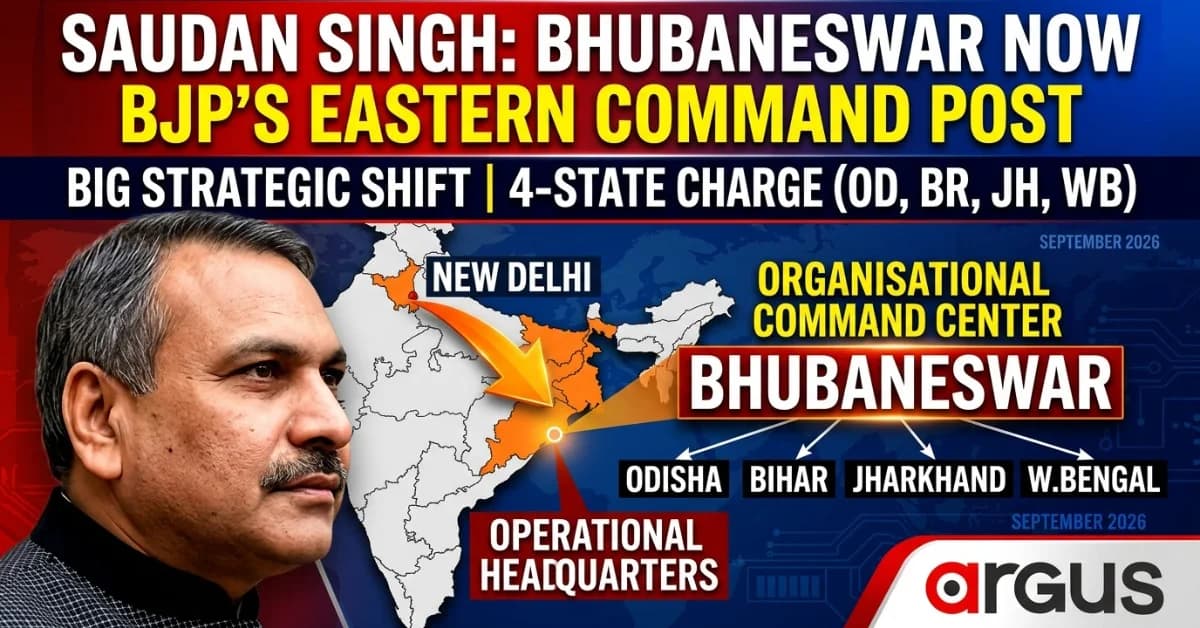
Bhubaneswar:When power changes hands, political headquarters can change meaning. And the BJP's decision to make Bhubaneswar the operational headquarters of National Joint General Secretary (Organisation) Saudan Singh, with charge of Odisha, Bihar, Jharkhand and West Bengal, appears to mark precisely such a structural shift.
This is bigger than a routine organisational appointment.
According to the organisational restructuring outlined in the BJP material, September 2026 marks a departure from the earlier eastern-region model in which national organisational leaders largely operated from New Delhi or other established party centres.
For the first time, the eastern organisational command is being given a permanent, localised base in a ruling state – Bhubaneswar. As per the BJP release Thursday, Party President Nitin Nabin has appointed Saudan Singh as the current National Joint General Secretary (Organisation) for the four-state eastern bloc, with Bhubaneswar designated as his operational headquarters.

📱 Get Argus News App
✨That distinction matters.
For years, Odisha was an electoral theatre in which the BJP had to build its organisation without controlling the state government. Today, it is the party's governing laboratory in the East. The move therefore converts Bhubaneswar from a state party headquarters into a potential regional organisational command centre.
The Big Strategic Shift: From Visiting Odisha to Operating From Odisha
The BJP's eastern strategy appears to be moving from remote supervision to permanent ground-level management.
The
organisational brief explicitly describes the earlier arrangement as
one in which eastern states were handled through centralised
leadership based in New Delhi or other central hubs. The September
2026 restructuring, by contrast, creates a dedicated four-state
eastern bloc with Bhubaneswar as its operational base.
The
political significance is straightforward: Odisha
is no longer merely a state the BJP is trying to win. It is now the
state from which the BJP can organise.
That is the fundamental difference.
A permanent organisational headquarters provides something election-time visits cannot – continuous access to state leaders, cadre networks, organisational data, training systems, inter-state coordination and political feedback.
For which, this is seen by political watchers as a transition from "remote monitoring" to "real-time intervention", allowing the national organisation to supervise day-to-day developments rather than waiting for information to move to Delhi.
In political language, the East gets a command room rather than a visiting command.
Why Bhubaneswar Became the Choice
The choice of Bhubaneswar over Kolkata or Ranchi is strategically revealing.
An analysis throws the three broad considerations.
First is political control.
Bhubaneswar is the capital of a state where the BJP has formed its own government. A permanent national organisational base can therefore operate alongside a BJP-led state government rather than depending on an opposition-controlled administrative environment. The significance here lies in the fact that a ruling-state capital offers the security and institutional ecosystem required for a permanent multi-state organisational hub.
Second is geographical connectivity.
The four-state charge stretches across Odisha, Bihar, Jharkhand and West Bengal. Bhubaneswar provides a coastal eastern location from which the BJP can connect Odisha's tribal and western belts with the wider eastern political geography. Bhubaneswar give the canvas of the tribal belt of Jharkhand and northern/western Odisha alongside the coastal belt as an important strategic bridge.
Third is organisational suitability.
The BJP's organisational model depends heavily on booth-level structures, cadre training, voter mapping and continuous feedback. Therefore, Bhubaneswar offers a comparatively stable environment for such micro-management, while simultaneously placing the organisational command close to the new state government.
There is therefore a deeper message in the geography:
Kolkata may be the larger political metropolis; Ranchi may be geographically central to the tribal belt but opposition ruled state; but Bhubaneswar is now the capital where the BJP combines political power with organisational control.
Why Not Kolkata? The Strong-State Argument
The decision not to make Kolkata the operational base becomes particularly interesting when the organisational requirement is examined.
The analysis points to the different political situations in West Bengal and Odisha.
It reveals that where a strong state-level leadership structure is already established, the national organisation may have less need to create another permanent command centre in the same capital.
Odisha presents the opposite organisational requirement.
The state BJP has moved from opposition to government, while the government itself is relatively new. Chief Minister Mohan Charan Majhi is leading his first state government and so, the proximity of a veteran organisational hand provides a structural bridge between the state government, cabinet, party organisation and central leadership.
In other words, Kolkata can remain a major political battlefield without becoming the eastern organisational headquarters. Bhubaneswar, by contrast, can serve as the command centre of a BJP government while simultaneously looking outward toward neighbouring states.
That is the strategic distinction.
Enter Saudan Singh: The Organisation Man Who Knows Odisha's Ground
The choice of Saudan Singh makes the Bhubaneswar decision even more significant.
He is not being positioned as another public-facing political leader. He belongs to the BJP's organisational architecture.
Singh as a senior BJP organisational leader with RSS Pracharak roots, served for years as a National Joint General Secretary (Organisation), before later becoming a National Vice-President. His principal strength is organisation-building rather than public political projection.
His style is therefore fundamentally different from that of a conventional political campaigner.
He builds systems.
His profile carries the expertise trademark in booth-level structures, Tridev and Panna Pramukh networks, cadre training, organisational discipline and faction-management. He is seen, by politcal observers , as a behind-the-scenes operator who works away from media glare.
That profile matters because the BJP's eastern challenge is no longer simply winning an election.
It is institutionalising the gains it has already made.
Odisha Is Where His Organisational Memory Matters
Singh's return to an Odisha-centred eastern assignment carries an additional layer: he has organisational memory of the state before the BJP became the ruling party.
A glance at the BJP history outlines his earlier organisational tenure with the BJP's rise in Odisha, particularly the dramatic expansion in the 2017 panchayat elections and the party's subsequent emergence as the principal opposition force.
The 2017 rural election figure is independently documented: the BJP won 297 Zilla Parishad zones, up sharply from 36 in 2012.
It is well documented how his organisational groundwork had been behind that expansion, including the BJP's efforts to build booth-level structures and its rapid growth in western and tribal Odisha.
Singh's organisational strategy is being widely seen as helping establish the BJP's rural network, booth-management architecture and tribal outreach.
The significance today is not simply that Singh knows Odisha.
He knows Odisha as an organisation-building project.
He has seen the BJP when it was the challenger.
He is returning when it is the government.
That makes his deployment qualitatively different from sending an outsider to supervise a state unit.
Why Nitin Nabin Needed a Tested Organisation Man
The decision by BJP president Nitin Nabin to put Singh in charge of this four-state eastern bloc can therefore be read as a choice for institutional continuity rather than political theatrics.
The eastern belt contains four very different political environments:
|
State |
Strategic organisational requirement |
|---|---|
|
Odisha |
Consolidate, handhold the BJP's newly acquired government and expand organisational depth |
|
West Bengal |
Sustain and deepen the party's organisational challenge |
|
Jharkhand |
Strengthen the party across a politically significant tribal belt to win the next elections |
|
Bihar |
Maintain organisational coordination in a major Hindi-belt state |
For which, the eastern assignment requires a senior organisational hand capable of linking the cadre machinery across these differing political environments.
This is where Singh's profile becomes relevant.
He is being deployed not primarily to make speeches, but to make the organisation work.
That includes synchronising the RSS-BJP cadre pipeline, auditing booth-level structures, strengthening grassroots feedback and containing internal organisational friction.
For Nitin Nabin, therefore, the choice of Singh represents a familiar organisational principle: when the political map becomes more complicated, put a tested organisation man at the centre of the map.
The BJD-Congress Problem: Optics Versus Organisation
This is where the move acquires its immediate Odisha political meaning.
The BJD and Congress have increasingly sought to create political pressure around the Majhi government's performance and use public issues to construct an anti-incumbency narrative.
But the BJP's response, if the Bhubaneswar headquarters is viewed strategically, is not necessarily to answer every opposition charge with a fresh political statement.
It is to build a permanent counter-machine.
The difference is crucial.
Opposition parties can generate protests, press conferences, legislative confrontations and political optics. A permanent national organisational command can work on something less visible but potentially more consequential: cadre deployment, constituency feedback, booth networks, local leadership management and rapid political response.
This move by new party president carries four potential consequences for the opposition:
reducing the gap between Delhi-level intervention and local response;
continuous monitoring of rural opposition networks;
quicker processing of political inductions; and
systematic conversion of government achievements into cadre-level messaging.
That does not automatically translate into electoral outcomes. But it changes the organisational equation.
The Real Message to BJD: The BJP Is Preparing for the Long Game
For the BJD, the more important message may be that the BJP is not treating its 2024 breakthrough as a one-election phenomenon.
The party's historical experience in Odisha provides the clue.
The BJP's 2017 rural breakthrough was followed by its emergence as the principal opposition force in 2019. But the 2022 panchayat election showed that organisational gains can also be reversed: the BJD won 766 of 853 Zilla Parishad seats, while the BJP fell to 42.
That history teaches both parties the same lesson:
Electoral momentum without permanent organisation can evaporate.
The BJP appears to have absorbed that lesson.
Hence the permanent eastern command.
The objective is not merely to defend today's government but to ensure that the organisation underneath it remains active between elections.
And for Congress, a Different Warning
For Congress, the strategic implication is even more structural.
The BJP's rise in Odisha historically coincided with Congress's displacement from the principal-opposition position. The 2017 rural elections were a major marker: BJP's 297 ZP seats contrasted with Congress's 60.
The Congress therefore faces not simply the task of attacking the government.
It has to compete with a BJP that is attempting to deepen its organisational footprint below the level of headline politics.
That makes the political contest less about who produces the sharper daily statement and more about who owns the booth, the mandal, the panchayat and the local political narrative when the cameras are gone.
The Larger Political Meaning: Bhubaneswar Becomes More Than a State Capital
The most consequential element of the appointment, therefore, may not be Saudan Singh himself.
It is the address.
For decades, the eastern BJP's organisational command was largely external to Odisha. The restructuring now places the operational command inside Bhubaneswar and assigns it responsibility for four states.
That is a symbolic reversal.
Earlier, Delhi managed the East. Now the BJP wants the East to be managed from the East.
And the choice of Bhubaneswar tells the story of Odisha's transformation within the BJP – from an opposition battlefield to a governing base.
Saudan Singh's permanent presence could consequently mean that Odisha's BJP government is not being left to operate as an isolated state unit.
It is being positioned as the anchor of a wider eastern organisational grid.
For the BJD and Congress, that changes the political chessboard.
Their challenge is no longer merely to manufacture anti-incumbency optics against the Majhi government.
They must contend with a ruling party that is simultaneously trying to ensure that its organisation remains permanently switched on.
The
BJP's strategic message from Bhubaneswar is therefore simple: the
election may be periodic, but the organisation will not be.
Also Read: EXCLUSIVE | BJP State-Level Rejig: Why D. Purandeswari Is Back in Odisha, and What Her New Partner Swadesh Singh Brings to the Table