



Congress Changes Playbook in Odisha: What BJP and BJD Can Expect from Lalji Desai's Cadre-First Strategy | Political Analysis
Key Points
* The AICC is betting on organisational discipline over street agitations to revive the party's electoral fortunes.
* BJP and BJD may now face a quieter but more structured Congress ahead of future elections.
Bhubaneswar: The Congress party has pressed the reset button in Odisha – not by changing its ideology, but by changing the man tasked with rebuilding it.
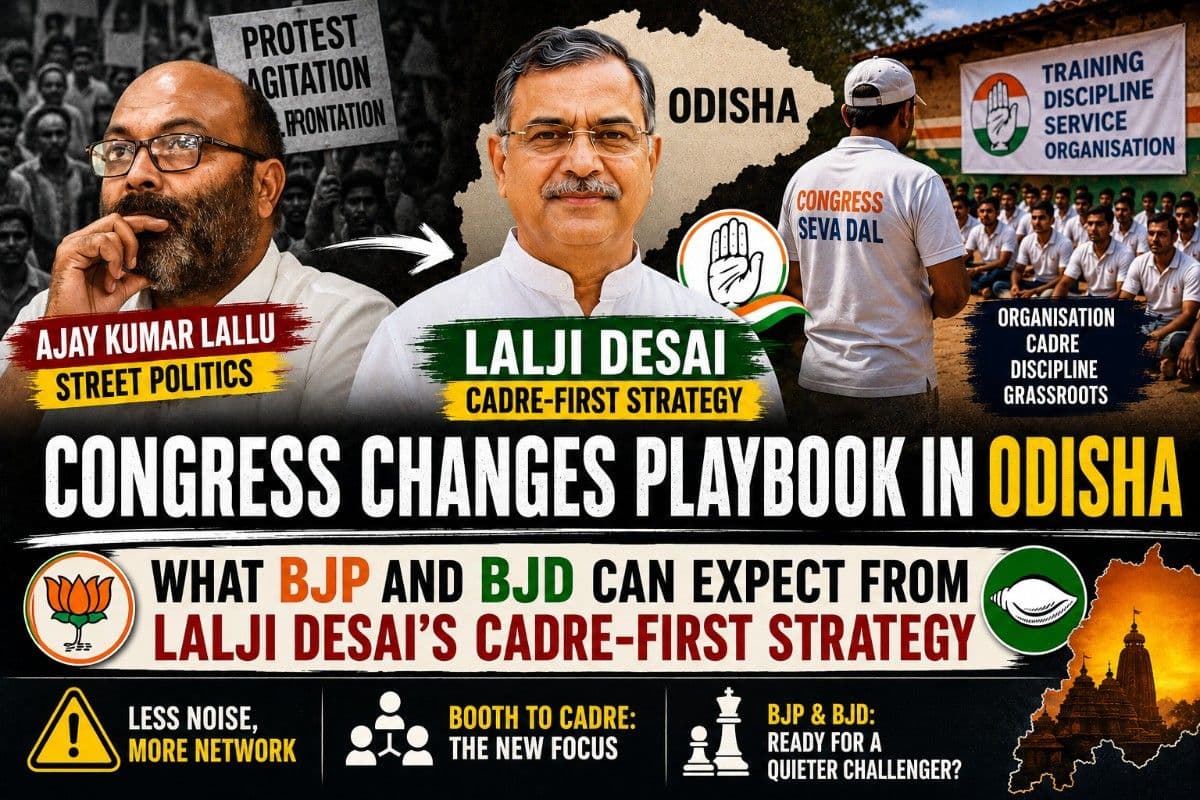
The All India Congress Committee's decision to appoint Lalji Desai as the new AICC in-charge for Odisha, replacing the fiery Ajay Kumar Lallu, signals far more than a routine organisational reshuffle. It represents a calculated shift in strategy – from loud street politics to quiet organisational consolidation – as the party attempts to regain relevance in a state where it has steadily slipped into political irrelevance.
For a Congress struggling to emerge from the shadows of the BJP and the BJD, the message from the high command is unmistakable: protests alone cannot revive a party whose grassroots machinery has withered over the years.
From Agitation to Organisation

📱 Get Argus News App
✨Ajay Kumar Lallu arrived in Odisha with a reputation built on confrontation.
A grassroots leader from Uttar Pradesh, Lallu became nationally known for leading aggressive agitations, courting arrests and taking on governments head-on. His appointment was aimed at injecting energy into a demoralised Odisha Congress.
During his tenure, the party witnessed more frequent protests against both the BJP-led Centre and the Mohan Majhi government in Odisha. District leaders were pushed to become more visible, booth committees were reviewed regularly, and accountability became the central theme.
His style, however, also generated friction within the state unit.
Senior leaders accustomed to traditional functioning often found themselves uncomfortable with Lallu's high-pressure approach. While he succeeded in shaking the organisation out of complacency, translating agitation into a cohesive political structure remained a challenge.
Why Lalji Desai?
The choice of Lalji Desai reveals what the Congress leadership now believes is Odisha's biggest weakness.
Unlike Lallu, Desai is not known for headline-grabbing protests.
The Gujarat leader built his reputation as National Chief Organiser of the Congress Seva Dal, the party's ideological and volunteer-training arm. His expertise lies in building disciplined cadres, strengthening communication networks and creating organisational systems that function beyond election seasons.
In political circles, Desai is regarded less as an agitator and more as an institution builder.
His appointment indicates that the Congress leadership now considers organisational rebuilding – not public confrontation – the immediate priority.
A Different Game Plan for Odisha
Desai is expected to pursue a fundamentally different political strategy.
Rather than organising frequent demonstrations, the focus is likely to shift towards rebuilding the party from the booth upwards.
That could involve reviving the Seva Dal network, expanding volunteer training programmes, strengthening booth committees, identifying young local leadership and reconnecting with voters through sustained grassroots engagement instead of event-based politics.
Congress insiders believe this model could be particularly effective in tribal districts such as Koraput, Rayagada, Nabarangpur and Malkangiri, where the party still retains pockets of traditional support despite years of electoral decline.
The emphasis is expected to be on creating a permanent human network rather than temporary protest crowds.
Healing Internal Divisions
Perhaps Desai's biggest challenge will not be fighting political opponents but managing Congress itself.
Factionalism has long plagued the Odisha unit, with competing camps often weakening the party's electoral preparations.
Unlike Lallu's directive style, Desai is expected to adopt consensus-building and organisational restructuring to reduce internal rivalries.
His experience in managing the Seva Dal suggests a leadership style centred on training, dialogue and institutional discipline rather than public confrontation.
If successful, this could provide the stability that the state unit has lacked for years.
Building an Ideological Counter
Another likely focus area is ideological training.
Congress leaders privately acknowledge that the BJP's expansion has been driven not merely by electoral campaigns but by decades of grassroots ideological work through its affiliated organisations.
Desai's background positions him to strengthen Congress's own ideological ecosystem by training volunteers, expanding the Seva Dal network and nurturing long-term political workers instead of relying solely on election-time mobilisations.
The strategy mirrors organisational models that prioritise building committed cadres over attracting short-term political crowds.
What It Means for Odisha Politics
The leadership transition comes at a crucial phase in Odisha politics.
The BJP is consolidating power after replacing the BJD government, while the BJD itself is recalibrating its role as the principal opposition.
For Congress, reclaiming political space will require more than symbolic protests.
The party must first rebuild its grassroots structure before it can hope to convert public dissatisfaction into electoral gains.
That appears to be the mandate handed to Lalji Desai.
The Bottom Line
Ajay Kumar Lallu's tenure was about waking up a dormant organisation. Lalji Desai's assignment is far more demanding – turning that awakened organisation into a disciplined political machine.
Whether this quieter, organisation-first strategy succeeds will determine if Congress can once again become a serious player in Odisha politics or continue to remain a distant third force.
The change
in leadership, therefore, is not merely administrative. It marks a significant
shift in how the Congress intends to fight its political battles in Odisha – from
the noise of the streets to the silent strength of the organisation.
Also Read: Sujata Joins BJD, Naveen Says 'I Lead in 2029'; Succession Plan Hanging Fire Tells the Bigger Story| Political Analysis
Related Topics
Explore more stories