



Sujata Joins BJD, Naveen Says 'I Lead in 2029'; Succession Plan Hanging Fire Tells the Bigger Story| Political Analysis
Key Points
* While officially inducted as an ordinary party member, Sujata's political launch mirrors the gradual projection strategy once adopted for V.K. Pandian before the 2024 elections.
* The bigger challenge lies ahead: transforming bureaucratic credentials into political legitimacy in a BJD that is no longer protected by the glue of state power.
Bhubaneswar: In politics, what is said publicly is often less important than what unfolds before everyone's eyes.
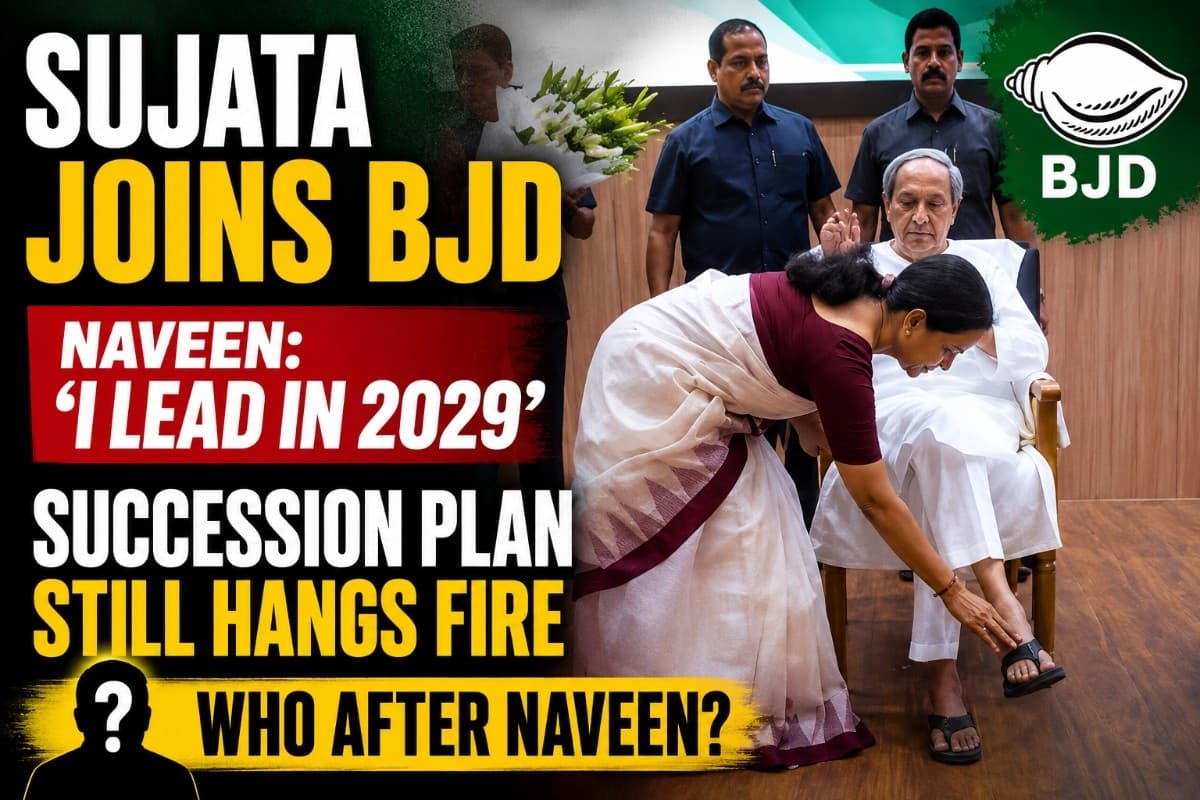
That is why the significance of former IAS officer Sujata Rout Pandian's formal entry into the Biju Janata Dal (BJD) on Thursday extends far beyond a routine political induction. Her joining comes at a time when the party is still grappling with its first electoral defeat in nearly a quarter century and, more importantly, with a question it has repeatedly postponed confronting: Who after Naveen Patnaik?
The immediate headlines focused on BJD president Naveen Patnaik welcoming Sujata into the party and declaring that he himself would lead the BJD in the 2029 Assembly elections.
The statement was politically reassuring for party workers. Yet it was hardly new.

📱 Get Argus News App
✨Naveen Patnaik was also the undisputed leader of the BJD in 2024.
The real political story lies elsewhere.
It lies in what the party did not say.
And it lies in the timing of Sujata Pandian's arrival.
The Return of the Pandian Factor
For over a decade, Odisha politics revolved around an extraordinarily influential power centre: the husband-wife duo of V.K. Pandian and Sujata Rout Pandian.
Following the eclipse of Pyarimohan Mohapatra from the BJD's power structure, V.K. Pandian steadily emerged as Naveen Patnaik's most trusted aide and eventually the most influential bureaucrat in Odisha.
As Private Secretary to the Chief Minister, Pandian evolved from a powerful administrator into the political face of the government. By 2023, he was no longer functioning merely as a bureaucrat. He had become the principal public interface of the Naveen administration, travelling extensively across Odisha and effectively acting as the government's chief political communicator.
The transformation culminated in 2024.
Pandian resigned from the IAS, joined the BJD, became its star campaigner and was projected across the state in a manner unprecedented for a political entrant.
Then came the election verdict.
The BJP stormed to power.
Within days, Pandian resigned from the primary membership of the BJD, publicly distanced himself from active politics and virtually disappeared from Odisha's political landscape.
Many interpreted it as the end of the Pandian chapter.
Thursday's development suggests otherwise.
Because politics rarely releases those who have experienced the gravitational pull of power.
Two years after the BJD's defeat, the Pandian surname has formally returned to the party's political centre stage – this time through Sujata Rout Pandian.
Why Naveen’s Statement Matters
Perhaps the most telling moment came when Naveen Patnaik appeared eager to clarify that Sujata had merely become a primary member of the party.
Simultaneously, he reiterated that he would remain the leader of the BJD in 2029.
On the surface, the message was straightforward.
But politics operates on subtext.
Naveen Patnaik will turn 80 in October this year. By the time Odisha votes again in 2029, he will be around 83 years old.
Indian political history offers very few examples of leaders at that age actively criss-crossing an entire state, conducting extensive campaigns and sustaining the physical demands of a modern election.
That reality inevitably raises the succession question.
And the fact that the BJD continues to avoid answering it makes every political development around Naveen Patnaik enormously consequential.
The more the party postpones the succession debate, the more observers search for clues elsewhere.
Sujata Pandian's entry is one such clue.
A Familiar Pattern
There is a striking resemblance between what happened with V.K. Pandian before 2024 and what appears to be unfolding now.
Years ago, Naveen Patnaik famously stated that "the people will choose my successor."
Yet when the need arose for a public political face beyond Naveen himself, the party increasingly relied upon V.K. Pandian.
He moved from bureaucratic authority to public visibility.
From public visibility to political legitimacy.
From political legitimacy to becoming the BJD's principal campaign face in 2024.
No formal succession announcement was ever made.
Yet the projection was visible to everyone.
Today, a similar process may be beginning with Sujata Pandian.
Significantly, while joining the BJD, she emphasised her long association with Naveen Patnaik's administration.
"I was very fortunate to have the opportunity to work under Naveen Patnaik's leadership and serve the people of Odisha for the last 24 years. Today again, I am blessed to get this opportunity once again to work for the state under his leadership," she said.
The wording is notable.
It establishes continuity.
Not a fresh political beginning.
But a continuation of an existing relationship with the Naveen Patnaik ecosystem.
Building the Political Narrative
Since her induction, BJD leaders have rapidly highlighted Sujata Pandian's administrative achievements.
Mission Shakti has emerged as the principal reference point.
Her role in implementing the Mamata scheme has also been repeatedly mentioned.
This is politically understandable.
Every political entrant requires a narrative.
Administrative achievements provide that foundation.
However, the political packaging also deserves scrutiny.
Mission Shakti, while undoubtedly a transformative programme, was not exclusively a BJD political initiative. Its success depended on the participation of self-help groups, institutional support from NABARD and assistance from the Union government's women and child development framework.
Similarly, Mamata was implemented across Odisha through district administrations led by collectors and field-level bureaucratic machinery.
The effort to foreground these achievements appears aimed at constructing political credentials for a leader who, despite a distinguished administrative career, possesses virtually no direct electoral experience.
That distinction matters.
Administration and politics are fundamentally different professions.
One functions through authority.
The other through persuasion.
The Difference Between Bureaucracy and Politics
During her bureaucratic career, Sujata Pandian operated within an ecosystem where Naveen Patnaik headed the government and V.K. Pandian enjoyed extraordinary influence within it.
The political terrain now is entirely different.
The BJD is no longer in power.
The BJP controls the state government.
The authority that once flowed naturally from government office has disappeared.
Politics outside power is a far harsher arena.
There are no official channels to mobilise support.
No administrative machinery.
No institutional leverage.
Only political capital.
Sujata Pandian must now build that capital from scratch.
She will need to travel extensively.
Engage workers.
Navigate factional interests.
Manage competing ambitions.
And most importantly, convince the wider party organisation that her political stature extends beyond her surname.
That challenge should not be underestimated.
Power Was the Glue
For years, many senior BJD leaders accepted the rise of V.K. Pandian because he enjoyed Naveen Patnaik's confidence and operated from within a government that wielded immense authority.
Political resistance remained largely muted.
Power has a remarkable ability to maintain discipline.
But power is no longer with the BJD.
The adhesive that once held competing interests together has weakened.
Consequently, any attempt to elevate a new leadership centre will face far greater scrutiny than before.
The question is not whether Sujata Pandian can enter politics.
She already has.
The question is whether she can emerge as a consensus political figure within a party that is navigating life after electoral defeat.
Curious Optics of the Joining Ceremony
Reports suggested that several senior leaders were absent during her induction ceremony.
In politics, optics are rarely accidental.
The absence of a full display of senior leadership may have been deliberate.
A grand show of unity around Sujata Pandian would have immediately intensified speculation regarding succession.
By keeping the event relatively restrained, the party appears to have attempted a balancing act.
It wanted to welcome her.
But not so enthusiastically that it appeared to be unveiling a future leader.
The strategy allows the BJD leadership to maintain plausible deniability.
Officially, Sujata is merely a primary member.
Unofficially, her political importance is already being debated.
The Real Political Plot
This brings us to the central question.
If Naveen Patnaik remains the leader in 2029, who becomes the party's principal political face during the years leading up to that election?
The answer increasingly appears to be emerging.
Not formally.
Not explicitly.
But through a gradual process of projection.
The same method was used with V.K. Pandian.
And it may now be deployed with Sujata Pandian.
The BJD cannot indefinitely avoid discussing succession.
Yet it also appears unwilling to trigger an internal contest by openly naming an heir.
The middle path is familiar: project a leader without officially declaring one.
Allow visibility to create legitimacy.
Allow legitimacy to generate acceptance.
Allow acceptance to evolve into leadership.
Whether that strategy succeeds remains uncertain.
Unlike 2023, the BJD today is in opposition.
Unlike V.K. Pandian's rise, there is no government machinery in the background.
Unlike before, there is a powerful BJP government ready to challenge every move.
The risks are therefore substantially higher.
The Bottom Line
Sujata Rout Pandian's entry into the BJD is not merely the story of a former bureaucrat joining politics.
It is a story about the unresolved future of Odisha's largest regional party.
Naveen Patnaik's declaration that he will lead the BJD in 2029 settles one question temporarily.
But it does not answer the larger one.
Who leads the BJD beyond Naveen?
The party insists that succession is not under discussion.
Yet politics often communicates through actions rather than announcements.
And viewed through that lens, Thursday's induction may well represent the opening chapter of the BJD's next succession experiment.
The official narrative says Naveen remains the leader.
The
political narrative suggests the search for the future face of the BJD may
already be underway.
Also Read: From Pandian to Sujata? Why Odisha’s Political Corridors Are Once Again Debating the Future of BJD | Political Analysis
Related Topics
Explore more stories