



Beyond the Optics: Odisha State BJP Executive in Cuttack Deploys Masterclass Counter-Offensive for Assembly and Hustings | Political Analysis
Key Points
Bhubaneswar: “In the midst of chaos, there is also an opportunity,” Chinese General & Startegist Sun Tzu famously observed.
In Odisha’s political theatre, the BJP appears to be preparing to turn precisely that opportunity into its weapon as it braces for an aggressive Opposition offensive in the Assembly.
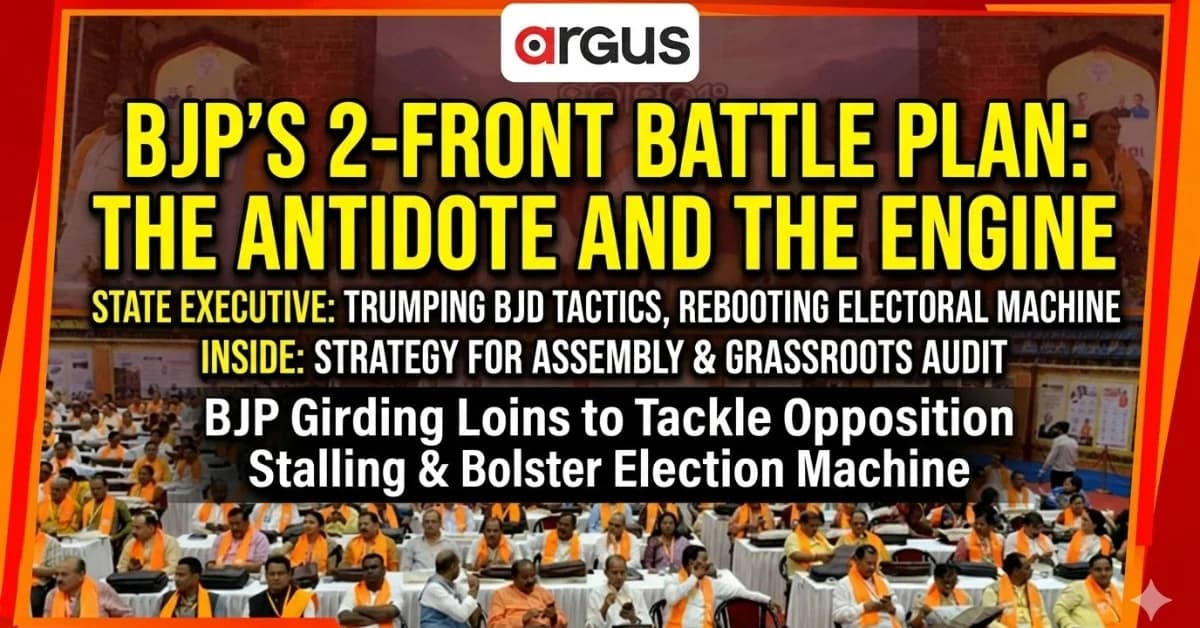
The two-day State Executive meet of the BJP in Cuttack seems to have adopted the political doctrine when it is bracing up for the immediate political chhallenge – the confrontation with the Opposition in the upcoming Monsoon session starting September 22.
The State BJP's poltical radar has been smart enough to pick up the Opposition battle readiness and ammos. And reading the radar blips, the ruling BJP Sunday expressed its apprhension on Opposition BJD and Congress design to stall the upcoming Monsoon session aka the Lok Sabha style, where Congress led INDI alliance stalling led to wash out of the monsoon session of Lok Sabha and Rajya Sabha.

📱 Get Argus News App
✨The all-important BJP State executive sesing an opportunity here to corner the Opposition's larger political optics, preaperd a counter-offensive politcal startegy as an antidote to trump the Opposition Campaign.
The holding of BJP State executive at this hour assumes significance also for another big reason.
Two years after holding its state executive post its election victory, the Odisha BJP on Sunday in Cuttack went into a stocktaking mode.
A close observation of the key politcal meet of the BJP pops up the following big poltical takeawys:
how to neutralise the BJD-Congress strategy of turning the upcoming Assembly session into a political theatre, and
how to reboot its electoral machine by taking a hard look at voter feedback and grassroots performance.
The timing is significant. With the Odisha Assembly’s monsoon session scheduled to begin on September 22, the BJP leadership appears to be preparing for the possibility that the House could witness disruptions over the Mines and Minerals (Development and Regulation) amendment issue, after the BJD and Congress sought a special session on the matter.
For the ruling party, the lesson from the washout of the Lok Sabha is clear: a stalled House can become an Opposition’s most effective political optic unless the government has a counter-narrative ready.
The Cuttack deliberations, therefore, focused on how the BJP can prevent legislative disruption from automatically translating into political damage for the government.
The Assembly battle: Don’t let Opposition own the optics
The BJP’s proposed counter-offensive is not merely about defending itself inside the Assembly. It is about ensuring that any disruption is politically attributed to the Opposition rather than being allowed to become a referendum on the government’s performance.
The party is preparing to frame repeated disruptions as an obstruction to development and welfare, arguing that legislative time meant for public issues, government business and welfare measures should not be consumed by political confrontation.
The strategy discussed at the executive meet is essentially to turn the optics around: if the BJD and Congress attempt to stall proceedings, the BJP wants its ministers and legislators to remain focused on government business, developmental issues and welfare delivery, while the cadre simultaneously taking the Opposition’s disruption to the public.
The BJP’s political calculation is that the Assembly may become the stage for the Opposition’s protest, but the real counter-stage will be outside the House – through the party’s organisational network, MLAs, MPs and district units.
MMDR issue: BJP prepares to flip the Opposition’s attack
The Mines and Minerals (Development and Regulation) Amendment issue is emerging as the immediate political flashpoint.
The BJD and Congress have sought a special session over the issue, giving the BJP an opening to turn the debate from the technicalities of the legislation towards the Opposition’s record and political intent.
Sources in the party revealed that the ruling party is expected to bring the BJD’s 24-year record in government into the conversation, particularly its handling of mining allocations, mineral resources and the minning scam controversies surrounding the sector.
The political message being prepared is straightforward: the Opposition cannot suddenly claim the mantle of protector of Odisha’s mineral interests after years in power.
The BJP’s counter will therefore seek to shift the debate from “what the Opposition is demanding” to “what the Opposition did when it was in government” – while keeping the government’s development and welfare agenda at the centre of its response.
The ‘Vikas versus 'Vinash’ counter
The BJP’s broader political formulation is likely to be a development-versus-obstruction narrative.
The party sees a political opportunity if the Assembly is disrupted: every stalled sitting can be portrayed as lost legislative time and an attempt to prevent discussion on government schemes, development projects and welfare delivery.
The executive meet’s discussion points towards a coordinated response in which ministers, legislators and party workers will communicate the same message outside the House.
The objective is to ensure that a potential Assembly washout does not become an Opposition success story.
Instead, the BJP wants the public narrative to be: the government came prepared to transact business, ready to discuss threadbare on all issues; the Opposition came prepared to obstruct it.
“Government responsibility has multiplied”
The organisational dimension of the discussion was underlined by national general secretary Sunil Bansal, whose message was that the party’s responsibility has multiplied after forming the government.
That marks an important transition for the BJP. The party can no longer operate primarily as an election machine attacking an incumbent government. It now has to simultaneously defend its own government, communicate its achievements and maintain an electoral organisation capable of fighting the next round of elections.
The executive meet therefore appears to have treated governance and organisation as two sides of the same political equation.
Second front: BJP puts its own organisation under audit
If the Assembly strategy is the BJP’s immediate political shield, the grassroots review is its longer-term electoral weapon.
Two years after its historic electoral victory, the party appears to be asking a more uncomfortable question: what is the voter actually saying on the ground?
The Cuttack meeting brought district-level functionaries into the discussion to assess the reach of programmes and events and, more importantly, to gather political feedback on what worked, what failed and what could have been done differently.
This is significant because the BJP is moving from campaign mobilisation to organisational auditing.
The Sunil Bansal talk at the meet clearly indicate that district and grassroots units are being examined not merely for whether they conducted programmes, but for their actual reach – whether beneficiaries were connected, whether schemes were reaching people and where the party’s communication machinery was falling short.
The focus on district-wise events and their reach signals a shift towards micro-level accountability rather than relying solely on the broad political goodwill generated by the 2024 victory.
From cadre reports to voter feedback
The most politically consequential part of the exercise could be the attempt to create a feedback loop between the party organisation and government.
The party is looking beyond internal mobilisation reports to understand whether people actually know about government schemes, whether beneficiaries are receiving the intended benefits and which grievances are becoming politically potent.
The internal assessment framework outlined in meet includes district and mandal-level feedback, independent organisational assessments and efforts to verify whether the party’s claims about grassroots outreach correspond with the reality on the ground.
That could eventually make the exercise more than a party organisational review. It could become an early-warning system for the government.
If several districts flag the same implementation problem, grievance or communication gap, the feedback can be pushed towards the government leadership for corrective action before the Opposition turns it into an electoral issue.
Why the timing matters: 2027 polls are the real deadline
The BJP’s immediate test may be the Assembly session beginning September 22, but the bigger organisational deadline lies several months ahead.
With rural and civic elections expected early next year, the Cuttack exercise gives the party an intervening window to undertake a SWOT assessment of its organisation.
That window could prove crucial.
The 2024 victory demonstrated the BJP’s ability to convert political momentum into an electoral breakthrough. The challenge now is to convert that momentum into a durable grassroots network capable of surviving local contests, where electoral equations are often much more granular and intensely local.
The district feedback exercise can tell the leadership where the party is strong, where its cadre network is weak, which schemes are generating goodwill, where delivery gaps persist and which Opposition narratives are gaining traction.
The bigger political message from Cuttack
Taken together, the two strands of the executive meet point to a BJP preparing for a two-front political battle.
On one front is the Assembly, where the party expects the BJD and Congress to aggressively use issues such as the MMDR amendment to create political optics and potentially disrupt proceedings.
On the other is the electoral battlefield outside the Assembly, where the BJP wants to audit its own machinery before the rural and civic polls.
The first strategy is defensive and combative: neutralise Opposition disruption before it becomes a narrative of government failure.
The second is corrective and organisational: find out what voters are actually saying before the next election exposes the gaps.
In that sense, the Cuttack executive meet was not merely another routine organisational gathering. It was the BJP’s attempt to simultaneously prepare an antidote for the Opposition’s Assembly strategy and a diagnostic report for its own electoral machine.
The
message emerging from the meeting is therefore clear: if the
Opposition plans to weaponise the Assembly through disruption, the
BJP intends to fight that battle in the court of public opinion. And
before the next electoral battle arrives, it wants to know exactly
what that public opinion is saying at the grassroots.
Also Read: September Signal: Why Odisha BJP Is Calling Its State Executive Meet Now? | Political Analysis
Related Topics
Explore more stories