



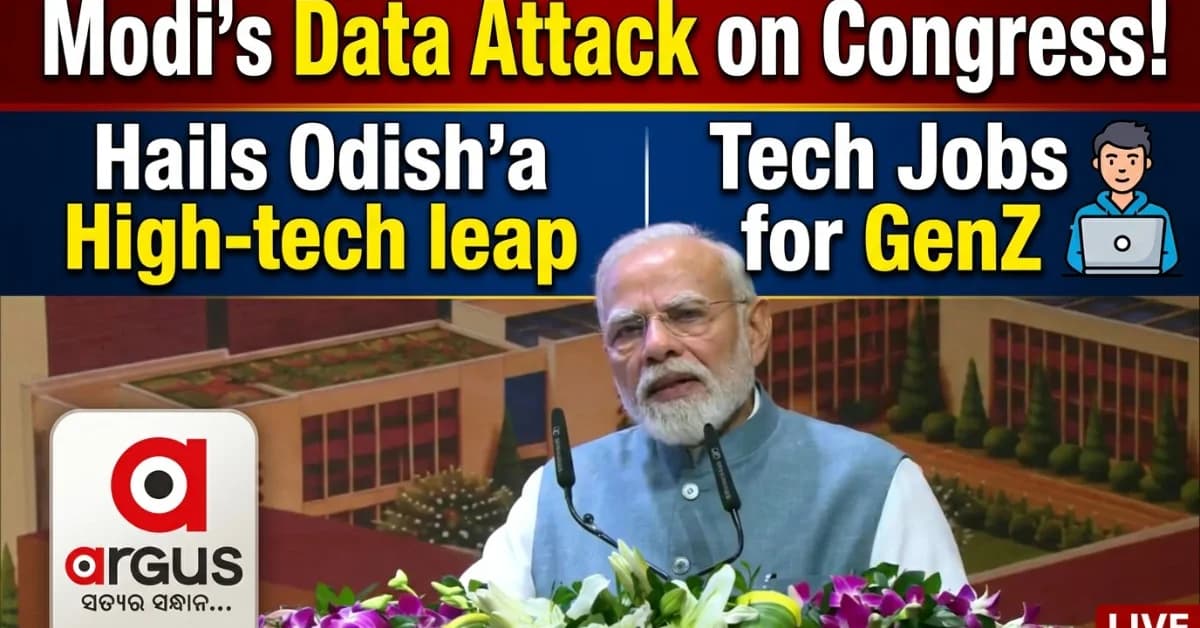
At RBI Data Centre Launch, PM Modi Attacks Congress With Data, Hails Odisha’s ‘Double-Engine’ Future for Gen Z
Key Points
Economic Pivot: PM Narendra Modi declared a transition "from mines to microchips," shifting Odisha's narrative from resource extraction to a high-value knowledge economy.
Political Critique: Modi contrasted past systemic leakages ("15 paise") with modern Direct Benefit Transfers (DBT) that deliver 100% value to citizens with zero leakage.
National Security: The speech elevated secure financial data centers as critical defensive fortresses against modern economic and cyber warfare.
Bhubaneswar: In political rhetoric, raw commodities and high technology rarely occupy the same sentence. Yet, opening his address with his signature chant of "Jai Jagannath" after dedicating the Reserve Bank of India’s (RBI) next-generation data centre to the nation, Prime Minister Narendra Modi bridged that exact chasm, proclaiming a structural shift in Odisha's economic paradigm: an evolution "from mines to microchips."
The Prime Minister's address was far more than a ceremonial ribbon-cutting for a financial data facility; it served as a sophisticated, dual-track manifesto.
Economically, it framed state-of-the-art digital infrastructure as an indispensable shield against asymmetric modern warfare.

📱 Get Argus News App
✨
Politically, it weaponised that same digital architecture to launch a scathing critique against the opposition Congress party's legacy, contrasting past systemic inefficiencies with the contemporary "double-engine" governance model.
By dissecting the speech, a distinct blueprint emerges – one that reveals how the Modi administration uses technology not merely as an administrative tool, but as a primary vehicle for political messaging, national security, and sub-national economic realignment.
Anatomy of a Political Attack: Weaponising Data against Legacy
The most striking feature of the Prime Minister's speech was its direct, data-driven offensive against the erstwhile Congress administration. Rather than relying on vague ideological critiques, Modi anchored his political arguments in the material realities of daily financial access, turning historical policy failures into sharp contrasts with current governance.
Redefining "Phone Banking"
In Indian political discourse, "phone banking" historically carried a deeply pejorative connotation. It referred to an era where high-profile loans were allegedly secured through direct telephonic interventions by influential politicians in New Delhi, often leaving state-run banks saddled with non-performing assets (NPAs).
Modi deliberately co-opted and flipped this terminology. By asserting that "earlier, only a few special families in Delhi were the beneficiaries of phone banking; now, the entire country benefits from it," he executed a masterful linguistic pivot. The phrase was transformed from a symbol of elite nepotism into a metric of mass empowerment—redefining "phone banking" as the democratic ubiquity of mobile applications and digital wallets in the hands of ordinary citizens.
The "15 Paise" Metric as an Institutional Foil
To substantiate his claims of structural transformation, the Prime Minister invoked one of the most famous admissions of institutional failure in Indian political history: former Prime Minister Rajiv Gandhi’s 1985 declaration, made from Odisha itself, that out of every rupee dispatched from New Delhi for welfare, only 15 paise actually reached the intended beneficiary.
Here is a mobile-friendly, vertically stacked version of the flow chart designed to fit small screens without horizontal scrolling:
PAST LEAKAGE VS. MODERN DIGITAL EFFICIENCY
Congress Era (1985 Estimate)
- [1 Rupee Sent]
↓
- [85 Paise Lost to Leakage]
↓
- [15 Paise Reaches Citizen]
Current DBT Architecture
- [1 Rupee Sent]
↓
- [0% Leakage via Digital Transfer]
↓
- [₹1.00 Full Amount Reaches Citizen]
By explicitly evoking this memory on Odisha soil, Modi achieved multiple political objectives simultaneously:
· Validating the Present: He framed the modern Direct Benefit Transfer (DBT) framework not just as an incremental upgrade, but as a revolutionary system that completely eliminates middle-men and systemic leakages.
· Quantifying Transparency: The assertion that "when 1 rupee is sent, the full 1 rupee reaches them" transforms abstract claims of anti-corruption into a tangible, mathematical reality for the electorate.
· Social Empowerment: The transition from restricted financial privileges to universal instruments – such as the scaling of the Atal Pension Yojana to 9 crore beneficiaries nationally and 38 lakh in Odisha alone – was presented as evidence that financial inclusion is the ultimate driver of social equity.
Geopolitics of Financial Infrastructure: Data as a Fortress
Beyond the immediate political friction, the speech offered a sober assessment of contemporary global realities, elevating a regional data centre into a critical node of national security.
Financial Systems as the New Frontline
Modi’s rhetoric reflected a profound shift in how modern nation-states conceptualise conflict. By stating that "wars are not fought with weapons alone; an attack on the economy is also a war," the Prime Minister officially elevated cybersecurity within the banking sector to a matter of sovereign defense.
In an era characterized by hybrid warfare, state-sponsored ransomware, and coordinated cyber offensives targeting critical infrastructure, the RBI data centre is no longer just an IT repository. It is positioned as a digital fortress. Securing financial data is directly equated with protecting territorial integrity, framing cybercriminals and economic saboteurs as modern adversaries requiring a militarized level of domestic defense.
THE EVOLUTION OF SOVEREIGN FRONTLINES
1. Traditional Warfare
· Frontline: Kinetic Weapons & Physical Borders
· Focus: Territorial Defense
↓
2. Economic & Modern Warfare
· Frontline: Cyber Threats & Data Nodes
· Focus: Systemic & Financial Security
"Nagarik Devo Bhava" and Digital Trust
At the core of this economic security apparatus is the philosophical maxim introduced in the speech: "Nagarik Devo Bhava" (The Citizen is God). Within a data-driven economic framework, treating the citizen as sovereign translates to protecting their digital identity and financial assets.
By building high-capacity, secure, domestic data centers, the state attempts to foster institutional trust. For a population rapidly transitioning away from cash, ensuring that digital banking systems are resilient against external shocks is a psychological necessity to sustain long-term economic growth.
Odisha Blueprint: Dynamics of "Double-Engine" Growth
The third pillar of the Prime Minister's address focused heavily on sub-national economics, specifically targeting the host state of Odisha. The rhetoric sought to validate and accelerate a profound shift in the state's industrial DNA.
Moving Beyond Extractivism
For generations, Odisha's economic identity was deeply intertwined with its geology. As a resource-rich state, its growth was predominantly driven by the extraction of iron ore, coal, and bauxite. While mining generated substantial state revenue, it historically left the region vulnerable to global commodity cycles and failed to generate the high-skilled, white-collar employment required by a growing, educated youth demographic.
Modi's phrase, "from mines to microchips," serves as an ambitious economic narrative. It signals an intentional pivot away from a purely extractive economy toward a high-value knowledge economy.
· Mines: Represent the old paradigm – capital-intensive, environmentally heavy, and cyclical.
· Microchips: Represent the future – intellectual property-driven, technologically advanced, and structurally resilient.
The entry of a sophisticated RBI data facility acts as a foundational anchor for this transition, signaling to global tech firms that the state possesses the necessary power grid, fiber connectivity, and regulatory environment to host complex digital architecture.
The Political Economy of Alignment
The acceleration of this economic pivot was explicitly attributed to the arrival of the "double-engine government"—the political alignment achieved when the same party holds power at both the Federal Center in New Delhi and the State Capitol in Bhubaneswar.
Here is a mobile-friendly, vertically stacked version of the diagram designed to fit small screens seamlessly without horizontal scrolling:
THE "DOUBLE-ENGINE" ACCELERATION MODEL
1. Synergistic Inputs
- Engine A: Central Government
Focus: Macro Policy & Capital Allocation (Policy & Execution Alignment)
- Engine B: State Government
- Focus: Land, Power & On-the-Ground Execution
2. Strategic Outcome
Accelerated Development & Implementation
From an analytical standpoint, this narrative addresses a classic challenge in Indian federalism: the historical friction between central planning and state-level execution.
The Prime Minister argued that political synchronization eliminates bureaucratic gridlock, allowing central initiatives – like advanced financial infrastructure – to be integrated smoothly into state development plans. The "double-engine" is thus marketed as an efficiency multiplier that transforms a state from a standard performer into a primary growth engine for Eastern India.
Bottomline: The Tech-Led Political Paradigm
Prime Minister Narendra Modi’s address at the RBI data centre inauguration illustrates how modern political communication fuses technological milestones with political messaging.
By anchoring his speech in the tangible benefits of digital governance, the Prime Minister sought to achieve two goals at once: delivering a devastating critique of past political models while mapping out a high-tech future for a traditionally resource-dependent state.
The transition "from mines to microchips" is more than an attractive catchphrase; it represents a calculated economic pivot backed by major infrastructure investments in semi-conductor sector.
As Eastern India takes on a more prominent role as an economic driver, the integration of secure financial systems, digital governance, and aligned political leadership is being presented as the definitive formula for modern statecraft.
For the youth of Odisha, the speech serves as a firm assurance that their
economic future will no longer be determined solely by what can be dug out of
the earth, but by the data secured and processed within it.
Also Read: Political Analysis| BJD's Machiavellian Gamble: Naveen Patnaik Backs CJP Leaders Despite Delhi HC Warning on Jantar Mantar