



Analysis| Opposition Optics On Playing To Gallery To Cook Anti-Incumbency After Honeymoon Period, Matured BJP Plays Counter-Optics To Foil The Cook
Key Points
The Shift in Strategy: The BJP government transitioned from merely surviving legislative disruptions in 2025 to actively contesting the political narrative in 2026.
The Optics Battle: The Opposition leverages protests on public issues like women crime and textbook errors to dominate the visual news cycle.
Facts Over Fiction: Treasury benches now counter allegations immediately with data, documents, and structured pre-session preparation.
Bhubaneswar: “When the House is repeatedly forced into silence, the real battle may no longer be over legislation – it may be over what the television screen tells the voter.”
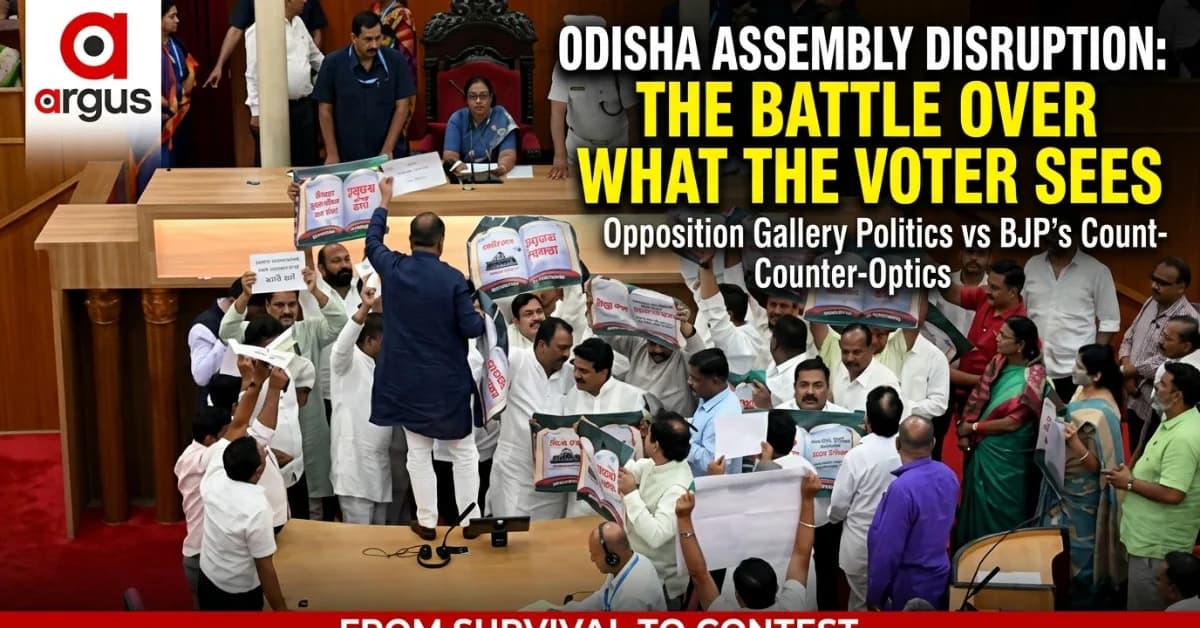
That appears to be the emerging political-strategic contest inside the Odisha Assembly: the Opposition seeking to convert repeated disruptions into an image of an administration under pressure, while the BJP government, after an initial period of defensive floor management, is increasingly trying to turn those disruptions back into a political liability for the Opposition.
The significance lies in the timing.
The BJP government completed its first year in June 2025. By the second half of 2025, the BJD and Congress had moved from testing the new government's floor management to increasingly aggressive protests around issues with immediate public resonance – from Women Crime, fertilizer availability then to textbook errors and mineral taxation. By the September 2026 Monsoon Session, the confrontation had acquired a more institutionalised character, with the first two days witnessing disruption over textbook errors and MMDR.

📱 Get Argus News App
✨The political calculation behind such disruption is not necessarily confined to stopping legislation. In a majority government, bills can eventually be passed despite walkouts or protests. The larger contest is over optics, news cycles and the public perception of governance.
And that is precisely where the BJP's approach appears to have changed.
The honeymoon is over – and so is the Opposition's restraint
The first phase of the BJP government's tenure was marked by an Opposition still adjusting to a historic change in Odisha's political power structure.
After 24 years of BJD rule, the BJP came to power in June 2024. The first year therefore carried a natural political transition period. But by 2025, the Opposition had a different incentive: to demonstrate that the new government was no longer entitled to a "honeymoon" with the electorate.
The September 2025 Monsoon Session became an important marker.
The fertilizer issue provided the Opposition with an unusually potent political instrument because it connected legislative confrontation directly with farmers. Of the six scheduled working days, three were substantially disrupted by protests. The message the Opposition wish to send around: a government that had campaigned heavily on development and governance was being confronted over an issue affecting the rural economy.
The optics were therefore larger than the immediate legislative issue.
The Opposition's gallery politics
The emerging Opposition strategy can be understood through three simultaneous objectives.
1. Convert individual failures into a government-wide narrative
A fertilizer shortage, textbook printing error or disagreement over mineral taxation is an individual policy or administrative issue.
But an Assembly protest can attempt to transform it into something broader:
administrative failure → Opposition protest → repeated disruption → media coverage → perception of governance failure.
That is the political communication chain.
For the BJD and Congress, issues affecting farmers, students and Odisha's mineral interests offer particularly useful platforms because they can be communicated beyond the Assembly's political audience.
The objective is not necessarily to prove that every government action has failed. It is to repeatedly place the government on the defensive.
2. Own the news cycle
A functioning Assembly produces debates, answers, committee work, bills and government announcements.
A disrupted Assembly produces pictures.
Members in the well, placards, slogans, walkouts and adjournments are inherently more television-friendly than lengthy legislative debates.
That creates the second layer of the strategy: the House becomes a stage for political communication outside the House.
For an Opposition trying to rebuild its electoral narrative after losing power, this distinction matters.
3. Attack the perception of administrative grip
There is another political message embedded in repeated disruptions.
The BJP inherited a legislative environment in which the previous government had operated with considerable numerical dominance and organisational control. The Opposition can therefore use repeated adjournments to ask a much broader question:
Can the new government manage the House as effectively as it claims to manage the State?
That is why floor management itself becomes a political story.
2025: BJP's first response was endurance
The BJP's response during 2025 was substantially different from what is being seen now.
The government was still developing its legislative-floor machinery. Its principal objective appeared to be ensuring that legislative business was completed despite confrontation.
During the prolonged Budget Session, the government relied on procedural tools, including suspension of protesting Congress MLAs, while the Speaker's office became central to restoring order.
The government also resorted to an extraordinary overnight legislative sitting lasting around 12.5 hours to complete important legislative and budgetary business.
That approach had one clear objective:
get the government's legislative work done, regardless of the Opposition's tactics.
It was a survival-and-delivery model.
But politically, it had a limitation.
Every prolonged disruption still gave the Opposition visual and media space.
2026: BJP changes the grammar of floor management
The significant change in 2026 is therefore not simply that the BJP has become more combative.
It is that the treasury benches appear to have recognised that remaining silent while the Opposition controls the visual narrative can itself become a political disadvantage.
The strategy has consequently moved towards pre-emptive preparation, coordinated responses and immediate counter-messaging.
Closed-door legislative party meetings before the session, allocation of specific subjects to ministers and MLAs, and instructions to directly respond to Opposition charges indicate a more structured approach.
The underlying principle is simple:
Do not allow an Opposition protest to become the only version of the story.
From “survive the disruption” to “contest the optics”
This marks the most important tactical evolution.
|
Legislative politics |
2025 BJP approach |
2026 BJP approach |
|---|---|---|
|
Primary objective |
Complete government business |
Contest the political narrative |
|
Response to disruption |
Wait, adjourn, suspend if necessary |
Immediate counter-response |
|
Preparation |
Reactive |
Pre-session strategic preparation |
|
Opposition allegations |
Primarily defended |
Countered with documents/data |
|
Media strategy |
Legislative work first |
Legislative work + narrative response |
|
Political calculation |
Floor survival |
Floor + public perception |
The distinction is important.
A government can win every vote in the Assembly and still lose the day's political narrative.
The BJP appears increasingly conscious of that second battlefield.
“Facts over fiction”: the new counter-optics
The mining-related confrontation around the Mines and Minerals (Development and Regulation) Amendment Act, 2026, illustrates this shift.
When the Opposition raised questions over Odisha's interests and alleged erosion of the State's authority, the BJP did not simply allow the issue to remain framed through the Opposition's protest.
The treasury benches sought to respond through legal provisions, official records and institutional material.
That is a fundamentally different political technique from simply saying that the Opposition is obstructing the House.
The message becomes:
“Here is the Opposition's allegation; here is the document; now judge the difference.”
That approach seeks to move the political contest from slogans to evidence.
Whether the public accepts that counter-narrative is ultimately a political question. But strategically, it prevents the Opposition from enjoying an uncontested information monopoly.
Textbook controversy: counter-protest replaces passive defence
The textbook controversy provides another example.
The Opposition's demand for accountability from the School and Mass Education Minister gave it a straightforward political frame: errors in school textbooks were presented as evidence of administrative failure.
The BJP's response has been more confrontational than in the earlier phase.
Instead of allowing the Opposition's protest to dominate the visual narrative, treasury-bench members have sought to contest the charge on the floor itself and communicate their version rapidly outside the Assembly.
This is controlled confrontation rather than uncontrolled disruption.
The government is not attempting to prevent the Opposition from protesting. It is attempting to ensure that the protest does not automatically translate into the Opposition's preferred political message.
The numbers tell a story – but the interpretation needs caution
The available session pattern indicates an escalation in disruption:
|
Period |
Legislative disruption pattern |
|---|---|
|
First half of 2025 |
Around five days substantially affected by Opposition protests during the longer Budget Session |
|
September 2025 |
Three of six scheduled days substantially disrupted |
|
September 2026 |
First two consecutive days disrupted |
That distinction is critical.
Disruption is evidence of a political strategy; it is not evidence by itself of electoral impact.
What it does demonstrate is a change in the character of legislative politics.
The Opposition is increasingly using the Assembly as a public political platform, while the government is learning to use the same platform to contest the Opposition's framing.
Why the BJP's learning curve matters
The first BJP government in Odisha entered office without the institutional experience of running the State's Assembly machinery after 24 years in Opposition.
The initial learning curve was therefore inevitable.
The events of 2025 exposed one problem: procedural control could keep government business moving, but it could not necessarily control the political imagery surrounding the session.
The response in 2026 is consequently more sophisticated.
The BJP's emerging formula is:
prepare before the session → anticipate the Opposition's issues → equip ministers with facts → answer immediately → take the counter-message outside the House.
This is not merely floor management.
It is political narrative management through legislative proceedings.
The real contest: who defines what the disruption means?
That makes the Odisha Assembly's current confrontation more interesting than the individual issues triggering the protests.
For the Opposition, disruption can be presented as evidence of accountability pressure: the government is being forced to answer.
For the BJP, the same disruption can be presented as evidence of political theatre: the Opposition has no substantive alternative and therefore prefers obstruction.
Neither interpretation is automatically established by the disruption itself.
The emerging formula
Opposition: Issue → Protest → Disruption → Optics → Anti-incumbency narrative
BJP: Issue → Counter-data → Floor response → Media response → Counter-optics
The political contest has thus moved beyond who can force an adjournment.
It is increasingly about who can explain the adjournment to the voter outside the Assembly.
And that is why the second year of the BJP government could prove significantly different from its first: the Opposition has moved beyond testing the new government, while the government itself appears to have moved beyond merely defending itself.
The
next phase of Odisha's Assembly politics may therefore be less about
whether the House is disrupted – and more about who
ultimately owns the meaning of that disruption.
Also Read: EXCLUSIVE | BJP State-Level Rejig: Why D. Purandeswari Is Back in Odisha, and What Her New Partner Swadesh Singh Brings to the Table
Related Topics
Explore more stories