



Amit Shah's Odisha Visit: BJP's Big Farmer Outreach Through Two Mega Projects| Special Political Analysis
Key Points
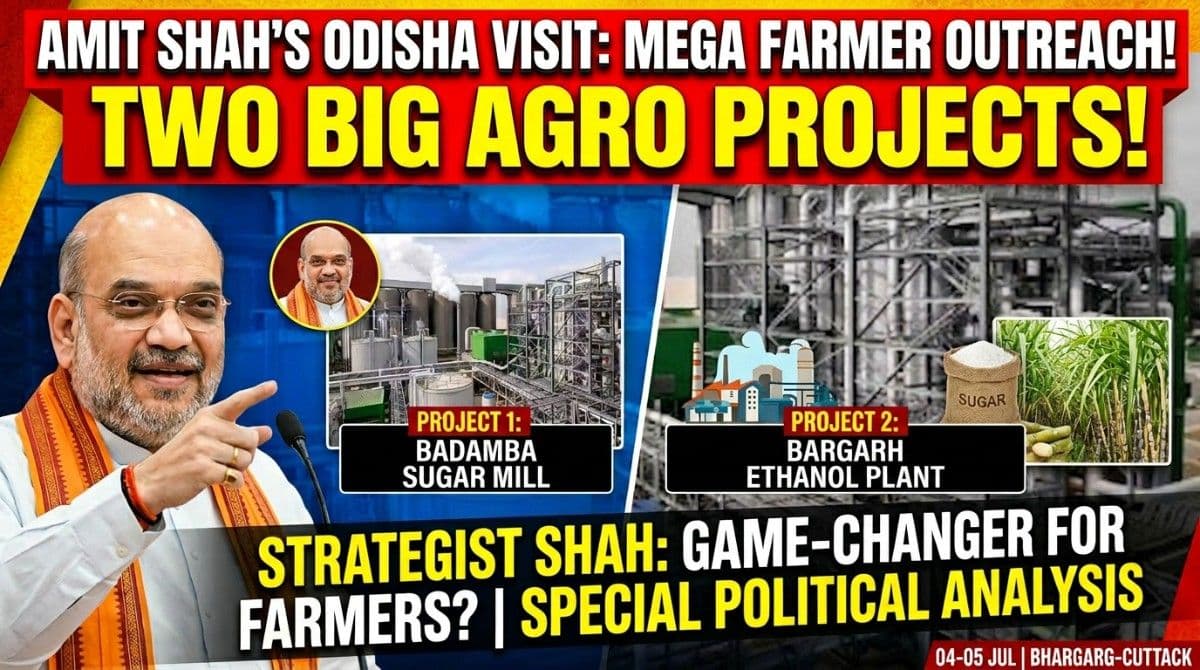
Bhubaneswar: Union Home Minister Amit Shah, widely regarded as the Bharatiya Janata Party's principal election strategist, will undertake a two-day visit to Odisha on July 4 and 5, officially to dedicate two major agro-industrial projects to the state.
On July 4, Shah will inaugurate Bharat Petroleum Corporation Limited's (BPCL) Rs1,775-crore Integrated Bio-Ethanol Refinery at Baulsingha in Bargarh district, before offering prayers at the revered Samaleswari Temple in Sambalpur.
On July 5, after arriving in Bhubaneswar, he will travel to Badamba in Cuttack district to participate in the revival and modernization programme of the Badamba Cooperative Sugar Mill, whose revival foundation stone he himself had laid on March 6, 2026.
Officially, both engagements are about agriculture, bio-energy and farmer welfare. Politically, however, the itinerary carries a far wider electoral message.

📱 Get Argus News App
✨In Politics, Projects Are Also Political Messaging
In Indian politics, particularly under the BJP's electoral model, development projects rarely remain confined to infrastructure alone. Every inauguration is carefully aligned with a target constituency.
Seen through that prism, Amit Shah's Odisha itinerary appears less about inaugurating two industrial units and more about reassuring the state's largest electoral constituency – farmers – that the BJP's "double-engine government" intends to place agriculture at the centre of its governance agenda.
The timing reinforces that perception.
The visit comes almost exactly as the first BJP government in Odisha completes two years in office, making Shah's visit politically significant. Rather than announcing urban infrastructure or industrial investments, the BJP's chief strategist has chosen two projects that directly touch rural livelihoods, agricultural incomes and value addition.
The symbolism is difficult to ignore.
Why Farmers Matter Most in Odisha Politics
The political importance of farmers in Odisha extends far beyond rural demographics.
Nearly 60-62% of Odisha's workforce continues to depend on agriculture, either as cultivators or agricultural labourers. Together, they constitute the state's single largest consolidated voting bloc.
Unlike many states where urban issues increasingly dominate elections, Odisha's electoral outcomes continue to be decisively shaped by rural voting patterns.
Three major agrarian clusters determine this influence.
The western belt comprising Bargarh, Sambalpur, Subarnapur, Balangir and Kalahandi remains the state's politically most organised farming region, driven by canal irrigation from the Hirakud system and strong MSP-centric farmer movements.
The coastal agrarian districts – including Cuttack, Jajpur, Ganjam, Balasore and Bhadrak – contain the state's largest absolute number of farmer voters because of their dense rural populations.
Meanwhile, the tribal interior comprising Mayurbhanj, Koraput, Nabarangpur and adjoining districts records some of Odisha's highest proportional dependence on agriculture, often exceeding 70 percent of the electorate.
Collectively, these three belts decide the political complexion of Odisha.
The Vote That Changed Odisha's Politics
The 2024 elections demonstrated the decisive role played by these agrarian regions.
The BJP captured 20 of Odisha's 21 Lok Sabha seats while securing 78 Assembly seats, ending the BJD's uninterrupted 24-year rule.
The verdict was driven substantially by farmer-dominated constituencies.
In the western agrarian belt, BJP swept the Lok Sabha seats of Bargarh, Sambalpur, Balangir and Kalahandi.
Across the coastal farming districts, it won Cuttack, Aska, Berhampur, Balasore, Bhadrak and Jajpur parliamentary constituencies.
Even in the tribal agrarian heartland, BJP secured Mayurbhanj and Nabarangpur, while Koraput remained the only Lok Sabha constituency outside BJP's fold.
The Assembly picture reflected the same trend.
In Bargarh district, BJP captured Bargarh, Attabira, Bhatli and Bijepur, retaining dominance across one of Odisha's strongest paddy-producing regions.
In coastal Odisha too, BJP expanded significantly into rural constituencies that had traditionally remained under BJD influence.
For the BJP, therefore, the farmer vote did not merely contribute to victory – it became one of the principal pillars that brought the party to power for the first time in Odisha.
Against this backdrop, Amit Shah's itinerary appears carefully calibrated to reassure precisely that constituency which powered the party's historic mandate.
Project One: Bargarh Ethanol Plant – Converting Agricultural Waste into Farmer Income
The first stop of Shah's visit is the Rs1,775-crore BPCL Integrated Bio-Ethanol Refinery at Baulsingha.
The project is among eastern India's most advanced biofuel facilities.
Built under the Pradhan Mantri JI-VAN Yojana, the refinery combines First Generation (1G) and Second Generation (2G) ethanol production with a total capacity of 200 kilolitres per day.
Its significance lies less in ethanol production and more in its procurement model.
The refinery will annually consume nearly two lakh tonnes of rice straw, material that farmers previously considered agricultural waste.
Instead of burning post-harvest residue, farmers across Bargarh, Sambalpur, Balangir and Kalahandi will now have an institutional buyer.
For western Odisha's paddy farmers, this effectively creates a second revenue stream from fields that previously generated income only through grain sales.
The project also requires approximately 230 tonnes of broken and surplus rice grains daily for its grain-based ethanol unit.
This is particularly significant for districts like Balangir, where weather-damaged or broken grain often fetches distress prices.
The refinery provides a stable industrial market for such produce, protecting farmers from losses during adverse harvest seasons.
The benefits extend beyond procurement.
Collection, baling, storage and transportation of biomass are expected to create nearly 1,200 direct and indirect employment opportunities, strengthening rural logistics networks across western Odisha.
Politically, the message is unmistakable.
Instead of limiting support to MSP procurement, the BJP seeks to demonstrate that farmers can earn from every component of agriculture, including crop residue previously treated as waste.
Project Two: Badamba Sugar Mill — Reviving an Entire Rural Economy
If the ethanol refinery represents the future of bio-energy, the Badamba Sugar Mill revival seeks to restore a lost chapter of Odisha's agrarian economy.
Once the backbone of sugarcane cultivation across undivided Cuttack district, the cooperative mill ceased operations in 2011, triggering a gradual collapse of cane cultivation across Badamba, Narasinghpur, Tigiria and Banki.
The consequences were severe.
Farmers either abandoned sugarcane altogether or shifted to paddy and smaller cash crops.
Others resorted to producing jaggery locally because transporting cane to distant mills became economically unviable.
The numbers illustrate the decline.
Cuttack district's sugarcane acreage fell from nearly 5,450 hectares in 2004-05 to around 2,630 hectares within a few years, before shrinking further over the next decade.
Historically, during Odisha's sugarcane peak in the 1980s, nearly 6-8 percent of farming households in undivided Cuttack cultivated cane as their principal cash crop.
The closure of cooperative mills dismantled that ecosystem.
The revival attempts to rebuild it.
Under an agreement with Indian Potash Limited (IPL), the defunct mill is being transformed into a modern integrated agro-industrial complex centred around a 3,500-tonnes-per-day sulphur-less sugar plant.
The facility will also house a 16 MW co-generation power plant, a 10-tonnes-per-day Bio-CNG unit, and a modern cold storage facility, creating a diversified rural processing hub rather than a conventional sugar mill.
Why the Cold Storage Matters Politically
Among the various components of the Badamba project, the cold storage facility may ultimately prove as significant as the sugar mill itself.
Unlike conventional cold storages that operate independently and pass high electricity costs to farmers, this facility will draw subsidised power from the mill's own 16 MW bagasse-based co-generation plant.
The result is expected to be significantly lower storage costs.
For vegetable growers in Badamba, Narasinghpur, Tigiria, Banki and adjoining riverine areas, the facility offers something they have historically lacked – a local mechanism to prevent distress sales during periods of excess production.
Farmers cultivating tomatoes, chillies, pointed gourd, potatoes and other perishable vegetables will be able to store produce and sell when prices stabilise rather than immediately after harvest.
Expected to have a storage capacity of 5,000-10,000 metric tonnes, the facility broadens the project's benefits beyond sugarcane growers.
The government estimates nearly 10,000 sugarcane farmers will directly benefit from the revived mill, while thousands of additional vegetable-producing households stand to gain from the cold-chain infrastructure.
The Larger Political Message
Viewed together, the two projects reveal a common political theme.
One targets Odisha's western paddy belt.
The other reaches the coastal agrarian region.
One monetises rice straw.
The other revives sugarcane while supporting vegetable farmers.
One promotes biofuels.
The other integrates sugar, Bio-CNG, co-generation and cold-chain logistics.
Both focus squarely on raising farm incomes rather than merely expanding agricultural production.
That convergence explains why Amit Shah's itinerary appears politically significant.
As the BJP government completes two years in Odisha, the party's principal strategist has chosen to engage not with industry, urban infrastructure or administration, but with projects directly linked to the state's largest voting bloc.
The underlying political message is straightforward.
The BJP appears keen to remind Odisha's farmers that the electoral support they extended in 2024 is being reciprocated through investments designed to improve farm incomes, create rural employment and rebuild agricultural value chains.
How the projects ultimately deliver their promised economic transformation will unfold over time.
But as a
piece of political signalling, Amit Shah's Odisha visit sends a clear message: the
BJP intends to retain farmers at the centre of its electoral and governance
strategy, reinforcing the proposition that the "double-engine
government" will continue to translate political support into
farmer-centric development.
Also Read: Amit Shah Orders Mandatory ED Crackdown on Drug Cartels to Crush their Finances; New Doctrine Revealed| Big Breaking