



Amit Shah Orders Mandatory ED Crackdown on Drug Cartels to Crush their Finances; New Doctrine Revealed| Big Breaking
Key Points
* Latest data reveals a dramatic structural shift as laboratory-produced synthetic drugs like ATS and Mephedrone rapidly outpace traditional plant-based narcotics.
* India deploys advanced AI, blockchain analytics, and cyber tools to dismantle darknet marketplaces and cryptocurrency-enabled money laundering networks.
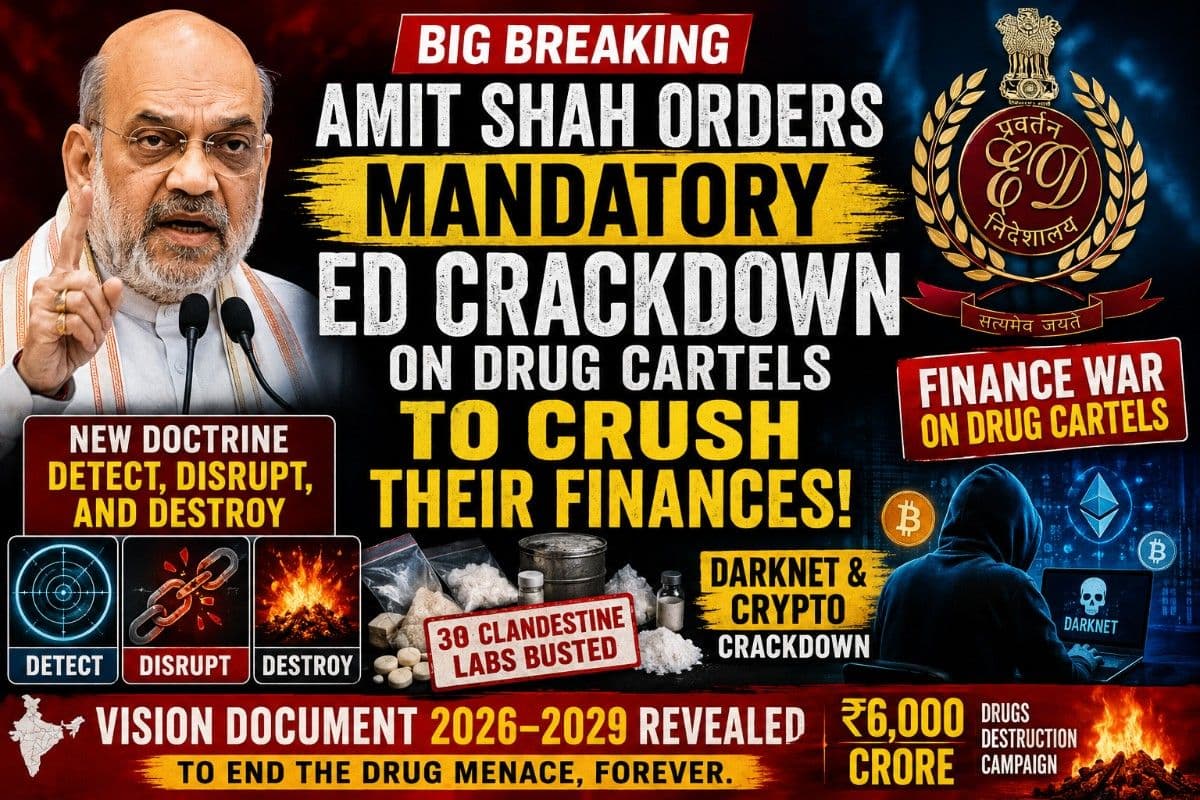
Bhubaneswar: India is overhauling its entire anti-drug enforcement strategy to confront a dramatic, tech-driven transformation in its narcotics landscape. With highly potent synthetic drugs rapidly replacing traditional plant-based substances as the country's biggest narco threat, Union Home Minister Amit Shah has unveiled an aggressive three-year Vision Document on Drug Control (2026–2029).
Released during the 10th Apex Level Meeting of the Narco-Coordination Centre (NCORD), this new roadmap signals India's biggest enforcement shakeup in recent history. The government is officially abandoning its traditional seizure-centric model to adopt a network-based doctrine: "Detect, Disrupt, and Destroy."
The FinTech War: Mandatory ED Action & Darknet Crackdowns
The most significant institutional reform in the new vision document is the mandatory integration of financial investigations into all major NDPS cases.

📱 Get Argus News App
✨- Targeting the Money Trail: The Enforcement Directorate (ED) will now work directly alongside narcotics agencies to trace, seize, and freeze proceeds of crime. Officials believe stripping cartels of their cash flow will weaken syndicates far more effectively than isolated drug seizures.
- Combating Digital Trafficking: Recognizing that modern cartels rely heavily on technology, the government will deploy blockchain analytics, artificial intelligence, and specialized cyber tools to dismantle darknet drug markets and cryptocurrency-enabled money laundering.
What is Amit Shah’s ‘Destroy’ Plan
The big strategy behind UHM Amit Shah making ED financial investigations under the Prevention of Money Laundering Act (PMLA) mandatory, the government is shifting the battlefield:
- Attacking the Sovereign Vulnerability: Drug lords do not fear losing a shipment; they fear losing their wealth. Forcing a concurrent financial probe into major drug busts means law enforcement can systematically freeze bank accounts, seize real estate, and liquidate shell companies.
- Targeting the "Untouchables": The actual kingpins and financiers behind synthetic drug networks never touch the physical contraband. They exist purely in the financial layer. Mandatory ED involvement forces a paper-trail (or digital-trail) investigation that can climb the ladder to reach cartel leadership.
- Permanence of Disruption: Standard NDPS arrests often end in the accused securing bail or managing logistics from inside prisons using hidden funds. Ruthless asset forfeiture ensures that even if an offender goes to jail, their operational network outside is financially paralyzed.
Why the Union Home Ministry has launched this new doctrine has been reasoned below.
The Synthetic Explosion: NCB Report Exposes Alarming Shift
Data from the newly released National Crime Records Bureau (NCB) Annual Report 2025 paints an alarming picture of an evolving domestic market. While traditional narcotics like opium and cannabis still dominate total volume, synthetic drugs are skyrocketing because they can be manufactured year-round in hidden labs without relying on crop cycles.
- ATS Seizures Skyrocket: Amphetamine-Type Stimulants (ATS) seizures exploded from just 387 kg in 2021 to an unprecedented 8,211 kg in 2024, remaining at an extraordinarily high 3,269 kg in 2025.
- Clandestine Domestic Labs: India is transitioning from a mere transit corridor to an active manufacturing zone. Enforcement agencies dismantled 30 clandestine synthetic drug laboratories over the past year—more than the previous three years combined. This rise is mirrored by a sharp increase in the illegal diversion of key precursor chemicals like Acetic Anhydride.
- Traditional Routes Resilient: Conventional trafficking pressures remain high. Opium seizures hit 8,632 kg in 2024 before marginally declining to 8,094 kg in 2025. Meanwhile, heroin smuggling continues to fluctuate as cartels use advanced methods, such as drone deliveries, to drop pre-ban Afghan stockpiles across India's western border states.
Enforcement Realities: State Police Bear the Burden
The NCB report highlights a stark reality in day-to-day enforcement: State Police forces account for 94.8% of all registered NDPS cases, followed by State Excise departments at 4.5%.
Specialized central agencies (NCB, DRI, Customs, and CBN) handle less than 1% of total cases, focusing instead on high-level, intelligence-driven operations against international and interstate cartels. To bridge this gap, the Centre has directed all states to convert temporary Anti-Narcotics Task Forces (ANTFs) into permanent, fully equipped operational units.
Securing Borders and Saving Youth
The comprehensive strategy pairs ruthless enforcement with societal rehabilitation:
- High-Tech Borders: Land, coastal, and airport routes will receive major surveillance upgrades, including integrated drone technology and community-based policing to stop drugs before they enter the domestic market.
- Compassion for Victims: While showing zero tolerance for traffickers, the document prioritizes the youth. The government will establish dedicated "Drug-Free Zones" around educational institutions and aggressively expand de-addiction and counseling infrastructure.
- Rs6,000 Crore Destruction Campaign: Marking the launch of the roadmap, the government initiated an Online Drugs Disposal Fortnight Campaign to publicly destroy 2,09,500 kilograms of seized narcotics valued at over Rs6,000 crore, ensuring transparent logistics and preventing recycled drugs from leaking back onto the streets.
With the
"Detect, Disrupt, and Destroy" strategy targeting everyone from
chemical suppliers and darknet operators to cartel financiers, India has
officially signaled its intent to wage its most aggressive and unified
offensive against organized crime to date.
Also Read: Odisha No Longer Just India's Cannabis Capital: A Silent Synthetic Drug Market is Taking Root | Exclusive
Related Topics
Explore more stories