



World Environment Day 2026: Odisha in Top-5 Environmental Performer Still Battling Extreme Heat, Dirty Air| Special Feature
Key Points
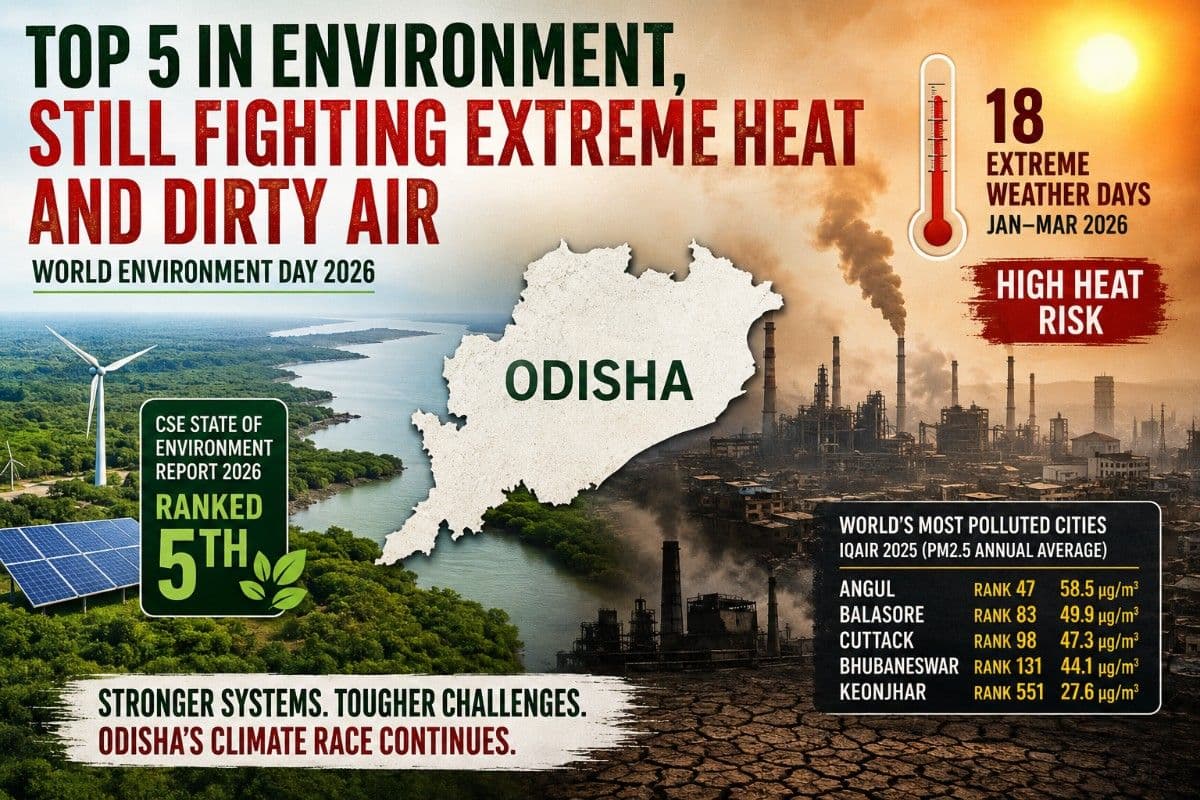
* The state recorded 18 extreme weather days in January–March 2026 and remains in the higher heat-risk category.
* While climate governance and disaster preparedness have improved dramatically since the 1999 Super Cyclone, air pollution in cities like Angul, Cuttack and Bhubaneswar remains a major concern.
Bhubaneswar: Few Indian states tell the story of climate change as vividly as Odisha. Over the last three decades, the state has transformed from being a disaster-prone coastal region into one of India's most closely watched laboratories for climate adaptation. Yet, even as Odisha earns recognition for its environmental governance, fresh data show that the battle against climate and pollution risks is far from won.
The contradiction is striking.
The Centre for Science and Environment's (CSE) State of Environment Report 2026 ranks Odisha among the country's top five states in overall environmental performance, reflecting sustained investments in disaster preparedness, waste management, climate budgeting, forest protection and renewable energy initiatives.
At the same time, Odisha remains among India's most climate-stressed states.

📱 Get Argus News App
✨Data from CSE's climate vulnerability indicators show Odisha recorded 18 extreme weather days between January and March 2026, placing it among the states witnessing frequent weather disruptions. The report's heat-related indicators also place Odisha in the higher-risk category, underlining how rising temperatures continue to threaten public health, agriculture and livelihoods.
For a state that endured the devastating 1998 heatwave and the 1999 Super Cyclone, these numbers are more than statistics. They are reminders of why Odisha began investing in climate resilience.
The State That Learned From Disaster
Environmental experts often point to Odisha's response to successive climate shocks as a model of institutional learning.
The 1998 heatwave exposed the state's vulnerability to rising temperatures. A year later, the Super Cyclone claimed thousands of lives and reshaped the state's development priorities.
Since then, Odisha has built one of India's most sophisticated disaster management architectures. Cyclone shelters, early warning systems, evacuation protocols, climate-resilient infrastructure and dedicated disaster funds have significantly reduced mortality from extreme weather events.
The state's climate strategy has gradually expanded beyond disaster response to include environmental governance, renewable energy, urban waste management and climate budgeting.
That transition is reflected in Odisha's strong performance in the State of Environment Report 2026.
Air Pollution Remains Odisha's Weakest Link
Yet, while Odisha scores well on several environmental governance parameters, air quality remains a major concern.
The latest global assessment from IQAir paints a sobering picture of pollution across the state's industrial and urban centres.
Among the
9,446 cities monitored worldwide, several Odisha cities continue to rank among
the world's most polluted urban locations.
Odisha's Most Polluted Cities In World 2025 List
| City |
Global Rank |
PM 2.5 Average |
| Angul |
47 |
58.5 μg/m³ |
| Balasore |
83 |
49.9 μg/m³ from 70μg/m³ in 2021 (Improved significantly) |
| Cuttack |
98 |
47.3 μg/m³ from 16.4μg/m³ in 2021 (Precariuously Worsened) |
| Bhubaneswar |
131 |
44.1 μg/m³ |
| Keonjhar |
551 |
27.6 μg/m³ |
| Rourkela (Steel City) |
64 |
53 μg/m³ from 51 μg/m³ in 2024 |
Every one of
these cities exceeds the World Health Organization's recommended annual PM2.5
guideline of 5 μg/m³, in some cases by nearly twelve times.The
concentration of heavy industries, mining activity, coal-based power generation
and rapid urbanisation continues to exert enormous pressure on Odisha's air
quality profile.
The list shows how major cities and industrial epicentres of State figuring in the world's top 100 polluted cities from a tally of 9,964 cities, globally.
The Industrial Belt Challenge
The state's biggest pollution hotspots largely overlap with its economic growth centres.
Angul, home to major thermal power and aluminium industries, remains Odisha's most polluted city. Barbil continues to face mining-linked dust emissions, while urban centres such as Cuttack and Bhubaneswar are increasingly affected by vehicular emissions, construction activity and urban expansion.
The data illustrate a central policy dilemma: Odisha's industrial growth engine is also among its biggest environmental stressors.
Why Odisha Still Ranks High Despite Climate Risks
The answer lies in the distinction between environmental governance and environmental outcomes.
Odisha's high ranking reflects the strength of systems it has built to confront environmental challenges rather than the complete elimination of those challenges.
Several initiatives have contributed to this recognition:
1. Climate Budgeting Goes Mainstream
Odisha is among the few Indian states that have institutionalised climate-sensitive budgeting.
Large allocations continue to be directed toward:
- Water resource management
- Coastal protection projects
- Renewable energy expansion
- Disaster risk reduction
- Climate adaptation programmes
This approach enables climate resilience spending to be tracked across departments rather than treated as an isolated environmental expenditure.
2. Strong Disaster Management Framework
The state's disaster preparedness model has become nationally recognised.
The investment is paying dividends. While cyclones continue to strike Odisha's coast, casualties have fallen dramatically compared to historical disasters such as the 1999 Super Cyclone.
3. Waste Management Improvements
The State of Environment Report highlights progress in rural sanitation and solid waste management.
The expansion of waste segregation systems, village-level waste processing infrastructure and efforts to reduce open burning have helped address one of the longstanding contributors to local air pollution.
4. Digital Pollution Monitoring
The deployment of Online Continuous Emission Monitoring Systems (OCEMS) across major industries has improved regulatory oversight.
Real-time monitoring now allows pollution control authorities to track emissions more effectively and identify violations faster than in the past.
The Emerging Heat Challenge
Perhaps the most concerning signal from the latest environmental indicators is the growing heat burden.
The CSE data show Odisha's heat vulnerability remains significant despite progress in other sectors.
The state's ranking on heat-related indicators reflects a broader trend visible across eastern and central India, where rising temperatures are increasing the frequency, intensity and duration of heat stress events.
For Odisha, this challenge is particularly important because:
- Heatwaves are arriving earlier.
- Urban heat island effects are intensifying.
- Electricity demand for cooling is rising.
- Agricultural productivity faces increasing stress.
- Public health risks are expanding.
The state's experience since the late 1990s suggests that climate adaptation can reduce vulnerability, but adaptation alone cannot fully offset the pace of warming.
A Climate Success Story Still Under Construction
Odisha's environmental story in 2026 is neither one of failure nor of complete success.
The state has emerged as one of India's most proactive administrations in preparing for climate risks. Its Top-5 ranking in the State of Environment Report validates decades of policy evolution that began after the twin shocks of the 1998 heatwave and the 1999 Super Cyclone.
Yet the same state continues to grapple with severe air pollution in industrial hubs, recurring extreme weather events and growing heat stress.
That is Odisha's climate paradox.
The state's governance systems are increasingly becoming stronger, but the environmental pressures they are designed to manage are also intensifying.
As the world marks World Environment Day 2026, Odisha offers an important lesson for India: climate resilience is not a destination. It is a continuous race between improving preparedness and worsening environmental risks. In that race, Odisha may be ahead of many states, but the finish line remains far away.Also Read: Weather Update / Heatwave Alert: Odisha May Sizzle at Over 47°C Till June 14 Despite Kerala Monsoon Onset, Warn Weather Models| Exclusive