



Why SC Defers Odisha DGP Matter to Sept 2: Know How SG Tushar Mehta Outlined Odisha Govt’s Stand| Exclusive
Key Points
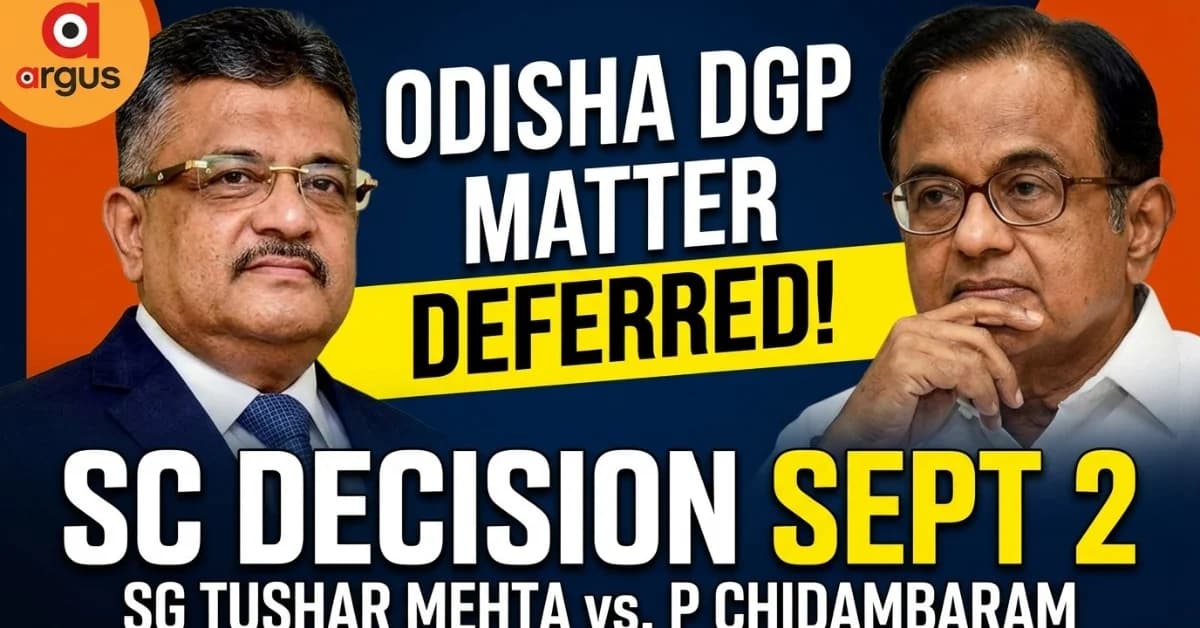
Bhubaneswar: The anxiety over Odisha’s DGP appointment lingers as the Supreme Court Bench led by Chief Justice Surya Kant deferred the hearing on the matter to September 2, 2026.
As the CJI-led three-judge Bench comprising Justices Joymalya Bagchi and V Mohana sat to hear the matter on Tuesday, Solicitor General Tushar Mehta appeared for the Odisha government and informed the court that the State had filed its response to the PIL challenging the DGP selection process.
The State’s stand, as outlined by the Solicitor General, is that the promotions of senior IPS officers are routine administrative and service matters, and that Odisha is within its administrative rights to send a fresh proposal to the Union Public Service Commission (UPSC) containing officers who meet the prescribed rank and eligibility criteria.
Why The Deferment?

📱 Get Argus News App
✨The deferment came as the Supreme Court wanted the State’s detailed response to be properly available on the court record before the Bench proceeds with the substantive hearing. Although Solicitor General Tushar Mehta informed the Bench that Odisha had already filed its counter, the CJI indicated that the response needed to be on the physical record and examined before the court takes the matter forward.
In other words, Tuesday’s hearing did not settle the contentious question of whether Odisha manipulated the DGP selection process. Instead, the September 2 hearing is now set to become the next major legal checkpoint in a controversy that has already brought the State government’s handling of its DGP panel under intense judicial scrutiny.
As the Solicitor General today mentioned that Odisha has filed its full reply on the DGP issue, it is therefore important to take a glance at what the State government’s defence could be against the allegations raised by former Union minister and senior advocate P Chidambaram.
Odisha’s Defence
The legal battleground essentially revolves around one question: Did Odisha merely follow the latest UPSC framework while updating its eligible pool, or did it use administrative manoeuvres to alter the field of contenders for DGP?
The distinction becomes sharper when the 2006 Prakash Singh police reform judgment is compared with the new UPSC guidelines issued in January 2026.
|
Feature |
Prakash Singh Mandates, 2006 |
New UPSC Rules, January 2026 |
|
Primary objective |
Insulate police leadership from political interference and ensure stability of tenure |
Tighten empanelment timelines and plug procedural loopholes |
|
Residual service |
Focused on reasonable tenure, later crystallised around the principle of a two-year tenure |
Minimum six months’ residual service at the time of vacancy |
|
Shortlisting |
State sends names of eligible senior officers; UPSC recommends a panel of three |
Three-name shortlist retained, but eligibility is more tightly regulated by rank/pay level |
|
Submission timeline |
No rigid quantified deadline linked to retirement |
Proposal to be sent at least three months before retirement of incumbent DGP |
|
Delay in submission |
No explicit Supreme Court permission mechanism for delayed panels |
Clause (xii), Section 5 requires Supreme Court permission where the prescribed process is delayed |
|
Acting DGP |
Temporary/interim arrangements strongly discouraged |
Acting DGP arrangement barred, except in sudden death or emergency vacancies |
|
Tenure |
Minimum fixed tenure of two years |
Two-year fixed tenure retained and protected against arbitrary premature removal |
The January 2026 framework thus moves beyond the broad principles of Prakash Singh and introduces quantified eligibility and procedural safeguards.
The most consequential changes for Odisha are the six-month residual-service test, three-month advance submission requirement and restrictions on delay and acting DGP arrangements.
Odisha Pass UPSC January 2026 Guideline Test?
This is where the Odisha government can build its principal defence.
The State can argue that its actions were driven by the new UPSC framework itself, rather than by any attempt to manipulate the selection. The six-month residual-service requirement, for instance, meant that not every senior DGP-rank officer could automatically remain in contention.
Odisha could also contend that expanding the pool was not an attempt to dilute seniority but an effort to place all technically eligible officers before the UPSC, allowing the Commission to exercise its statutory role of shortlisting three names.
The State’s counter-affidavit is expected to emphasise that expanding the panel from three to 11 did not amount to violating the rules.
Instead, it gave the UPSC a wider pool of officers from which to assess merit and suitability.
The government can further argue that promotion of an ADGP to DGP rank was a routine service matter, carried out under normal administrative procedures and not to pre-empt any judicial order.
That defence, however, faces its biggest test on the chronology of events.
The Odisha Case: April 2026 To August 2026
The sequence of events explains why the Odisha DGP appointment has become legally peculiar.
April 2026: Odisha initially sent a panel of three DGP-rank officers to the UPSC.
At that point, Odisha had four officers in the DGP rank/Level-16 category: Sudhanshu Sarangi, 1990 batch; Susanta Nath, 1993 batch; Vinaytosh Mishra, 1993 batch; and R P Koche, 1993 batch.
Why, then, were only three names sent?
The State could argue that Vinaytosh Mishra did not meet the six-month residual-service requirement because of his retirement schedule. The new UPSC framework specifically requires an officer to have at least six months of residual service at the time of the vacancy.
The UPSC, however, wanted Odisha to expand its pool so that it could exercise its mandate of selecting a panel of three from a sufficiently broad group of eligible officers.
May 2026: Odisha consequently expanded the list from three to 11 officers. The enlarged pool included the three DGP-rank officers along with eight ADG-rank officers from the 1994 to 1996 batches.
August 7: The Odisha government withdrew the integrity certificate of DGP-rank officer Susanta Nath following more recent adverse CBI findings.
That move had a direct consequence: the panel was left with only two DGP-level officers among the names submitted. The UPSC took the position that it could not proceed with the panel in that form, while the eight ADG-rank officers could not simply substitute for DGP-rank officers because they were in the lower pay level (L-15).
August 10: Odisha then elevated two 1994-batch IPS officers, Sanjeeb Panda and Y K Jethwa, to DGP rank.
August 11: Former Union minister P Chidambaram moved the Supreme Court, alleging that the State had manipulated the process and violated the principles laid down in the Prakash Singh judgment.
August 13: The amicus curiae also supported the petitioner's concerns, adding another layer of judicial scrutiny.
The matter was thereafter deferred to August 18 – and Tuesday’s hearing has now been deferred again, this time to September 2.
Why The August 10 Promotions Matter
The most sensitive issue for the Supreme Court will likely be the timing.
Odisha’s possible defence is straightforward: promotion to DGP rank is a routine service matter, and the government cannot be prevented from promoting an eligible IPS officer merely because a DGP selection process is pending.
The State can therefore argue that once the earlier panel became untenable following the withdrawal of Susanta Nath’s integrity certificate, it was administratively necessary to ensure that a sufficient number of officers at the requisite DGP level were available for consideration.
That is consistent with the State's stated position that promotions of senior IPS officers are routine administrative decisions and that the government has the right to submit a fresh proposal containing officers who satisfy the prescribed criteria.
But the petitioner's counterargument is equally sharp: Why were the promotions made immediately before the UPSC meeting?
That is the question which can make the chronology legally significant. The court will have to distinguish between a legitimate administrative exercise and an action that, in effect, changed the composition of the eligible pool at a strategically important moment.
Bottom Line
The Odisha DGP case has therefore acquired a peculiar legal character.
The State's defence is likely to be that it did not manipulate the process; it adapted its panel to the January 2026 UPSC rules, responded to eligibility constraints, withdrew an officer's integrity certificate when adverse CBI findings emerged, and made routine promotions to ensure that eligible DGP-rank officers were available for consideration.
The petitioner's case, however, is that the elevation of two officers immediately before the UPSC meeting – points to an engineered alteration of the selection field.
The Supreme
Court has now deferred the matter to September 2. All eyes will
therefore be on the CJI Surya Kant-led Bench as it examines whether Odisha's
peculiar sequence of administrative decisions amounts to legitimate compliance
with the January 2026 UPSC guidelines, or whether, despite technical
adherence to the new rules, it crosses the line drawn by the Prakash Singh
principles.
Also Read: Odisha DGP Row: What Will Happen on August 18 in Supreme Court? | Exclusive
Related Topics
Explore more stories