



Odisha DGP Row: What Will Happen on August 18 in Supreme Court? | Exclusive
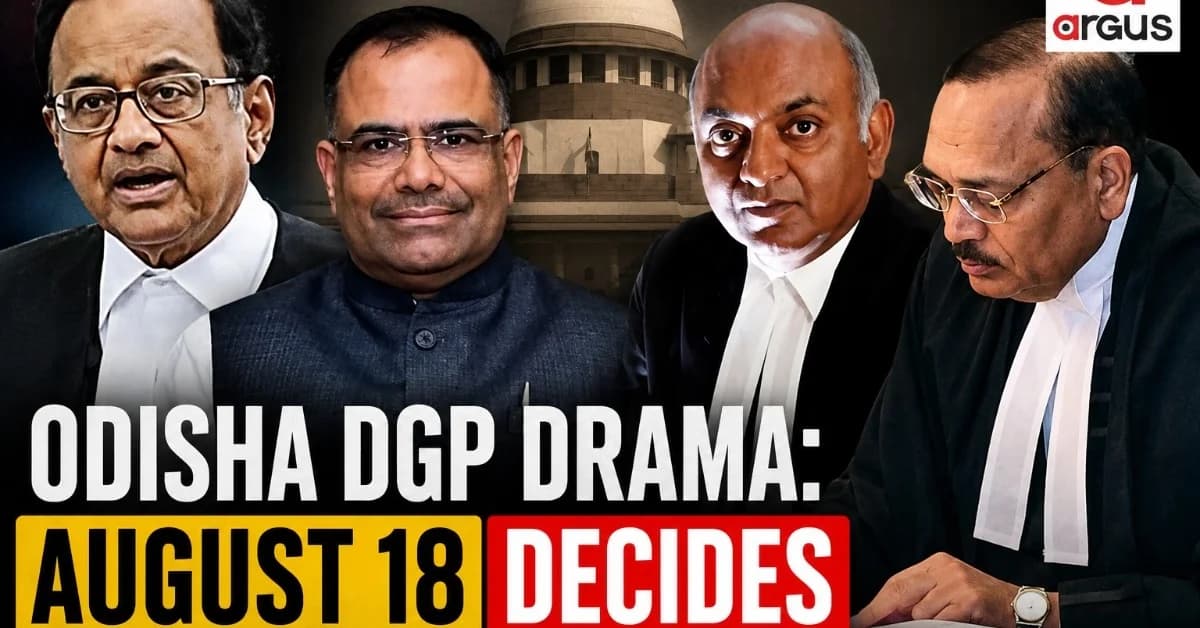
Key Points
- SC stays UPSC’s Odisha DGP selection process till August 18 after Amicus Curiae Raju Ramachandran flags concerns over the State’s last-minute promotions.
- With Khurania retiring on August 16, the DGP pool could effectively narrow to Sudhanshu Sarangi and R.P. Koche if the new promotions are not accepted.
- Supreme Court precedents suggest a genuine shortage of eligible Level-16 officers may permit a two-name panel instead of manufacturing a third candidate.
Bhubaneswar: Odisha’s DGP selection drama has entered a far more consequential phase. With incumbent DGP Y.B. Khurania due to retire on August 16, the question of who will become Odisha’s next police chief seems to have got entangled in legal web.
But one certain impact of SC’s Thursday Judgement is the incumbent DGP YB Khurania is set to continue as acting DGP from Aug 16 till the SC decide the matter on Aug 18.
SC Drama: CJI Bench Puts UPSC on Hold After Amicus Intervention
The case took a dramatic turn on Thursday, August 13. Senior advocate P. Chidambaram told the CJI-led bench that the UPSC was scheduled to meet to finalise the DGP panel and alleged that an ADGP-rank officer had been promoted just a day earlier with the apparent objective of bringing him into the selection pool.

📱 Get Argus News App
✨Odisha’s Advocate General Pitambar Acharya rejected any breach of the Prakash Singh framework and also questioned the maintainability of the PIL, with the bench itself initially expressing doubts because no affected officer had approached the court.
But the turning point came when the bench sought the opinion of Senior Advocate Raju Ramachandran, the amicus curiae assisting the Supreme Court in the Prakash Singh matter. Ramachandran supported the petition and expressed concern over the selection process. The bench thereafter told the UPSC not to finalise the process before August 18.
The significance of the intervention is substantial. The CJI bench did not, at this stage, finally pronounce upon the legality of the State’s promotions. Nor did it decide the PIL on merits.
But after the amicus – who is directly associated with the implementation of the Supreme Court’s police-reform directions – backed the petition, the bench considered it prudent to prevent the UPSC process from reaching a fait accompli. The UPSC has accordingly agreed not to finalise the panel until the next hearing on August 18.
That gives the State a few days, but it also makes August 18 the decisive date. The court will essentially have to examine whether Odisha merely used an administrative power available to it, or whether it altered the eligibility landscape after the UPSC process had already run into a structural deadlock.
What Was the Violation Ramachandran Pointing To?
At the heart of Ramachandran’s objection is not simply the promotion of an officer. It is the timing and consequence of that promotion.
The Prakash Singh framework requires the State DGP to be selected by the State government from among officers empanelled by the UPSC on the basis of length of service, a very good record and the experience necessary to head the police force. The Supreme Court has also made clear that the State cannot use the shortage of eligible officers as a licence to bypass the prescribed framework.
The Odisha controversy arose because the State had initially sent a pool containing DGP-rank officers as well as ADGP-rank officers. According to the arguments placed before the Supreme Court, the UPSC was not prepared to treat the ADGP-rank officers as equivalent to officers already holding the required DGP-level status. The State subsequently moved to elevate officers including Sanjeeb Panda and Y.K. Jethwa to the DGP level immediately before the UPSC process.
That is where the allegation of “backdoor entry” comes from. The Supreme Court itself used that expression on Thursday, saying that if there was a backdoor entry, “it is not acceptable.”
The legal question, therefore, is sharper than whether the State has the power to promote an IPS officer. It is whether that power can be exercised at the very point when the UPSC is determining the senior-most eligible pool for appointment as State Police Chief, thereby changing the pool after the selection machinery has already begun.
Chidambaram alleged that until August 10, Sanjeeb Panda and Y.K. Jethwa were ADG rank officers (pay level 15), whereas the State Police Chief is a Level-17 post and the relevant feeder pool is made up of officers holding Level-16/DGP rank. The amicus objection is that an overnight elevation cannot be used to manufacture an additional eligible name.
Odisha DGP Drama: Is the State Pushing Its Officers?
This is where the police-establishment mathematics becomes critical.
Before the August 10 promotions, Odisha’s senior police structure already presented a peculiar situation: Odisha had 2 DGP cadre posts – The regular Level-17 apex DGP post with Y.B. Khurania (1990 batch) and the regular Level-16 DG post with Sudhanshu Sarangi (1990 batch).
Whereas, it had three Ex-Cadre DGP level (Level-16) positions associated with DG Prisons, DG Crime Branch and Director Intelligence.
And in the 3 Ex-Cadre DGP posts, 1993 batch Susanta Kumar Nath is occupying the position of DG Prisons, 1993 batch Vinaytosh Mishra (DG Crime Branch) and 1993 batch R.P. Koche (Director Intelligence) in the Level 16 positions, while 1994 batch Sanjeeb Panda and Y.K. Jethwa were at Level 15 before Aug 10.
So what did the UPSC actually need? It needed a legally eligible pool of DGP-level officers from which the three-member panel could ordinarily be drawn.
The difficulty was that the number of officers who were both at the required level and free from the two principal disqualifying hurdles – integrity clearance and the six-month residual-service requirement – had effectively fallen to two.
The first problem was Susanta Kumar Nath. Reports say his integrity certificate became problematic after the State indicated that it proposed to withdraw the certificate following adverse CBI-related inputs. The UPSC cannot simply treat an officer with a compromised integrity clearance as a clean candidate.
The second was Vinaytosh Mishra. He did not satisfy the six-month residual-service requirement because of his impending retirement in Nov 2026. That left Sudhanshu Sarangi and R.P. Koche as the two clean, standing Level-16 choices.
And this is the crucial point: the shortage was real.
The question is whether the answer to that shortage could legally be the overnight creation of additional Level-16 candidates.
The State’s likely defence is that the promotions were not designed merely for DGP selection but were legitimate administrative decisions made against an impending leadership transition.
The State can also point to its power concerning ex-cadre arrangements. It is within the realm of the State that temporary ex-cadre posts can be created in an administrative exigency.
But P Chidambaram argued that: If it is a part of normal cadre management, why did the elevation occur precisely when the UPSC was struggling to find the third eligible name?
That timing is what makes the Odisha case different from an ordinary promotion dispute.
The factual inference, therefore, is not necessarily that Sanjeeb Panda or Y.K. Jethwa are intrinsically “ineligible” IPS officers.
They are senior IPS officers and their promotion itself is a separate administrative question. The sharper issue before the Supreme Court is whether their newly acquired Level-16 status can immediately be used to alter the UPSC's DGP-selection pool, particularly when the original pool had already been processed and the UPSC had raised objections.
The distinction matters. Eligibility for promotion to DGP rank and eligibility to enter a UPSC DGP empanelment exercise at that precise stage are not automatically the same legal question.
That is precisely what the amicus curiae has pointed out to the Supreme Court on Thursday.
August 18: What Can the Supreme Court Do?
The most important precedent for Odisha is not one where the Supreme Court mechanically insisted that the UPSC must always produce three names. In fact, the Court has already confronted a situation where fewer than three eligible officers were available.
In its January 23, 2023 order in the Prakash Singh proceedings concerning Nagaland, the Supreme Court expressly observed that the direction requiring selection from the three senior-most UPSC-empanelled officers did not mean the process could be bypassed when fewer than three officers actually satisfied the eligibility requirements. The Court dealt with Nagaland’s situation where only two officers could be empanelled and refused to dilute the eligibility requirements merely to fill a numerical third slot.
That is the precedent that makes August 18 particularly important for Odisha.
The broader UPSC framework has also contemplated exceptional circumstances in which the number of shortlisted officers can be fewer than three. The updated eligibility framework allows a panel to contain less than three names in exceptional circumstances rather than forcing the system to manufacture another candidate.
There is another useful precedent from the DGP-selection jurisprudence. In the Tamil Nadu process, when one of the officers in the proposed panel had already retired, the UPSC empanelment exercise ultimately resulted in only two names being available and, on the facts of that case, the selection process proceeded on that basis.
The legal message from these precedents is significant: the number three is the normal ceiling/target for the UPSC panel; it is not necessarily that a third eligible candidate must when the statutory or judicial eligibility conditions cannot be satisfied.
That is also why the August 18 hearing could become much bigger than an Odisha-specific DGP dispute. It will have a nationwide ramifications.
· If the court accepts the State’s contention that an officer can be elevated immediately before empanelment and thereby become part of the qualifying pool, it could open a significant administrative route for states facing a shortage of DGP-level officers.
· If it rejects that approach, the court would reinforce the principle that the eligibility pool cannot be retrospectively done to meet a numerical requirement.
Bottomline
The Odisha DGP equation has now narrowed to a basic legal choice: should the UPSC preserve the existing eligible pool, or should a last-minute promotion be allowed to expand it?
The Supreme Court’s own Prakash Singh proceedings provide an important answer: where there is a genuine shortfall of eligible officers, the solution is not necessarily to create a third name.
If the court
applies that principle on August 18, the State may have to live with a two-name
UPSC panel – Sudhanshu Sarangi and R.P. Koche – and choose Odisha’s next DGP
from those two.
Also Read: Odisha DGP Race Gets Twist: How Sanjeeb Panda’s DG Elevation Changed the Top 3 Equation| Exclusive
Related Topics
Explore more stories