



Who Will Become Next Odisha DGP? Sudhanshu Sarangi vs R.P. Koche vs Y.K. Jethwa — The Big Story Behind Odisha's Most Important IPS Race | Exclusive
Key Points
* UPSC eligibility norms, service tenure and institutional trust are emerging as decisive factors beyond seniority.
* The final choice could signal whether Odisha prioritises reform-oriented policing, intelligence-led leadership or vigilance-driven enforcement.
Bhubaneswar: With incumbent Odisha DGP Y.B. Khurania set to demit office on August 16, the contest to lead one of India's most politically significant police forces has quietly entered its decisive phase.
What initially appeared to be a straightforward seniority-based succession process has evolved into a far more complex exercise involving Supreme Court guidelines, central empanelment, service tenure calculations, institutional trust, and the state's preferred policing model for the next few years.
The Odisha government has already forwarded an expanded panel of 11 senior IPS officers to the UPSC after initially sending only three names. The UPSC will now shortlist eligible candidates and recommend a panel to the state government, which will make the final appointment.
Yet, as the process advances, one reality is becoming increasingly clear: the contest may effectively be converging around a handful of names rather than the entire field.

📱 Get Argus News App
✨The Rule That Changes Everything
At the heart of the selection process lies the Supreme Court's landmark directive on DGP appointments.
The court mandated that a DGP should ordinarily enjoy a minimum tenure of two years, insulating the office from frequent changes and ensuring continuity of leadership.
That requirement has become the most powerful filter in the current race.
While seniority remains important, eligibility increasingly depends on whether an officer possesses sufficient residual service to serve a meaningful tenure after appointment.
In other words, the battle is no longer being fought solely on rank and experience. It is also being fought on arithmetic.
The Senior-Most Contenders
Among the officers under consideration, three names stand out because of their seniority and existing DG-rank credentials:
- Dr. Sudhanshu Sarangi (1990 Batch)
- Sushant Kumar Nath (1993 Batch)
- R.P. Koche (1993 Batch)
At first glance, Dr. Sarangi enjoys a natural advantage. He belongs to an earlier batch and is one of Odisha's most recognisable police officers, having held several high-profile assignments.
However, seniority alone does not guarantee selection.
The tenure clause has introduced a second layer of scrutiny, potentially affecting the prospects of some otherwise strong contenders.
Why the Matrix Appears to Favour Sarangi and Koche
While the UPSC's deliberations remain confidential, administrative circles acknowledge that residual service considerations are likely to play a major role.
That has led many observers to believe that the field could effectively narrow towards officers who comfortably satisfy tenure requirements while simultaneously possessing strong professional credentials.
Within that framework, two names attract particular attention.
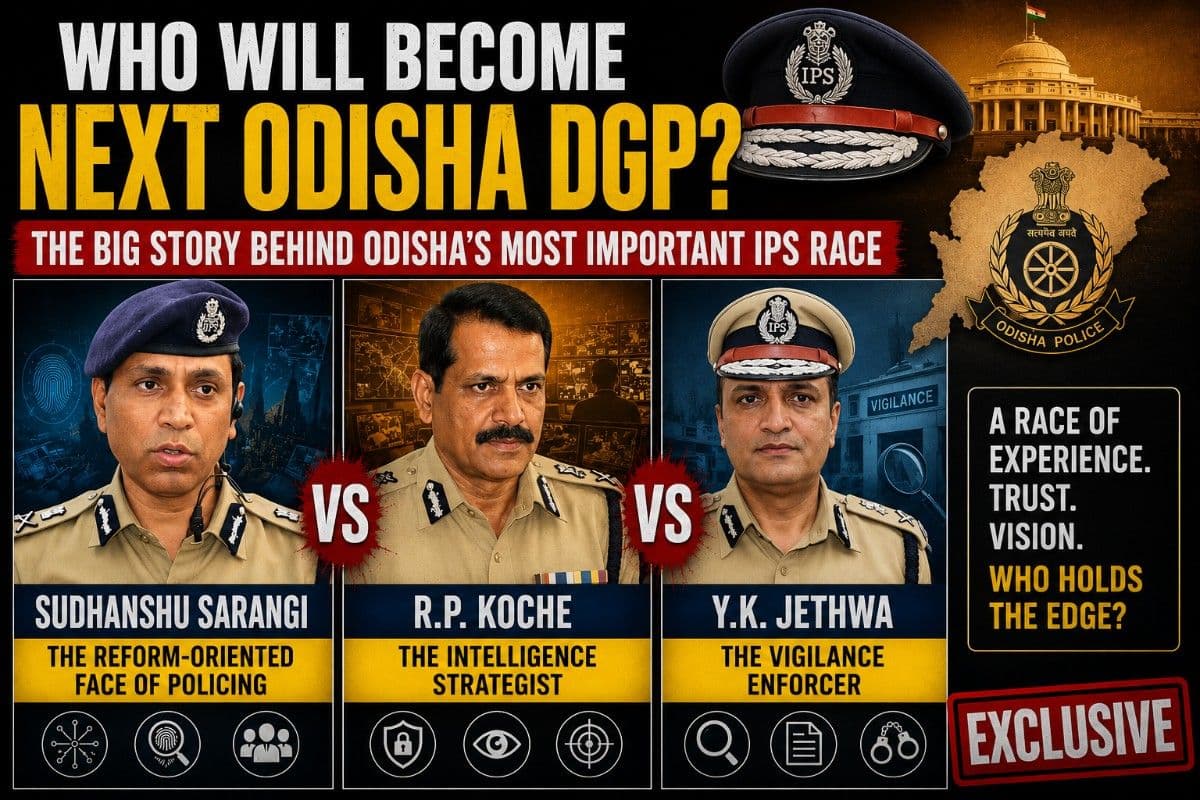
Dr. Sudhanshu Sarangi: The Reform-Oriented Face of Policing
Currently serving as DG, Fire Services, Home Guards and Civil Defence, Dr. Sarangi combines seniority with a highly visible public profile.
Over the years, he has built a reputation as a moderniser who emphasises:
- Technology-driven policing
- Forensic-led investigations
- Institutional reforms
- Public engagement and transparency
His career includes leadership roles in urban policing and several high-profile investigations.
Among Odisha's senior police leadership, few officers enjoy similar public recognition.
Observers opine Sarangi represents continuity with reform and modernization, making him an attractive choice if the government wants a DGP who embodies visible institutional transformation.
His recent empanelment for Director General-level positions at the Centre further reinforces his standing within the national policing establishment.
R.P. Koche: The Quiet Power Centre
If Sarangi's strength lies in visibility, Koche's lies in influence.
As Director, Intelligence, Koche occupies one of the most strategically important positions in Odisha's administrative structure.
His responsibilities place him at the centre of:
- Internal security assessments
- Political intelligence gathering
- Threat perception analysis
- VVIP security planning
- Sensitive government coordination
The intelligence chief traditionally enjoys frequent interaction with the highest levels of government, making the position one of the most trusted posts in the state apparatus.
Observers point to his deep understanding of Odisha's security ecosystem, his low-profile working style and his reputation as an officer who delivers without attracting unnecessary publicity significant.
In many states, intelligence chiefs have often emerged as strong contenders for the top police post precisely because of their proximity to executive decision-making.
The Jethwa Factor
Any analysis that stops at Sarangi versus Koche may still be incomplete.
Yeshwant Kumar Jethwa, a 1994-batch officer and current Vigilance Director, has introduced an intriguing variable into the equation.
Although he remains an ADG in the state cadre, the Centre has already empanelled him for DG-equivalent posts.
That distinction matters.
It signals that New Delhi considers him suitable to head major national-level police organisations.
As Vigilance Director, Jethwa oversees Odisha's anti-corruption machinery and commands a portfolio that requires substantial trust from the political leadership.
Like Koche, his current assignment places him close to the nerve centre of governance.
Whether that can offset the advantage enjoyed by senior DG-rank officers remains uncertain, but his presence ensures that the race is not entirely binary.
Clean Records, Different Styles
One notable feature of the leading contenders is that all possess strong professional records.
Neither Sarangi nor Koche faces any active vigilance inquiry or corruption case.
Both have secured central DG empanelment.
Both have spent decades handling sensitive assignments.
The difference lies more in style than substance.
Sarangi projects the image of a public-facing reformer who embraces transparency and institutional modernization.
Koche projects the image of a discreet strategist whose influence is exercised largely behind the scenes.
Jethwa, meanwhile, represents the accountability and enforcement dimension through his stewardship of the Vigilance organisation.
What History Suggests
DGP appointments across India often follow a predictable public script and a less visible administrative reality.
Officially, eligibility, seniority and service records dominate the discussion.
In practice, governments also assess softer variables:
- Administrative comfort
- Institutional chemistry
- Communication style
- Crisis-management ability
- Trust built over years of interaction
The Chief Minister naturally prefer a police chief with whom they can work seamlessly during periods of political, social and security stress.
That makes forecasting the final choice difficult.
Who Holds the Edge?
At this stage, declaring a definitive frontrunner would be premature.
The UPSC process is still underway and the final recommendation panel has not yet emerged.
However, based on current structural indicators, the contest appears to be tilting towards officers who combine three advantages:
1. Strong tenure viability.
2. DG-level credentials and central recognition.
3. Demonstrated trust within the state's administrative ecosystem.
By that measure, Dr. Sudhanshu Sarangi and R.P. Koche appear to occupy the strongest positions, while Y.K. Jethwa remains the most significant dark horse.
Yet the ultimate question confronting the Odisha government is not simply who is the most senior officer.
It is what kind of police leadership the state wants at this moment.
A reform-oriented public face?
An intelligence-driven strategist?
Or an accountability-focused enforcer?
The answer
to that question may determine who occupies the DGP's office after August 16
far more than any service record or seniority list.
Also Read: Majhi Govt Revives What ‘Mo Sarkar’ Dropped: How Odisha’s 15-IPS Police Audit Aims to Fix Crime – Why Bhubaneswar, Cuttack, Ganjam Missing| Exclusive
Related Topics
Explore more stories