



Majhi Govt Revives What ‘Mo Sarkar’ Dropped: How Odisha’s 15-IPS Police Audit Aims to Fix Crime – Why Bhubaneswar, Cuttack, Ganjam Missing| Exclusive
Key Points
* Fifteen DG-, ADG- and IG-rank officers will audit crime registration, investigations, police infrastructure and custodial compliance across 17 districts.
* The story reveals why Bhubaneswar, Cuttack and Ganjam were excluded and how district-specific crime challenges shaped IPS deployments.
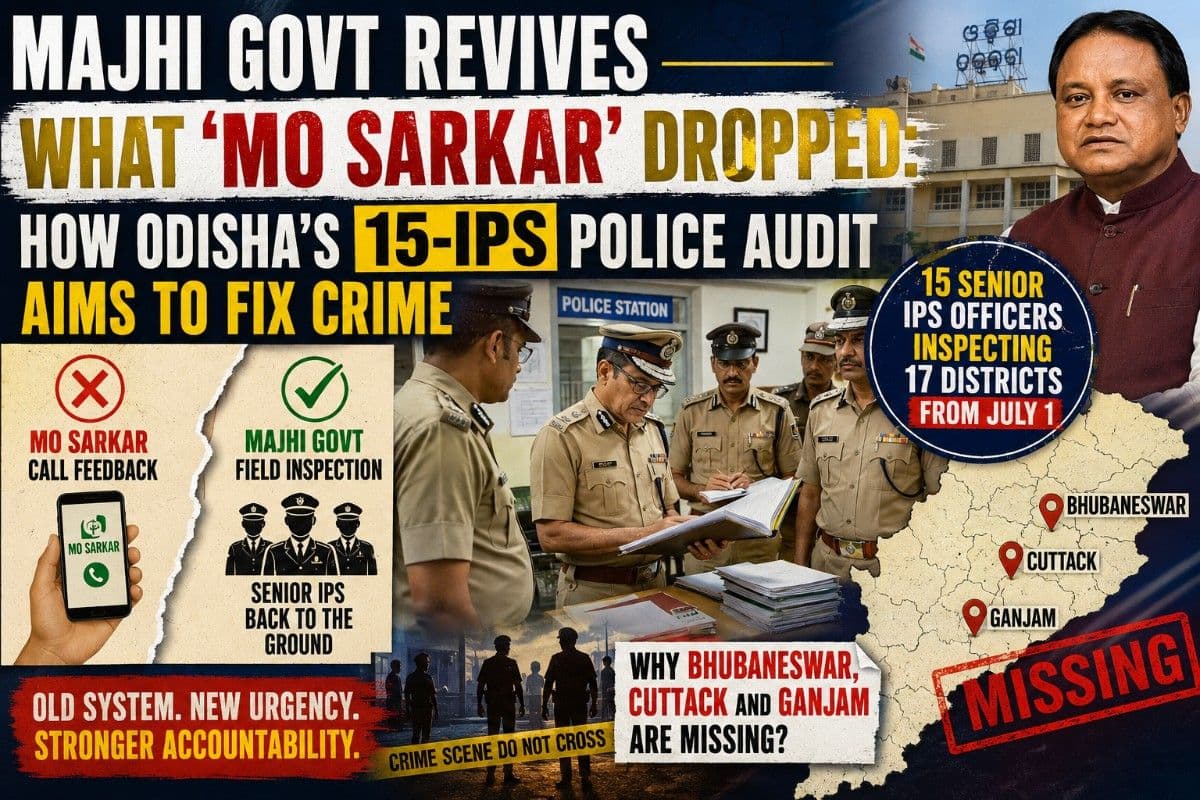
Bhubaneswar: At first glance, Odisha Police’s decision to send 15 senior IPS officers – ranging from DGs and ADGs to IGs – to inspect 17 districts from July 1 appears to be a routine administrative exercise.
However, in reality, it marks one of the biggest philosophical shifts in policing since the change of government in Odisha.
The move is not merely about inspections. It is about restoring an institutional mechanism that gradually disappeared after 2019, when governance increasingly shifted toward citizen-feedback-based monitoring under the Mo Sarkar framework and away from traditional field audits by senior police leadership.
In effect, the Mohan Charan Majhi government has decided to bring back a time-tested policing tool practiced in states like Uttar Pradesh, Tamil Nadu, Karnataka and Telangana that many officers privately believed had been lost during the past seven years.

📱 Get Argus News App
✨The Return of Police Manual
For decades, annual block inspections by senior IPS officers were among the strongest accountability mechanisms within Police across the nation.
The logic was simple: a DG, ADG or IG visiting a district could independently verify crime records, inspect police stations, examine pending investigations, review lock-ups, assess welfare conditions of personnel and detect manipulation of crime data.
The system gradually weakened after the launch of Mo Sarkar in 2019, when citizen feedback through direct phone calls became the preferred monitoring instrument. Combined with the COVID-19 pandemic, which redirected senior officers toward crisis management and mobility restrictions, the traditional inspection culture virtually disappeared.
Now, with concerns growing over law and order, the pendulum is swinging back.
Why Now?
The timing is significant.
The revival comes amid rising public concern over murders, custodial controversies, mob violence and allegations of police misconduct. Official figures showed an increase in cognisable crime and murders during 2025, prompting the government and police headquarters to conclude that remote monitoring alone cannot identify institutional weaknesses on the ground.
A senior IPS officer's physical presence inside a district sends a message that no dashboard or phone survey can.
When district police know that station diaries, rejected complaints, FIRs, lock-up records and investigation files may be physically examined, accountability becomes immediate.
What the Inspectors Will Actually Look For
Contrary to public perception, these inspections are not ceremonial visits.
The officers have been tasked with auditing four critical areas:
- Whether crimes are being properly registered or hidden through “burking”.
- Whether investigations, forensic reports and charge sheets are moving on time.
- Whether police stations, reserves, weapons and digital systems are functioning properly.
- Whether lock-ups and custodial facilities comply with human rights norms.
One of the most important exercises will be matching General Diary entries with FIR registrations to identify cases where complaints may have been suppressed or downgraded.
If
implemented rigorously, the exercise could produce something politically
uncomfortable but institutionally healthy: a temporary rise in crime statistics
because more crimes get formally recorded.
This could be the reason why 'Annual Block Inspections' were dropped after 2019 under the pretext of 'Mo Sarkar' launch.
Why Bhubaneswar and Cuttack Were Left Out
The exclusion of Bhubaneswar and Cuttack triggered immediate questions because the Twin Cities have witnessed several high-profile crimes in recent years.
However, their omission is not a sign of immunity.
The Twin
Cities operate under the Commissionerate Police system, which follows a
separate command structure. The Police Commissioner possesses independent
powers and the commissionerate has its own internal accountability framework
distinct from district policing.
Therefore, the annual block inspection model
designed for district police units does not automatically apply to the urban
commissionerate setup.
In administrative terms, Odisha Police is treating the commissionerate as a separate policing ecosystem rather than a conventional district unit.
The Bigger Mystery: Why Was Ganjam Left Out?
This is where the real debate begins.
Ganjam and Berhampur have frequently dominated headlines because of gang rivalries, organised crime concerns and politically sensitive law-and-order incidents.
Yet Ganjam is absent from the inspection list.
According to a top police offical, the district falls under a different security and monitoring priority matrix because of its political sensitivity and existing supervisory focus. Rather than indicating neglect, the omission suggests that Ganjam is being tracked through separate channels outside this statewide inspection sweep.
Whether that explanation satisfies critics is another matter.
Significance Of Crime Branch DGP Vinaytosh Mishra
Crime Branch DG Vinaytosh Mishra, who has been assigned Balasore and Bhadrak, will focus heavily on investigation quality and prosecution readiness. His assessment will include scrutiny of case diary standards, delays in forensic examinations, pendency of chargesheets, evidence management systems and anti-human trafficking performance. The objective is to determine whether investigations are capable of translating into successful prosecutions rather than merely registering cases.
Sanjeeb Panda on ‘Right’ Mission
Special Operations ADG Sanjeeb Panda has been entrusted with Koraput and Rayagada, where the priorities are markedly different. In districts affected by Left Wing Extremism, inspections will focus on anti-sabotage preparedness, security of remote police outposts, weapon maintenance, operational readiness and intelligence-sharing mechanisms between civil administration and security agencies. The emphasis here is less on routine crime and more on tactical resilience and internal security preparedness.
Arun Bothra Factor
Senior IPS officer Arun Bothra, widely regarded as a technology-driven investigator and operational strategist, Bothra has been entrusted with Angul – a district whose crime profile has evolved rapidly recently.
The district hit headlines in last two years over rising economic offences, property disputes, highway-related crimes and proliferation of narcotics, particularly brown sugar, among sections of youth population. And the drug trade has been linked to a rise in localized thefts, violent altercations and criminal networks seeking to exploit district's expanding urban-industrial ecosystem.
His inspection is expected to focus not only on crime statistics but also on field-level intelligence gathering, anti-narcotics enforcement, investigation quality and police preparedness in the district.
Soumendra Priyadarshi's Jagatsinghpur Mission
Another significant deployment is that of ADG Soumendra Priyadarshi, known in police circles as tactical specialist, has been tasked with reviewing policing in Jagatsinghpur.
The district hit headlines in crimes linked to illegal liquor operations, bootlegging networks and localized violent disputes, especially the repeated tensions in pockets of Paradip and Kujanga.
He is expected to closely examine enforcement mechanisms, habitual offender tracking systems, patrolling patterns and intelligence networks.
How the Reports Could Help Mohan Majhi
For Chief Minister Mohan Charan Majhi, the significance of these inspections extends beyond policing.
The reports are likely to provide an unfiltered assessment of district-level law-and-order realities – something that often gets diluted through multiple administrative layers.
Each inspection team has been given a limited timeframe to submit findings, creating pressure on district police units to clear pending investigations, improve FIR registration practices and address infrastructure deficiencies.
In governance terms, the reports could become an early-warning system for the Majhi government.
The Political Message
The larger political story is unmistakable.
The previous regime attempted to improve accountability through Mo Sarkar Citizen feedback.
The current regime is signalling that citizen feedback alone is not enough.
Its answer is to restore institutional supervision from the top down.
By
reviving annual block inspections, Odisha Police appears to be betting on the time-tested
field accountability to control crimes.
Also Read: Odisha Law and Order / Odisha Police Rounds Up 1,771 Criminals, But Why Do High-Profile Crimes Still Grab Headlines? | Analysis
Related Topics
Explore more stories