



Vinaytosh Mishra: The Calm, Analytical Officer Now Stepping Into Odisha’s Top Police Chair as Interim DGP
Key Points
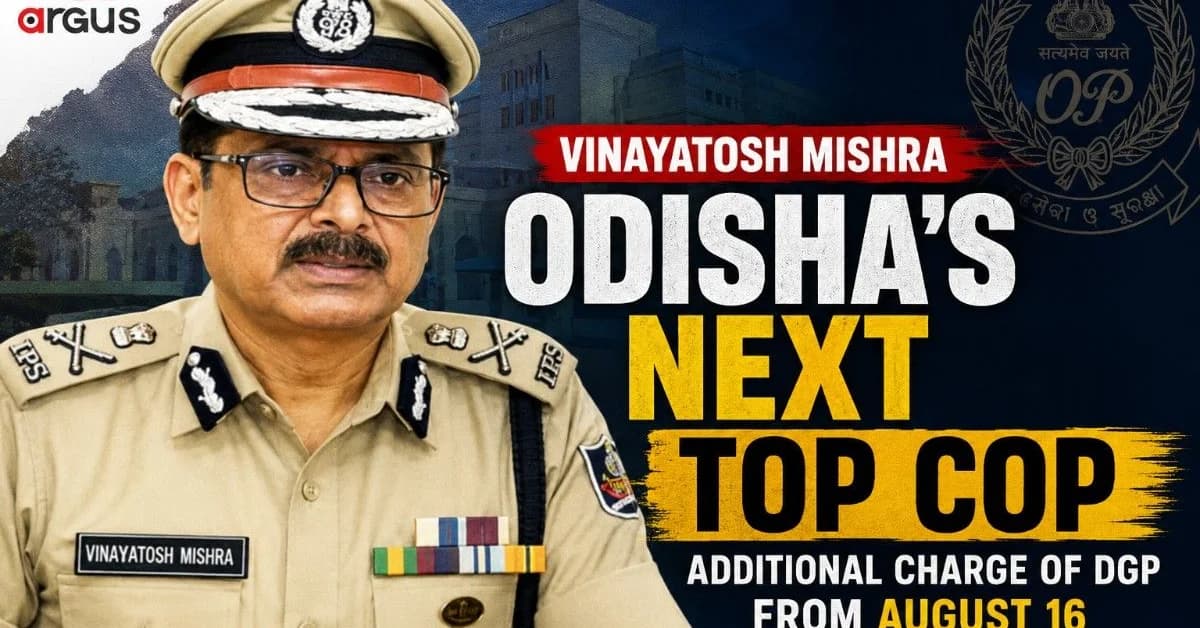
Bhubaneswar: A calm and analytical approach to policing, an emphasis on institutional discipline and an ability to coordinate across departments have been the defining traits associated with Vinaytosh Mishra, the senior Odisha-cadre IPS officer who is now set to take temporary charge of the State police force at a particularly sensitive juncture.
On August 14, 2026, Chief Minister Mohan Charan Majhi approved Mishra's appointment to hold the additional charge of Director General of Police and Head of Police Force (HoPF). The arrangement will take effect on August 16, following the retirement of incumbent DGP Y.B. Khurania.
For Mishra, however, this is not an elevation into the DGP rank. He is already a full-fledged DGP-rank officer. His promotion to the apex police rank took effect from January 1, 2025. What changes on August 16 is the office he will additionally occupy – the State's top policing post.
And his career suggests why an officer with a background spanning investigation, police databases, emergency services and transport security has been chosen to steer the force during a period of institutional uncertainty.

📱 Get Argus News App
✨An officer shaped by systems, not just policing
A 1993 batch Odisha cadre from Bihar, Mishra's career has extended across more than three decades of policing and administration.
In the Odisha IPS seniority list, he is 3-down, after Khurania, Sudhansu Sanrangi and Susanta Nath. Moreover, he is due to retire in November this year.
A glance at his postings reveal a professional trajectory that has repeatedly taken him into areas where policing intersects with technology, emergency management, investigation and coordination between different government agencies.
That is perhaps the most distinctive feature of his profile.
He has served as Director of the State Crime Records Bureau (SCRB) in Bhubaneswar, where his responsibilities involved the digital tracking and modernisation of criminal databases across Odisha.
The assignment placed him at the intersection of policing and information systems – an increasingly important part of modern crime investigation, where access to reliable data and the ability to connect information across cases and jurisdictions can determine how effectively a police force responds to crime.
Before his present assignment, Mishra also served at the DG level with Fire Services, Home Guards and Civil Defence.
That posting gave him exposure to a very different side of policing: emergency response, disaster preparedness, institutional mobilisation and the coordination of personnel and resources during crises.
He has also served as Inspector General of Police (IGP), Railways, where policing involves not merely conventional law enforcement but the management of security, logistics and safety across a complex transport network.
Taken together, these assignments point towards an officer whose experience has not been confined to conventional law-and-order policing.
From crime databases to emergency response
Mishra's current assignment as DGP, CID-Crime Branch is perhaps the strongest reflection of his investigative credentials.
As Crime Branch chief, he operates at the State's top investigative tier, dealing with sensitive criminal investigations and cases requiring coordination across multiple agencies.
His responsibilities also extend into areas such as economic offences, cybercrime and coastal-security coordination.
The Crime Branch assignment therefore puts him at the centre of some of the most complex investigations handled by the State police – cases where investigation, technology, financial intelligence and inter-agency coordination increasingly overlap.
It is a natural progression from his earlier experience at the State Crime Records Bureau, where the focus was on building and managing the information architecture supporting policing.
A mechanical engineer who made policing his career
Mishra's academic background is somewhat different from the conventional image of a police officer.
He holds a Bachelor of Science in Mechanical Engineering (B.Sc. Engineering, Mechanical) and has also undergone management-oriented training.
The combination is relevant to the way his professional profile is described: less centred on flamboyant policing and more on systems, processes and institutional coordination.
Bureaucratic profiles describe him as an officer with an analytical approach to policing, with a strong emphasis on structural discipline.
That description becomes particularly interesting in the context of his new assignment.
He is taking charge not in normal circumstances but at a time when the State's regular DGP selection process is caught in a legal dispute. The immediate task, therefore, is less about creating a new policing model and more about ensuring that the existing machinery remains stable, coordinated and functional.
Three decades, three very different policing worlds
Mishra's career can broadly be read through three institutional experiences.
Investigation and intelligence: His present role in the CID-Crime Branch places him at the centre of serious investigations and specialised policing.
Technology and police systems: His tenure at the State Crime Records Bureau exposed him to the digital backbone of policing and the modernisation of criminal-record systems.
Emergency and operational management: His DG-level responsibility for Fire Services, Home Guards and Civil Defence brought him into the world of emergency response and disaster management.
His Railways posting added another dimension – security and policing across a large, constantly moving transport network.
This range matters because the DGP's job is not restricted to directing crime investigations. The State police chief has to bring together law and order, investigation, emergency response, specialised wings, technology, security and coordination with the civil administration.
Mishra's career has touched almost all of those institutional layers.
A decorated career
Mishra's service record has also earned him several national police decorations.
He received the Police Medal for Meritorious Service in 2009, followed by the President's Police Medal for Distinguished Service in 2016.
He was also awarded the Police Antrik Suraksha Seva Padak in 2017 for domestic-security operations.
The sequence of these awards spans a significant portion of his career and underlines his long service in the police organisation.
Why his profile matters now
Mishra's entry into the DGP's chair is therefore less about a new officer being elevated and more about an experienced DGP-rank officer being asked to hold together the police establishment while the State waits for clarity on the regular appointment.
His substantive position remains DGP, CID-Crime Branch. From August 16, he will additionally take charge of the DGP and Head of Police Force post.
That makes his profile unusually suited to the immediate challenge.
He comes into the assignment with experience in investigation, police technology, emergency response, civil defence, transport security and multi-department administration.
But perhaps the most revealing description of Mishra is also the simplest: calm, analytical and institutionally oriented.
In a police establishment awaiting clarity over its next permanent chief, those qualities may prove more important than a dramatic change of style.
For now, Mishra's task is straightforward but consequential: keep Odisha Police running at full strength until the legal and administrative uncertainty over the State's regular DGP is resolved.
What can Mishra actually do as DGP?
This is where the additional-charge arrangement becomes more significant than its terminology suggests.
As the designated Head of Police Force, Mishra will be responsible for the day-to-day functioning of the Odisha Police. His responsibilities will include law and order, crime control, emergency response, police administration and implementation of ongoing policing programmes.
In other words, the State cannot afford to have a police chief who is merely a symbolic placeholder.
Mishra will have to run the police machinery through a period that could itself become politically and administratively sensitive, depending on what happens before and after the Supreme Court hearing on August 18.
But there is an important qualification.
Full operational control, but not a free hand on transfers
Although Mishra will exercise the day-to-day powers of the HoPF, his additional-charge status is unlikely to translate into a mandate for major structural changes.
As a matter of administrative convention, an officer holding additional charge generally avoids sweeping policy changes or large-scale reshuffles unless specifically authorised.
For Mishra, therefore, the practical equation is clear:
He will command the police force operationally, but major personnel movements and sweeping administrative changes will remain constrained by the existing government structure.
How long will Mishra remain DGP?
That is the biggest uncertainty.
The official arrangement is described as “until further orders”, rather than being tied to a specific end date.
The immediate legal milestone is August 18, when the Supreme Court is scheduled to take up the DGP selection dispute again.
If the court allows the UPSC process to move forward, the Commission could finalise its panel, following which the State could appoint a regular DGP. That could happen within days or weeks, depending on the court's order and the subsequent selection process.
But if the litigation continues, Mishra's additional charge could last considerably longer.
That makes August 16 more than a routine change of guard. It marks the beginning of an unusual phase in Odisha Police administration – a DGP-rank officer running the State police force on additional charge while the legal battle over who should become the regular police chief plays out in the Supreme Court.
Odisha Sees Third Interim DGP In Its Long History
In recent administrative history, Odisha has utilized a temporary "in-charge" or "additional charge" arrangement for its top police post three times.
1. Bijay Kumar Sharma (August 2019)
- When the outgoing DGP, Dr RP Sharma, was abruptly selected to join the state's anti-corruption watchdog body (the Lokayukta), he vacated the DGP post early.
- The then BJD government did not have a finalized UPSC panel ready immediately. They assigned 1986-batch IPS officer Bijay Kumar Sharma (then the Director General of Fire Services) the "full additional charge" of the DGP and HoPF office.
2. Arun Kumar Sarangi (December 2023 – August 2024)
- When the sitting DGP, Sunil Kumar Bansal, was allowed to retire from government service on December 31, 2023. Because the appointment process for a permanent successor was ongoing and delayed, an interim arrangement made.
- 1990-batch IPS officer Arun Kumar Sarangi (then Special DG of Police, Training) was given additional charge of the DGP post.
- Sarangi’s tenure turned to be thelong-term interim phase as he steered the entire Odisha police machinery for nearly eight months, including overseeing Lok Sabha and Assembly elections, until Yogesh Bahadur Khurania took over as the regular DGP in August 2024.
3. Vinaytosh Mishra (August 2026)
- Incumbent DGP Y.B. Khurania's scheduled retirement on August 16, 2026, coincided directly with a Supreme Court order freezing the UPSC empanelment process until August 18.
Related Topics
Explore more stories