



Tuesday’s IAS Transfers Put Odisha Government’s Immediate Governance Focus in Sharp Relief| Exclusive
Key Points
Bhubaneswar: Tuesday’s IAS reshuffle in Odisha may have involved only seven senior officers, but the choice of departments under the government’s scanner tells a larger story.
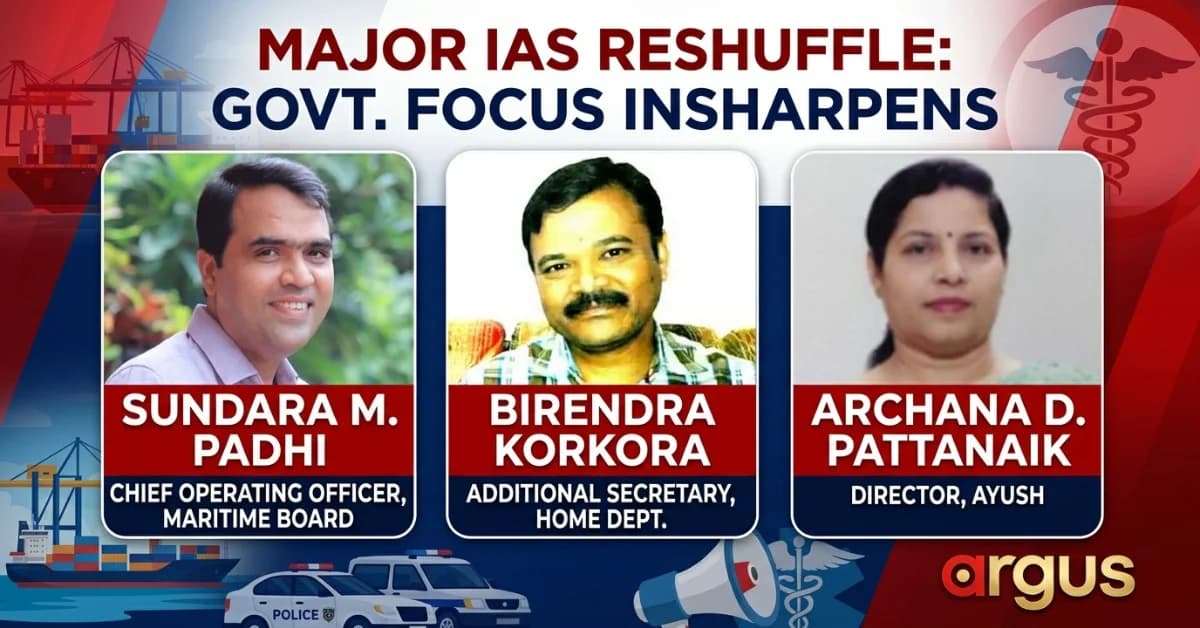
The transfers notified today puts glare on 4 signifcant departments: Home, Maritime Board, Information & Public Relations, AYUSH
The postings, when read alongside the recent IPS reshuffle, appear less like routine bureaucratic rotation and more like a coordinated administrative reset around four immediate objectives: tightening internal and financial security, accelerating the Blue Economy, modernising the government’s communication machinery and injecting fresh accountability into public-service delivery.
The most significant here is, the government has brought a Works Department officer to the Odisha Maritime Board at a moment when multi-crore port and shipbuilding projects are moving from policy papers towards execution.

📱 Get Argus News App
✨And while one officer with a transport and logistics background has been moved to head Information and Public Relations, a direct swap between AYUSH and Excise points to another administrative experiment: cross-pollinating departments with officers carrying different operational skill sets.
Home: Push towards a stronger central command?
The transfer of Birendra Korkora, IAS, from Director, Secondary Education to Additional Secretary in the Home Department comes at a time when the state’s policing architecture itself is being recalibrated.
While the police side is being strengthened through specialised command, the civil side of Home is receiving officers with experience in managing large institutions, personnel and regulatory systems.
Korkora's move is significant in this context.
His previous assignment involved managing a large public-sector education system, institutional discipline and sensitive personnel issues. Such administrative experience can be useful in the Home Department, where law and order is not merely about policing but also about coordination between police, district administrations, prisons, prosecution, emergency response and other agencies.
The transfer of Aradhana Das, IAS, from Home to Forest, Environment and Climate Change simultaneously opens the way for fresh administrative deployment within the Home ecosystem.
The focus, therefore, is not only on policing. It is on tightening the administrative architecture behind policing.
Maritime Board: Fast-tracking physical execution?
If Home represents the government’s security priority, the Odisha Maritime Board represents its biggest economic infrastructure bet.
The appointment of Sundara Madhaba Padhi, IAS, as Chief Operating Officer of the Odisha Maritime Board is arguably the most strategically loaded posting in Tuesday's reshuffle.
Padhi comes with his experience from the Works Department, where the core administrative challenges revolve around large engineering projects, tenders, contracts, clearances and construction deadlines. He will continue to hold additional charge as General Manager of OSRTC.
The timing is equally significant.
Under the Odisha Port Policy 2022, the state is pursuing an ambitious maritime expansion. The Odisha Maritime Board is driving projects that could together represent a maritime infrastructure pipeline of around Rs50,000 crore.
The immediate mandates include the proposed Rs21,500-crore-plus Bahuda Deep-Sea Port in Ganjam, envisioned with an ultimate cargo-handling capacity of 150 MTPA, and the proposed Rs24,700-crore shipbuilding and ship-repair cluster in Kendrapara in collaboration with the Paradip Port Authority.
There is also the development of non-major ports, inland waterways, coastal logistics, green fuel export infrastructure and maritime tourism projects, including a proposed international cruise terminal ecosystem in Puri.
These are no longer merely policy concepts.
They require officers who can move files into physical projects.
Land acquisition has to be synchronised. Environmental and CRZ approvals have to be pursued. Tendering and PPP structures have to be executed. Rail and road connectivity have to be aligned with the port master plan.
That is where a Works Department background becomes relevant.
The immediate focus of the Maritime Board appears to be execution.
Role of the Maritime Board Chairman
The Maritime Board's leadership structure explains why the government may be placing greater emphasis on administrative specialisation.
The chairman acts as the strategic and policy anchor, handling high-level government liaison, investment promotion, policy direction and coordination with multiple stakeholders.
For a state pursuing greenfield ports and a large shipbuilding ecosystem, this turns crucial.
By moving an officer from Works insight to the Maritime Board, the Odisha government appears to be betting on precisely this second stage.
The blue economy push now needs project managers.
Information & PR: A move to manage the narrative?
The transfer of Sanjay Kumar Biswal, IAS, from Commerce and Transport to Director, Information and Public Relations could be another clue to the government's immediate priorities.
Traditionally, an I&PR department has been seen primarily as the government's publicity and information dissemination arm. But the demands of digital media have altered that equation.
Government communication today has to respond rapidly to misinformation, explain complicated policies, disseminate information across multiple digital platforms and ensure that public perception does not lag behind policy implementation.
Biswal brings a background in commerce, transport and administrative coordination – sectors involving complex stakeholder management and logistical systems.
His move could indicate a shift towards more structured, data-driven and digitally responsive public communication.
The government is simultaneously pushing infrastructure projects, investment commitments and administrative reforms. As the scale of the policy agenda expands, the need to explain the government’s actions also grows.
In that sense, the I&PR transfer fits into the larger strategy.
Centralised enforcement and rapid infrastructure growth both need an effective communication architecture to maintain public trust.
However, it remains to be seen whether the department may increasingly move beyond conventional publicity towards a more proactive model of policy communication.
AYUSH: The accountability experiment
The AYUSH changes form the fourth pillar of the reshuffle.
Archana Das Pattanaik, IAS, moves from Excise to become Director, AYUSH, while Anjana Panda, IAS, moves in the opposite direction from AYUSH to Excise.
At the same time, Jugaleswari Dash, IAS, moves from Director, OBC to Director, Secondary Education.
The AYUSH-Excise swap is particularly interesting because the two departments demand different administrative instincts.
Excise is heavily regulatory and revenue-driven. It requires compliance monitoring, financial oversight and strict enforcement.
AYUSH, on the other hand, deals with a public healthcare and wellness ecosystem involving traditional medicine systems and service delivery.
Moving an officer from a tightly regulated revenue department into AYUSH can potentially bring a sharper focus on compliance, financial management and institutional accountability.
The government appears to be using the reshuffle to break departmental silos.
Rather than insisting that an officer must remain within one functional ecosystem, it is moving administrative skills across sectors.
The underlying assumption seems to be that regulatory discipline, institutional management and fiscal accountability are transferable skills.
That could become important for AYUSH as Odisha seeks to expand traditional healthcare services and potentially explore wellness-linked tourism and preventive healthcare models.
The larger pattern: skill-based deployment
The seven-officer reshuffle becomes more revealing when viewed as a skills map rather than a list of names.
Commerce and transport experience → Information & PR
Works and engineering exposure → Maritime Board
Large institutional management → Home
Regulatory and revenue experience → AYUSH
This is why Tuesday's reshuffle appears to go beyond routine transfer.
The Odisha government seems to be moving towards a more specialised model of administrative deployment, in which an officer's previous exposure is being used to address a specific operational bottleneck in another department.
The approach can be read as an attempt to replace generalised oversight with targeted execution.
What the transfers signify
The reshuffle, taken together with the IPS postings, points to a unified state governance strategy.
On one side is security – with a stronger headquarters focus on intelligence, economic offences, organised crime and law-and-order administration.
On the other is economic acceleration – with maritime infrastructure emerging as one of Odisha's biggest long-term investment priorities.
Then comes communication – the need to manage the public narrative in an increasingly digital information ecosystem.
And finally, public-service accountability – where cross-departmental transfers are being used to inject new management practices into sectors such as AYUSH and education.
The immediate message from Tuesday's transfers is therefore clear: the government is trying to align the bureaucracy with its next operational priorities.
Home is being positioned for tighter coordination. The Maritime Board is being prepared for execution-heavy infrastructure work. Information & PR is being readied for a more modern communication challenge. AYUSH is receiving fresh regulatory and administrative perspective.
The reshuffle may involve only seven IAS officers.
But
the departments they have been moved into put a far sharper glare on
where the Odisha government believes its immediate governance battle
will be fought – security,
infrastructure, communication and delivery.
Also Read: Odisha Big IPS Reshuffle: Heavy-Hitting IGs Himanshu Lal, Satyabrat Bhoi Pulled Out from Field-Range Desks to State Command| Exclusive
Related Topics
Explore more stories