



Odisha Big IPS Reshuffle: Heavy-Hitting IGs Himanshu Lal, Satyabrat Bhoi Pulled Out from Field-Range Desks to State Command| Exclusive
Key Points
Bhubaneswar: With change in the top police guard, and Vinayatosh Mishra now helming the top chair as interim head, and the Supreme Court hearing on the DGP issue lingering to September 2, the State Home Department has effected the first senior-level IPS reshuffle to tone up Odisha’s larger policing apparatus.
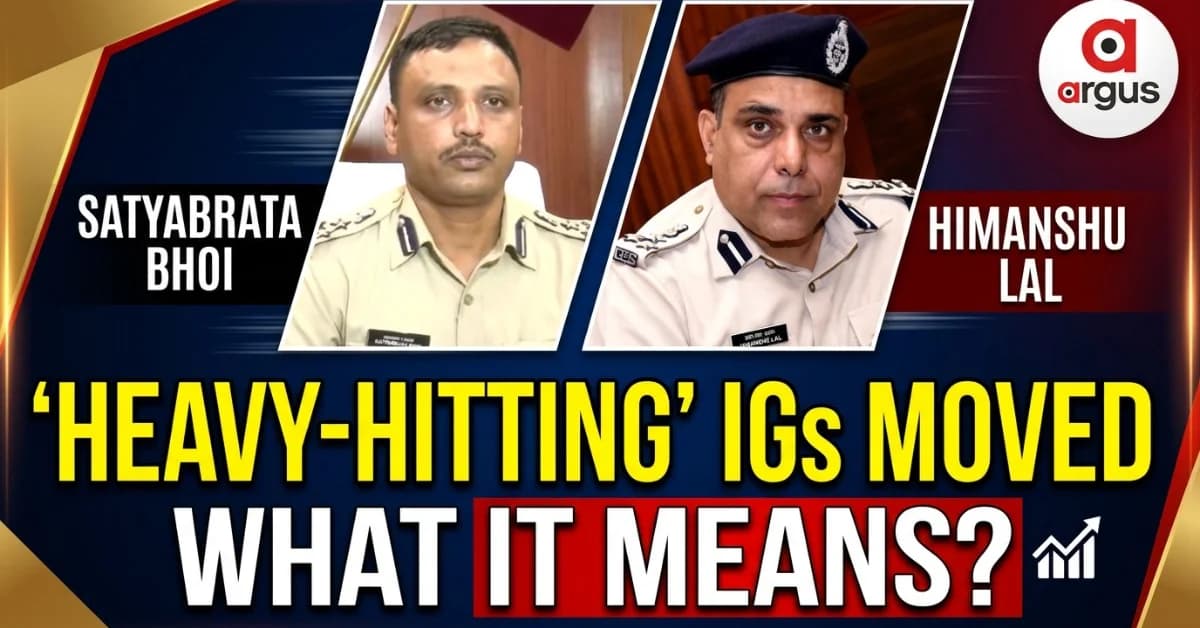
The strategic essence of the August 21 notification is unmistakable: the government has pulled two of its heaviest field-range commanders, Himansu Kumar Lal and Satyabrat Bhoi, into the state’s central command architecture, while handing the Northern and North Central Ranges to younger DIG-rank officers, for now.
|
Officer |
Present/Previous Posting |

📱 Get Argus News App
✨New Posting
Himansu Kumar Lal, IPS (RR-2003)
IG, Northern Range, Sambalpur
IG, EOW & STF
Satyabrat Bhoi, IPS (RR-2004)
IG, North Central Range, Talcher
IG, Intelligence
Charan Singh Meena, IPS (RR-2009)
DIG, Provisioning
DIG, Northern Range, Sambalpur
Ashish Kumar Singh, IPS (RR-2010)
On return from central deputation/IB exposure
DIG, North Central Range, Talcher, with additional charge as Principal, PTC Angul
Jai Narayan Pankaj, IPS (RR-2005)
Intelligence
IG, Southern Range, Brahmapur
Niti Shekhar, IPS (RR-2007)
IG, Southern Range, Brahmapur
IG (Prov.), SP Headquarters
IPS Scan: Four Officers, Four Distinct Policing Styles
A closer look at the four key postings shows that the reshuffle is more than a routine transfer exercise. The Home Department appears to have matched distinct policing temperaments with the changing nature of crime and security challenges in Odisha.
Himansu Kumar Lal, the force multiplier: The 2003-batch officer carries perhaps the strongest hard-field credentials among the officers moved in the reshuffle.
His tenure in the South Western Range and Maoist-affected Malkangiri established him as a commander comfortable with hostile terrain and high-risk operations.
The successful penetration of the once-formidable Swabhiman Anchal and the symbolic hoisting of the Tricolour in the region became defining moments of his field career. A recipient of the President’s Police Medal for Gallantry and the Police Medal for Gallantry, Lal’s operational personality has traditionally been direct, visible and decisive.
His policing philosophy is rooted in deterrence through targeted incapacitation.
The idea is simple: identify the operational nerve centre of a criminal network, gather actionable intelligence and hit it before the organisation gets time to regroup. Such a style now acquires greater relevance at the combined EOW-STF command, where Odisha is confronting increasingly sophisticated financial frauds, cyber-enabled economic offences, narcotics networks and interstate organised crime.
Satyabrata Bhoi, the quiet intelligence operator: If Lal represents the visible strike arm of policing, Bhoi represents the invisible radar.
The 2004-batch officer, decorated with the Medal for Meritorious Service, has built his reputation through a markedly different style of command. His stints as Bhubaneswar DCP and later in the Northern and North Central Ranges gave him extensive experience in both urban policing and multi-district security management.
Bhoi is
known more for building systems than seeking public visibility. His strength
lies in human intelligence, mapping criminal networks, identifying spatial
linkages and converting scattered local information into a larger threat
picture.
#Bhubaneswar | Odisha Government has transferred and posted six IPS officers to various positions across the state.
— Argus News (@ArgusNews_in) August 21, 2026
The reshuffle includes postings in Bhubaneswar, Sambalpur, Brahmapur and the Intelligence Directorate, as per a Home Department notification issued on August 21,… pic.twitter.com/XmvJ2Rcyuq
This is essentially intelligence-led policing – using information not merely to investigate crimes after they occur, but to forecast flashpoints and intervene before a law-and-order situation reaches the streets. His move to Intelligence, therefore, looks like a deployment of temperament rather than merely rank.
Charan Singh Meena, the iron-fist administrator: The 2009-batch officer brings a discipline-heavy administrative approach to the Northern Range. A recipient of the Police Antrik Suraksha Seva Padak and the Governor’s Medal, Meena has worked in difficult operational environments, including Koraput.
His style is uncompromising on internal police discipline and field accountability.
He places emphasis on station functioning, attendance, audits, visible policing and early intervention against smaller criminal activity.
In practical terms, his approach resembles a strict application of the “broken windows” philosophy – contain petty crime, roadside extortion, transport-related offences and local disorder before they graduate into larger criminal ecosystems.
That makes Sambalpur a natural fit. The range faces a mix of property crimes, coal-linked pilferage, transport corridor offences and localised extortion. Meena’s mandate is likely to be less about grand strategic policing and more about tightening the nuts and bolts of daily enforcement.
Ashish Kumar Singh, the systems analyst: The 2010-batch officer comes with a different kind of premium exposure – experience of central deputation with the Intelligence Bureau.
His working style is analytical, process-driven and institution-oriented. Rather than viewing policing solely as a law-and-order response, he approaches it as a system that can be improved through better intelligence, technology, training and institutional processes.
This is where his dual assignment becomes significant. The North Central Range, headquartered at Talcher, is one of Odisha’s most complex policing zones, encompassing Angul, Dhenkanal and Deogarh. The region sits at the intersection of coal, power, mining, industrial transport, labour unrest, land disputes and environmental protests.
At the same time, as Principal of PTC Angul, Ashish Kumar Singh has been entrusted with the training pipeline that shapes future police personnel. His appointment, therefore, combines field management with institutional capacity-building – an indication that the government wants both the range and its training infrastructure to run on more structured and analytical lines.
Why Heavy-Hitting IPS Officers Were Brought to Central Command
The biggest takeaway from the reshuffle lies in what the government has chosen to prioritise.
For years, the traditional prestige of senior IPS command was attached to field ranges – large geographical jurisdictions where the officer controlled multiple districts and dealt directly with local law and order. But the nature of crime is changing. The most consequential threats today often do not remain confined to a district or even a range.
A narcotics syndicate can operate across Odisha, Andhra Pradesh, Chhattisgarh and Jharkhand. An economic fraud can originate in one state, target victims in another and move money through a network of bank accounts and shell entities. A cybercrime syndicate may have no meaningful territorial boundaries at all. Likewise, intelligence failures often begin with small, scattered signals that need to be connected before they become a major crisis.
This explains the decision to pull Lal out of Sambalpur and Bhoi out of Talcher.
Lal to EOW-STF: From Territorial Control to Statewide Criminal Networks
Lal’s move is perhaps the clearest indication of the new priority. The EOW and STF deal with offences where specialised investigation and aggressive field operations must increasingly work together.
Economic offenders are no longer always paper-based white-collar criminals sitting in offices. Large financial frauds can involve digital trails, organised networks and interstate linkages. Similarly, narcotics and contraband operations require both long-term intelligence gathering and hard operational strikes.
Lal’s field credentials suggest the government wants a commander who can reduce the traditional gap between intelligence collection and enforcement action. His task will not simply be to supervise files from a state headquarters desk. The strategic value of his posting lies in applying the same focused, intelligence-backed operational pressure that marked his counter-insurgency years to sophisticated criminal networks.
Bhoi to Intelligence: Building Odisha Police’s Preventive Radar
Bhoi’s shift to Intelligence appears equally consequential. As Maoist violence shrinks in geographical spread, Odisha’s security challenge is becoming more fragmented and unpredictable. Community tensions, political flashpoints, local agitations, interstate criminal movements and isolated extremist threats often emerge quickly and without warning.
The policing requirement, therefore, is moving from reaction to prediction.
Bhoi’s experience in building human networks and managing complex geographical jurisdictions fits this requirement. The Intelligence Wing under him is expected to become less of a passive information repository and more of a preventive command system—one that identifies friction points, maps vulnerable networks and sends actionable warnings before a situation escalates.
In simple terms, Lal is being positioned to strengthen the state’s strike capability, while Bhoi is being positioned to strengthen its early-warning capability.
Together, the two appointments represent a fortification of the two most important pillars of modern policing: knowing first and striking faster.
Why the Ranges Were Handed to DIGs
The other half of the reshuffle is equally important.
Both the Northern Range at Sambalpur and the North Central Range at Talcher have now been handed to DIG-rank officers, even though they were previously commanded by IG-rank officers. This should not automatically be read as a permanent downgrading of the importance of the ranges.
Rather, it reflects a case of dynamic cadre management.
The government appears to have concluded that its limited pool of battle-tested IG-rank officers is presently more urgently required in specialised statewide command positions. The ranges, meanwhile, can be managed by capable DIGs whose working styles are better suited to closer supervision and tactical execution.
Sambalpur: From Macro Command to Hands-on Enforcement
The Northern Range covers Sambalpur, Bargarh, Jharsuguda, Sonepur and Bolangir. Its challenges are serious but largely operationally structured – property crime, coal and industrial pilferage, transport-related crime, highway offences, local extortion and political or public-order flashpoints.
This is where a hands-on DIG can make an immediate impact.
With Charan Singh Meena at the helm, the range is likely to see sharper emphasis on station audits, naka checks, night patrolling, inter-district crime coordination and visible street policing.
The immediate public effect could well be more aggressive and responsive field policing.
Talcher: Complex Industry, Complex Policing
The North Central Range presents a different challenge. It is Odisha’s industrial-agranian heartland and carries the security burden of major coalfields, power stations, mining operations and industrial infrastructure.
Its key concerns include coal pilferage, scrap theft, transport extortion, labour disputes, land protests and environmental agitations. The police here must often perform a delicate balancing act between enforcing law and order and facilitating dialogue among industry, workers and local communities.
Ashish Kumar Singh’s problem-oriented approach is expected to be tested in precisely this environment. His IB exposure may help him apply stronger intelligence and analytical frameworks to complex local disputes.
Why Southern Range Was Kept at IG Level
The reshuffle also reveals what the government considers non-negotiable.
The Southern Range at Brahmapur has been kept under an IG-rank officer, with Jai Narayan Pankaj moving in from Intelligence. This is strategically important because the Southern Range carries a different security profile from Sambalpur or Talcher.
Its policing environment is shaped by sensitive interstate borders, difficult forest terrain, lingering Left-Wing Extremism concerns in adjoining belts, narcotics movement and complex community-security challenges. Such a theatre often requires coordination with central agencies and armed forces, besides managing inter-state policing issues.
Here, the full rank and strategic authority of an IG remains critical.
The contrast is revealing: routine but high-volume field enforcement can be temporarily delegated to DIG-level commanders, but high-sensitivity ideological, border and national-security theatres still demand full IG command.
A Calculated Centralisation of Senior IPS Firepower
Seen together, the reshuffle points to a broader strategic shift in Odisha Police.
The government has effectively concentrated senior IG-level firepower at the state’s central nerve centres. Intelligence, EOW and STF now emerge as priority domains. The message appears to be that Odisha’s next policing challenge will not be fought only through geographical range control.
The new battlefields are:
- Interstate narcotics and contraband networks;
- Sophisticated economic and cyber-enabled crime;
- Organised criminal syndicates;
- Intelligence gaps and emerging law-and-order flashpoints;
- Coal, mining and transport-linked criminal ecosystems;
- Institutional capacity and police training.
Bottomline
The August 21 IPS reshuffle is not a routine exercise in changing nameplates. It is a redistribution of Odisha Police’s senior command muscle.
By pulling Himansu Kumar Lal from the Northern Range to EOW-STF, the government has shifted a battle-tested field commander into the state’s main strike architecture against organised crime. By moving Satyabrat Bhoi from Talcher to Intelligence, it has placed a low-profile network-builder at the centre of the state’s preventive security apparatus.
The simultaneous posting of Charan Singh Meena and Ashish Kumar Singh as DIG-level range commanders is the balancing act. Their job is to ensure that field policing does not weaken while senior IGs are redeployed to fight statewide and increasingly borderless threats.
In essence, Odisha Police is trading a measure of range hierarchy for centralised specialised firepower.
The immediate test will now be whether the two heavy-hitting IGs can convert Odisha’s Intelligence Wing, EOW and STF into a sharper early-warning-and-strike combination – and whether the DIG-led Sambalpur and Talcher ranges can maintain command effectiveness.
The
reshuffle, therefore, it seems mark the beginning of a larger transition: from
geography-centric policing to threat-centric policing.
Also Read: YB Khurania: The System Man Who Leaves Odisha Police With an Institutional Blueprint
Related Topics
Explore more stories