



The Serpent's Lesson: How PM Awas Yojana Can Cut Odisha's High Snakebite Deaths | Exclusive
Key Points
- Odisha accounted for over 11% of India's 1.4 lakh reported snakebite cases in 2025, making it the country's third-largest snakebite hotspot.
- Despite reporting one of India's highest snakebite burdens, Odisha recorded only 23 deaths in 2025 due to better surveillance, free anti-snake venom and faster treatment.
- Replacing kutcha houses with pucca homes under PM Awas Yojana could significantly reduce nocturnal snakebites by eliminating the mud-wall crevices that attract rodents and venomous snakes.
Bhubaneswar: Nearly one Indian dies every two hours from a snakebite. Every four minutes, another Indian is bitten by a venomous snake.
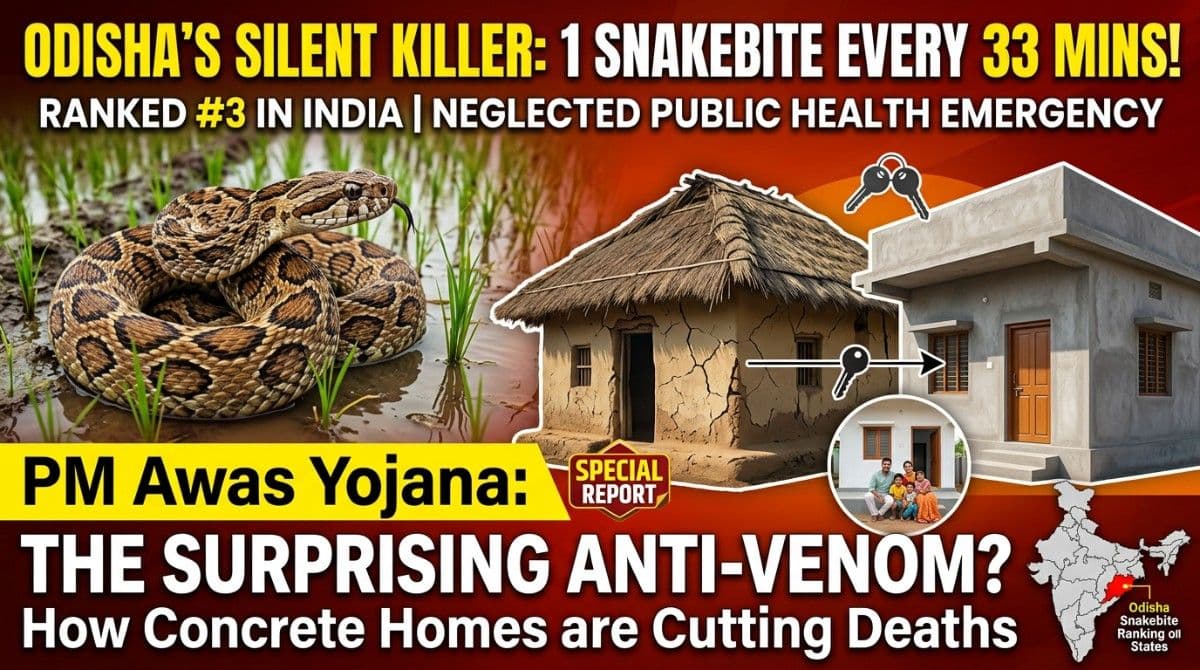
In Odisha, the frequency is even more alarming – one snakebite is reported roughly every 33 minutes. The numbers place Odisha among India's biggest snakebite hotspots, ranking third in the country in reported snakebite cases in 2025, behind West Bengal and Karnataka.
The figures, tabled by the Union Government in the Rajya Sabha this week, underscore that snakebite remains one of India's most neglected public health emergencies despite the availability of anti-snake venom and improved surveillance.
While India recorded 1,40,030 snakebite cases and 429 deaths in 2025, Odisha alone accounted for 15,815 cases, making it responsible for more than one in every nine officially reported snakebite incidents in the country.

📱 Get Argus News App
✨Odisha's Silent Rural Killer
Snakebite has long ceased to be merely a wildlife issue in Odisha. It has evolved into a rural public health challenge deeply intertwined with agriculture, housing, ecology and poverty.
It disproportionately strike farmers transplanting paddy, labourers walking through waterlogged fields, tribal families collecting forest produce, and villagers sleeping on mud floors inside traditional houses.
Recognising this unique burden, Odisha became the first state in India to declare snakebite a State-Specific Disaster, making victims' families eligible for ex gratia assistance while simultaneously strengthening surveillance and treatment mechanisms. The decision transformed snakebite from an under-reported rural tragedy into a monitored disaster category, allowing officials to capture cases that previously went unrecorded.
Official data show Odisha reported:
|
Year |
Snakebite Cases
Deaths
2023
9,325
29
2024
16,682
31
2025
15,815
23
The surge between 2023 and 2024 reflects not merely an increase in snake-human encounters but also improved reporting after the disease became notifiable and all government facilities were integrated with the Integrated Disease Surveillance Programme (IDSP-IHIP).
Odisha Among India's Snakebite Capitals
The latest national data reveal a striking geographical concentration of snakebite cases.
Top States by Snakebite Cases (2025)
|
Rank |
State |
Cases |
Deaths |
|
1 |
West Bengal |
27,471 |
65 |
|
2 |
Karnataka |
16,805 |
160 |
|
3 |
Odisha |
15,815 |
23 |
|
4 |
Tamil Nadu |
High burden |
Lower mortality |
|
5 |
Jharkhand |
Moderate cases |
26 |
|
— |
Kerala |
2,987 |
Low |
|
— |
Uttar Pradesh |
1,086 |
19 |
What makes Odisha's position particularly significant is that it records more than 15 times the number of officially reported snakebite cases than Uttar Pradesh despite having barely one-fifth of UP's population. This highlights that ecological conditions, agricultural practices and reporting systems often matter more than population size alone.
Why Odisha Reports So Many Snakebites
Experts point to a convergence of ecological and socio-economic factors.
1. Paddy Ecosystem
Odisha's extensive paddy cultivation creates ideal breeding grounds for rodents, which in turn attract Russell's Vipers and Cobras.
Standing water during kharif season forces snakes and farmers into the same landscape, sharply increasing accidental encounters.
2. Tropical Geography
Unlike north Indian plains, Odisha possesses an ecological mix of dense forests, wetlands, river deltas and coastal plains that naturally support India's "Big Four" venomous snakes—the Indian Cobra, Common Krait, Russell's Viper and Saw-scaled Viper.
3. Rural Housing
Thousands of rural households still reside in mud-walled (kutcha) houses with numerous cracks that provide cool daytime shelters for snakes and rodents.
Night-time bites, especially by the highly venomous Common Krait, remain common because many villagers continue sleeping on floor mats.
4. Climate Change
Extended summers, erratic rainfall and intense monsoon flooding increasingly force snakes out of burrows and into human settlements. Rising temperatures have expanded the period during which snake-human interactions occur.
5. Better Reporting
The apparent rise in cases is also a consequence of improved surveillance.
Historically, many victims sought treatment from traditional healers and never entered official records. Since Odisha declared snakebite a notifiable disease and integrated reporting through the IDSP-IHIP platform, virtually every government-treated case is now recorded. The higher numbers therefore reflect greater transparency as much as greater incidence.
Kerala Shows That Ecology Alone Doesn't Decide the Burden
Kerala shares Odisha's tropical climate, yet reported only 2,987 snakebite cases in 2025.
Public health experts attribute the difference to several structural advantages:
- Higher public awareness and immediate hospital seeking behaviour.
- Extensive brick housing.
- Smaller flooded paddy landscapes.
- Better waste management reducing rodent populations.
- The Forest Department's SARPA rescue network that safely removes snakes from homes before encounters turn fatal.
The comparison suggests that while climate determines where snakes survive, infrastructure largely determines how often humans are bitten.
Why Odisha Records High Snakebite Cases But Fewer Deaths
Odisha's snakebite story presents a paradox. Despite being India's third-largest snakebite hotspot with 15,815 reported cases in 2025, the state recorded only 23 deaths, far lower than Karnataka's 160 deaths and even lower than West Bengal's 65 deaths. The explanation lies not in fewer venomous snakes, but in a combination of better surveillance, faster treatment and policy interventions.
The first reason is mandatory reporting. Odisha is among the first dozen states to notify snakebite as a reportable disease. Every case reaching a government health facility is entered into the Integrated Disease Surveillance Programme (IDSP-IHIP), reducing the massive under-reporting that once plagued rural India.
Second is universal availability of Anti-Snake Venom (ASV). Polyvalent ASV is stocked from district hospitals down to Primary Health Centres (PHCs) under the National Free Drug Initiative. Doctors at peripheral health institutions have also been trained to administer the first life-saving doses immediately instead of referring patients to tertiary hospitals, saving precious hours after envenomation.
Third is Odisha's unique State-Specific Disaster policy. Snakebite victims' families are entitled to ex gratia assistance ranging from ₹4 lakh to ₹10 lakh. Since compensation requires hospital documentation and post-mortem verification, families are increasingly bypassing traditional healers and rushing victims directly to health facilities, improving survival and simultaneously strengthening official data.
Grassroots awareness campaigns led by ASHA workers have further improved outcomes by discouraging dangerous practices such as applying tourniquets, making incisions or consulting faith healers. Instead, villagers are encouraged to immobilise the bitten limb and seek immediate medical care.
Why Some Odisha Districts Remain the Snakebite Epicentre
A closer examination of district-wise data reveals that population alone does not determine snakebite fatalities. Ecological conditions, cropping patterns, housing type and access to healthcare collectively shape the burden.
Balasore & Cuttack: Where Floods Bring Snakes Home
Balasore and Cuttack consistently report some of Odisha's highest snakebite fatalities despite not being the state's most populous districts.
The reason lies beneath their feet.
Situated within the fertile Subarnarekha and Mahanadi delta systems, both districts are dominated by waterlogged paddy cultivation. Flooded fields attract rodents—the favourite prey of Russell's Viper. During the monsoon, riverine floods force snakes out of burrows and into nearby villages, cattle sheds and mud houses, dramatically increasing human-snake encounters.
The annual flooding cycle effectively turns these districts into seasonal snakebite hotspots.
Ganjam: Large Population, Different Ecology
At first glance, Ganjam's lower fatality numbers appear surprising because it is Odisha's most populous district.
However, its comparatively drier climate, fewer prolonged floods and different cropping patterns reduce prolonged snake-human interactions. Although Ganjam still reports significant snakebite numbers, the ecological conditions are less favourable for large-scale displacement of venomous snakes into human settlements than in Balasore or Cuttack.
The Tribal-Forest Belt: Where Distance Becomes Deadly
The districts of Mayurbhanj, Keonjhar and Sundargarh illustrate a different challenge altogether.
These districts possess lower population densities but consistently report disproportionately high fatalities because they combine three major risk factors:
|
Driver |
Impact |
|
Dense forests |
Higher density of cobras and kraits |
|
Kutcha tribal housing |
More nocturnal snake entry into homes |
|
Remote settlements |
Delayed access to anti-venom treatment |
Villages situated along forest fringes experience daily overlap between human activity and snake habitats. Residents collecting firewood, grazing livestock or harvesting minor forest produce frequently enter areas inhabited by venomous reptiles.
Traditional mud houses with tiled or thatched roofs provide cool crevices where Common Kraits hide during the day before emerging at night in search of rodents and lizards. Victims sleeping on floor mats remain especially vulnerable to painless nocturnal bites.
Modi's PM Awas Yojana May Offer the Long-Term Solution
Ironically, the country's largest rural housing programme may emerge as one of India's most effective snakebite prevention strategies.
The connection is structural rather than medical.
Most venomous snakes entering homes are not actively hunting humans. They are following rodents into mud-walled houses, seeking cool shelter inside wall crevices or moving through poorly protected floors.
PM Awas Yojana gradually replaces such kutcha houses with pucca concrete homes, eliminating many of these hiding spaces. Cement floors, plastered walls and sealed foundations significantly reduce opportunities for snakes to enter living spaces. The change is particularly important for preventing nocturnal Common Krait bites, which frequently occur when people sleep on mud floors.
Yet the risk has not disappeared entirely.
Large numbers of vulnerable families are still waiting for PMAY houses, especially in forest-fringe districts like Mayurbhanj and Keonjhar.
Moreover, even households that receive pucca homes often continue using adjoining mud cattle sheds, grain storage structures and firewood sheds that remain ideal habitats for rodents and snakes. Daily movement between these structures sustains the risk of encounters.
This explains why housing transformation must extend beyond the dwelling itself to encompass livestock shelters, grain storage facilities and village sanitation if snakebite risk is to decline substantially.
Beyond Houses: Building a Snake-Safe Rural Landscape
Experts argue that reducing India's snakebite burden requires integrating housing, healthcare and rural development.
The next phase should include:
- Accelerated PMAY coverage in forest-fringe and tribal districts.
- Pucca cattle sheds and grain storage units alongside residential houses.
- Universal availability of Anti-Snake Venom at PHCs and CHCs.
- Expansion of certified snake rescue networks.
- Continued community awareness campaigns promoting bed nets, torches, rubber boots and scientific first aid.
- Climate-resilient flood management in vulnerable delta districts.
Bottomline
For decades, India's fight against snakebite has centred on anti-venom, ambulances and hospital preparedness.
Odisha demonstrates that these interventions save lives, as reflected in its relatively low mortality despite a heavy caseload. But the state's experience also reveals a deeper lesson: snakebite is as much a housing and rural infrastructure issue as it is a medical emergency.
As millions of families continue to transition from mud houses to pucca homes under the Pradhan Mantri Awas Yojana, the programme could quietly become one of the country's most powerful public health interventions.
If PMAY prioritises remaining high-burden districts in Odisha, West Bengal, Karnataka and Jharkhand – while simultaneously upgrading cattle sheds, storage structures and rural sanitation—the country could substantially reduce snake-human encounters before they occur.
In that
sense, the next breakthrough in India's battle against snakebite may not come
from a new anti-venom vial inside a hospital, but from a concrete house
standing safely at the edge of a paddy field.
Also Read: How PM Modi's Vaccination Drive Cut Odisha FMD to 6.5% But It Is No 'Cow Comforting' | Special Report
Related Topics
Explore more stories