



How PM Modi's Vaccination Drive Cut Odisha FMD to 6.5% But It Is No 'Cow Comforting' | Special Report
Key Points
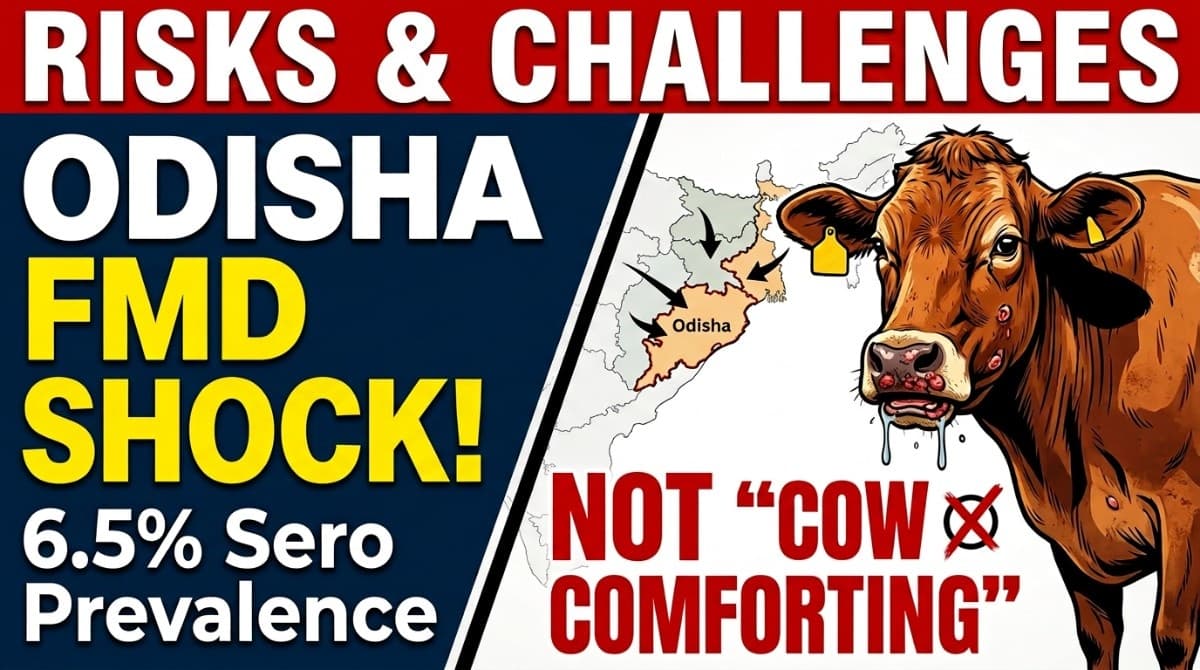
Bhubaneswar: Odisha, which sits along the Foot and Mouth Disease (FMD) hotspot of eastern India, has emerged as one of the success stories under the Narendra Modi government's nationwide livestock vaccination drive.
According to data tabled in the Lok Sabha, Odisha's FMD sero-prevalence (NSP antibody prevalence) stands at just 6.5%, significantly below the national average of 7.8%, indicating limited circulation of the virus among cattle despite being located in one of India's historically vulnerable regions.
The achievement assumes greater significance because Odisha lies at the doorstep of the country's traditional FMD epicentre, sharing long borders with states that have historically witnessed persistent virus circulation.
The state's improved disease surveillance, mass vaccination and declining outbreak numbers suggest that the Livestock Health and Disease Control Programme (LHDCP) is delivering measurable results on the ground.

📱 Get Argus News App
✨FMD Epicentre: Why Odisha's Performance Stands Out
The eastern region has historically accounted for a disproportionately high share of India's FMD burden due to dense cattle movement, porous interstate borders and extensive livestock markets.
|
Region/State |
FMD Scenario |
Comparison with Odisha |
|
Odisha |
6.5% NSP sero prevalence
Below national average; controlled virus circulation
National Average
7.8%
Odisha performs better than India
Eastern Belt (West Bengal, Bihar, Jharkhand)
Historically among the country's highest FMD burden
Odisha has successfully insulated itself despite proximity
Countrywide outbreaks
Declined from 132 (2019) to 32 (2025)
Reflects success of national vaccination programme
The NSP (Non-Structural Protein) antibody prevalence measures exposure to the actual virus rather than vaccine-induced immunity. A lower percentage therefore signifies lower active virus circulation in the field.
Odisha's figure of 6.5% indicates that widespread vaccination has effectively reduced transmission even while neighbouring regions continue to remain epidemiologically challenging.
Why Risk Still Remains High for Odisha
Despite the encouraging numbers, Odisha cannot afford complacency. View the table given below.
|
State |
FMD Status / Zone |
Estimated NSP Sero-Prevalence (Active Virus Circulation) |
Risk Profile / Key Driver |
|
Odisha |
Stabilised Endemic Zone |
6.5% (2025) |
Low. Active virus circulation has been significantly curtailed under the national vaccination programme, with only sporadic outbreaks reported. |
|
West Bengal |
High-Risk Border Zone |
12%–18% (estimated) |
High. Porous international border with Bangladesh and continuous transboundary livestock movement increase the risk of new FMD strain introductions. |
|
Bihar |
Moderate Endemic Zone |
10%–14% (estimated) |
Moderate. Dense cattle population and extensive livestock movement across Nepal and neighbouring states sustain virus circulation. |
|
Jharkhand |
Stabilised Endemic Zone |
8%–11% (estimated) |
Low-Moderate. Lower dairy intensification than neighbouring states, but vulnerable to spillover infections from adjoining high-risk regions. |
Its geographical location continues to expose the state to fresh viral introductions through interstate cattle movement.
The major risk factors include:
- Porous borders with West Bengal, Jharkhand and Andhra Pradesh.
- Seasonal movement of cattle through Balasore, Mayurbhanj and western Odisha.
- Livestock trade in weekly cattle markets.
- Airborne transmission of the virus through infected animals and contaminated transport vehicles.
Another challenge is the state's large population of smallholder dairy farmers, where ensuring timely booster vaccination every six months remains operationally difficult.
Although Odisha has sharply reduced virus circulation, veterinary experts point out that maintaining vaccination momentum is essential because immunity against FMD declines over time.
Odisha's Indigenous Breeds Offer a Natural Advantage
Odisha also enjoys an often-overlooked biological advantage.
Unlike several commercial dairy states dominated by Holstein Friesian crossbreeds, Odisha continues to maintain a sizeable population of hardy indigenous cattle that have evolved under local climatic conditions.
These indigenous breeds generally exhibit milder clinical manifestations after FMD infection than high-yielding exotic crossbreeds.
This natural resilience partly explains why Odisha has managed to keep virus circulation under better control despite operating from a higher-risk epidemiological zone.
Odisha Goal: Becoming FMD-Free Like Haryana and Gujarat
While Odisha has crossed an important milestone, it still trails India's leading dairy states.
Haryana and Gujarat are now among the frontrunners moving towards internationally recognised FMD-free status.
|
Indicator |
Odisha |
Haryana/Gujarat |
|
NSP Sero-prevalence |
6.5% |
5-5.3% |
|
Vaccination |
Extensive |
Extensive |
|
Digital Animal Identification |
Partial |
Nearly universal |
|
Ear-tag linked health records |
Limited |
Comprehensive |
|
Cooperative enforcement |
Moderate |
Strong (AMUL model) |
|
Border biosecurity |
Needs strengthening |
Highly regulated |
The biggest difference lies not in vaccination coverage but in post-vaccination traceability.
States such as Gujarat have integrated every vaccinated animal into digital livestock databases through 12-digit polyurethane ear tags linked with the INAPH/Bharat Pashudhan portal.
Every vaccination, artificial insemination, ownership transfer and booster dose becomes digitally traceable.
This ensures that no vaccinated animal misses its six-month booster schedule.
Why Controlling FMD Matters
Foot and Mouth Disease is seldom fatal in adult cattle, but economically it remains one of the world's most destructive livestock diseases.
An outbreak can trigger:
- Up to 80% immediate decline in milk production.
- Severe mouth ulcers preventing feeding.
- Permanent udder damage.
- Secondary mastitis leading to milk rejection.
- High calf mortality due to myocarditis.
- Long-term decline in productivity.
For a state like Odisha, where dairy income supports thousands of rural households, preventing even a handful of outbreaks translates directly into higher farmer incomes and improved milk availability.
For Odisha To Reach Finish Line, OMFED Must Lead
Odisha's 6.5% sero-prevalence demonstrates that the Modi govt’s vaccination campaign under the Livestock Health and Disease Control Programme (LHDCP) has significantly weakened the virus's footprint in the state.
However, vaccination alone may not be enough to achieve internationally recognised FMD-free status.
To match Gujarat and Haryana, Odisha needs to move beyond mass immunisation towards digital livestock governance.
That means universal ear-tagging, real-time integration with the INAPH/Bharat Pashudhan platform, compulsory tracking of booster doses, stronger animal quarantine checkposts along interstate borders, and tighter surveillance of cattle markets.
Perhaps the biggest opportunity lies with OMFED. Gujarat's AMUL transformed disease control by making digital animal identification virtually inseparable from cooperative milk procurement. A similar "No Tag, No Milk Collection" ecosystem, backed by traceable vaccination records, could dramatically improve compliance in Odisha.
The state has already demonstrated that it can suppress FMD despite living in India's eastern disease corridor.
The next
challenge is more ambitious – not merely controlling the disease, but joining
the select league of Indian states that can confidently declare themselves FMD-free.
Also Read: Amul Mega Venture in Howrah, West Bengal: Is OMFED Listening? | Exclusive
Related Topics
Explore more stories