



The 2024 Turnaround: How Odisha Quietly Built One of India's Cheapest E-Bus Networks While Bigger States Lagged | Exclusive
Key Points
Bhubaneswar: When discussions on India's public transport success stories arise, the spotlight usually falls on Delhi's Metro, Bengaluru's BMTC fleet or Mumbai's suburban rail network. Yet, away from the glare of the country's biggest metropolitan systems, Odisha has quietly engineered what may now be India's most affordable and fastest-growing green public transport model.
Data compiled from state transport systems across India suggest that Odisha's Capital Region Urban Transport (CRUT) has emerged as one of the country's cheapest electric mobility providers for ordinary commuters while simultaneously recording one of the fastest rates of electric bus expansion nationally.
What makes the achievement striking is that Odisha has done so not in a megacity environment but across a network of Tier-II and emerging urban centres including Sambalpur, Berhampur, Puri and Keonjhar.
From Capital-Centric Service to Statewide Mobility Network

📱 Get Argus News App
✨Until a few years ago, CRUT was largely identified with the Bhubaneswar-Cuttack-Puri urban corridor.
That model has now changed dramatically.
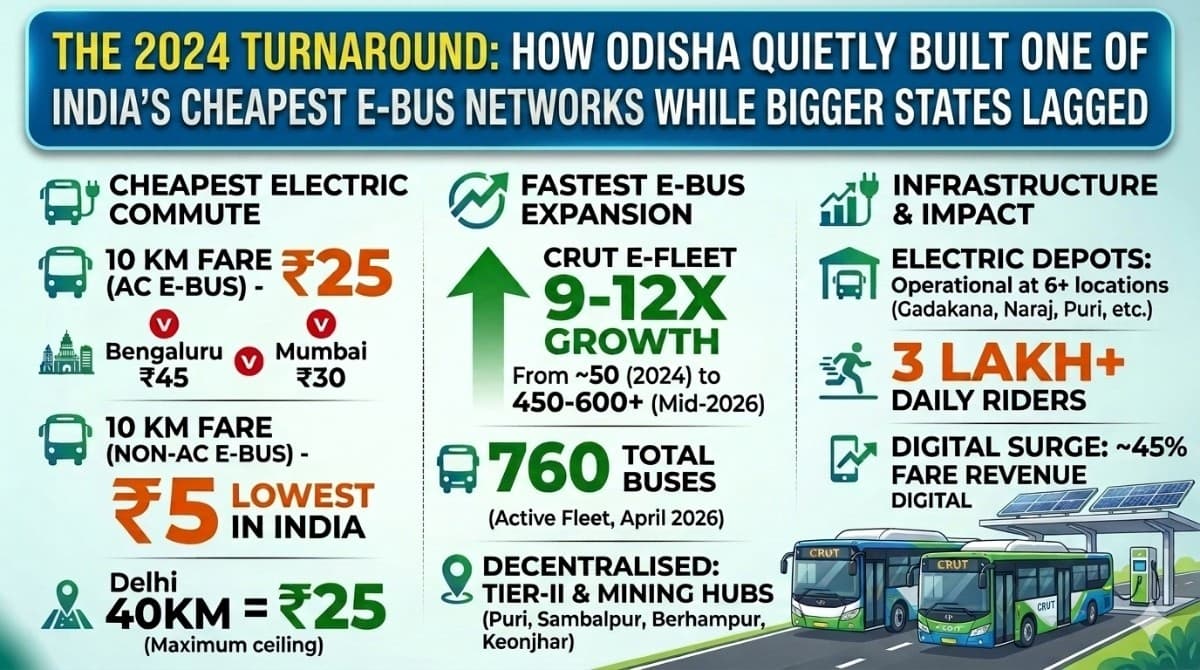
Between 2024 and April 2026, CRUT expanded its active fleet to 760 buses while deploying electric mobility infrastructure across multiple cities. Electric services were introduced in Sambalpur and Berhampur before expanding further into Puri, Naraj and Keonjhar.
The result is a rare example of decentralised public transport growth in India.
While many states continue concentrating electric buses inside their largest cities, Odisha has taken green mobility into industrial, mining and tourism hubs that traditionally remained outside major transit planning exercises.
India's Cheapest Electric Commute
Fare comparisons indicate that Odisha today offers some of the most economical electric bus travel available in urban India.
For a commuter travelling roughly 10 kilometres in an air-conditioned electric bus, Odisha charges around Rs25.
The same journey can cost approximately Rs45 in Bengaluru's premium electric bus network and around Rs30 in Mumbai.
For non-AC e-bus services, CRUT's fare structure stands at Rs 5, among the lowest in the country along with Delhi.
Unlike many
state transport undertakings that rely on large fare slabs, Odisha uses a
smoother distance-based fare structure, preventing passengers from facing
sudden jumps in ticket prices when crossing arbitrary distance stages.
However, Delhi remains the cheapest E bus transport provider in the country. A commuter travelling 40 km will pay only Rs 25. Because it operates with a maximum ceiling price structure, which Odisha may implement as the commuters size grows.
Green Mobility on the Fastest Lane
Perhaps even more significant than fare affordability is the pace of electrification.
Industry estimates indicate CRUT's electric fleet has expanded from roughly 50 buses in early 2024 to between 450 and 600 electric buses by mid-2026.
That represents growth of approximately 9 to 12 times in just over two years.
Although Delhi, Maharashtra and Karnataka operate larger absolute electric bus fleets, Odisha's proportional growth rate places it among the fastest expanding electric mobility programmes in the country.
The Infrastructure Advantage
One of the biggest obstacles to India's electric bus transition has been charging infrastructure.
Across the country, many sanctioned electric buses remain underutilised because charging depots and power infrastructure lag behind procurement.
Odisha appears to have tackled that challenge earlier than most.
CRUT has already operationalised electric depots at Gadakana, Naraj, Puri, Sambalpur, Berhampur and Keonjhar while strengthening supporting infrastructure through new terminals and maintenance facilities.
Transport experts say this infrastructure-first approach has enabled Odisha to deploy buses rapidly instead of leaving vehicles idle.
Three Lakh Daily Riders and Rising
The state's green mobility push is no longer a pilot project.
CRUT now carries more than three lakh passengers daily.
Digital adoption has also surged, with nearly 45 percent of fare revenue now generated through digital transactions.
More than 90,000 ticket bookings have been recorded through the Ama Bus platform, while services such as WhatsApp ticketing and National Common Mobility Card integration have helped expand cashless travel.
Why Odisha's Model Stands Out
The biggest differentiator may be CRUT's financing architecture.
Instead of purchasing buses outright, Odisha has increasingly relied on the Gross Cost Contract (GCC) model under which private operators procure and maintain buses while CRUT retains route control, branding and fare collection.
The approach reduces upfront capital burden on the state while accelerating fleet expansion.
Combined with central assistance under PM eBus Sewa and the planned induction of hydrogen fuel-cell buses, Odisha is positioning itself at the forefront of India's next-generation mobility ecosystem.
A New Mobility Benchmark
For decades, India's urban transport success stories were defined by metro rail projects and mega-city investments.
Odisha is attempting something different.
By combining affordable fares, aggressive electrification, decentralised expansion, digital integration and public-private financing, CRUT is creating a model that may be more relevant for India's growing Tier-II and Tier-III cities than expensive metro systems.
If the
current trajectory continues, Odisha may not only have built one of India's
cheapest electric bus networks – it may also have created a blueprint for how
medium-sized cities across the country can transition to green mobility without
breaking public finances.
Also Read: Odisha Leads India in Health Spending at Nearly 2% of GSDP: SBI Study Suggests Health Investment Paying Off for Children| Special Story
Related Topics
Explore more stories