



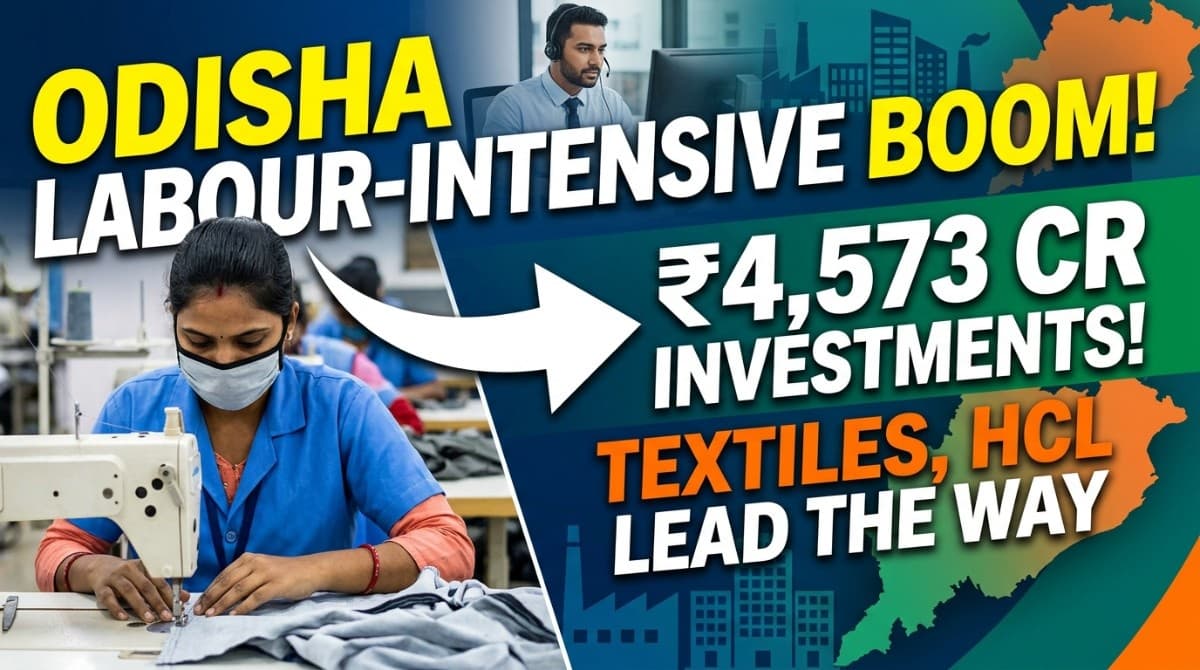
Textiles, HCL Lead Odisha's Labour-Intensive Industrial Evolution as SLWC Clears ₹4,573-Crore Investments | Special Report
Key Points
* The ₹4,573.87-crore SLWC approvals indicate a strategic move from capital-heavy industries to employment-rich manufacturing and IT sectors.
* Apparel, IT, healthcare and clean-tech investments promise faster job creation and wider economic benefits for youth, women and local businesses.
Bhubaneswar: Odisha's latest round of Single Window for Investor Facilitation and Tracking (SWIFT)/State Level Single Window Clearance Authority (SLWCA) approvals may appear at first glance to be another routine investment announcement. But a closer reading of the project mix reveals something far more significant — the state has quietly signalled the beginning of a new industrial evolution.
For decades, Odisha's industrial identity was built on mines, steel plants, aluminium smelters and power projects — sectors that generated massive investments but comparatively fewer jobs. The latest clearance list, however, suggests the state is consciously pivoting towards labour-intensive manufacturing and knowledge-based industries, where every crore invested creates substantially more employment opportunities.
The numbers tell the story.
Against a total proposed investment of Rs4,573.87 crore, the approved projects are expected to generate 22,873 jobs. More importantly, the biggest beneficiaries are sectors such as textiles, apparel, IT services, healthcare and clean technologies—industries capable of employing thousands of Odisha's youth within the next two years.

📱 Get Argus News App
✨Textiles Become the Biggest Employment Engine
If one sector dominates the latest approval list, it is apparel and textiles.
Three companies alone—
- SAPL Industries Ltd
- SPL Industries Ltd
- Richa Global Exports Pvt Ltd
—plan to invest just ₹388.45 crore, but together promise to generate over 10,000 direct jobs.
|
Company |
Investment |
Jobs
SAPL Industries
₹254 crore
4,570
SPL Industries
₹50 crore
3,000
Richa Global Exports
₹84.45 crore
2,500
Total
₹388.45 crore
10,070
That translates to roughly Rs3.8 lakh of investment per job, an extraordinary employment ratio rarely seen in capital-intensive industries.
By comparison, conventional heavy industries such as steel, aluminium and mining often require Rs10–20 crore of investment to create one permanent job.
The contrast underlines the state's changing priorities.
Evidence of a New Industrial Strategy
Rather than depending solely on mega steel and mineral projects, Odisha now appears to be building an industrial ecosystem around three pillars:
- labour-intensive manufacturing;
- knowledge-driven services; and
- sunrise industries such as clean energy and advanced materials.
This diversification is significant because it spreads employment opportunities across different skill levels – from sewing machine operators and diploma holders to software engineers and healthcare professionals.
HCL Brings White-Collar Revolution
While textiles dominate blue-collar employment, HCL Technologies represents perhaps the biggest white-collar breakthrough.
The company plans to establish a Global Development Centre in Khordha with an investment of Rs730 crore, creating 6,000 IT and ITES jobs.
For years, Odisha's engineering graduates largely migrated to Bengaluru, Hyderabad, Pune or Chennai for technology careers.
HCL's proposed campus could begin reversing that trend.
Instead of exporting talent, Odisha may increasingly retain its software engineers, management graduates and technology professionals within the state.
The project also has wider implications.
Historically, technology hubs anchored by major companies have transformed urban economies. Bengaluru and Hyderabad illustrate how IT investments stimulate demand for housing, retail, hospitality, transport, aviation and commercial real estate, generating revenues far beyond corporate activity.
Youth Across Skill Levels Stand to Gain
Beyond HCL and apparel, the approvals reveal a wider employment spectrum.
Among the notable projects are:
|
Project |
Sector |
Investment |
Jobs |
|
HCL Technologies |
IT & ITES |
₹730 crore |
6,000 |
|
SAPL Industries |
Apparel |
₹254 crore |
4,570 |
|
SPL Industries |
Apparel |
₹50 crore |
3,000 |
|
Richa Global Exports |
Apparel |
₹84.45 crore |
2,500 |
|
Growing Tree Oil & Refinery Projects |
Agro-processing |
₹330 crore |
1,585 |
|
Dion Riverside Township Hospital |
Healthcare |
₹275.89 crore |
941 |
|
ACME Cleantech |
Green Energy |
₹778 crore |
480 |
|
GGB Battery India |
Advanced Manufacturing |
₹202.50 crore |
254 |
Collectively, these projects indicate that Odisha is no longer relying on a single industrial narrative.
Instead, employment opportunities are emerging simultaneously in IT, manufacturing, healthcare, agro-processing and clean technologies.
The Apparel Cluster Tells a Bigger Story
Perhaps the most telling signal comes from the simultaneous entry of three major apparel manufacturers.
Industrial analysts often interpret such clustering as evidence of supply-chain confidence rather than isolated investments.
Their arrival aligns with broader global manufacturing shifts driven by the "China+1" strategy.
Traditional sourcing destinations such as Bangladesh face periodic supply-chain uncertainties, while established Indian apparel hubs in Tamil Nadu and Karnataka are grappling with rising land costs and labour shortages.
Odisha, meanwhile, offers dedicated textile parks, plug-and-play infrastructure, competitive power tariffs and comparatively lower operating costs.
Industry executives have increasingly argued that garment manufacturing costs in Odisha are becoming globally competitive, strengthening the state's prospects as an eastern export hub.
Women Could Be Among the Biggest Winners
The apparel projects also carry an important social dimension.
Garment manufacturing has historically emerged as one of the largest employers of women in India's organised manufacturing sector.
Odisha's Apparel and Technical Textiles Policy further reinforces this by offering employment-linked incentives, including a ₹7,000 monthly support per female worker paid to eligible factories.
The combination of formal employment, bank-linked salaries and workforce participation has the potential to significantly improve financial inclusion in districts hosting these projects.
Experiences from Tiruppur in Tamil Nadu and Noida in Uttar Pradesh show that dense garment clusters create secondary economic ecosystems involving transport, rentals, food businesses, retail shops, tailoring services and education.
Benefits Extend Beyond Employment
For the state government, the gains extend well beyond factory gates.
While investment incentives may initially reduce tax collections from industries, economic activity generated by thousands of salaried employees typically boosts:
- State GST collections through higher consumer spending;
- commercial property demand and land values;
- municipal revenues;
- transport services;
- hospitality businesses; and
- local entrepreneurship.
The multiplier effect means each formal-sector job often supports several additional livelihoods in the surrounding economy.
Jobs May Arrive Faster Than Mega Industries
Another noteworthy feature is the implementation timeline.
Unlike integrated steel plants or mining projects that often require years before production begins, many of the newly approved sectors have relatively shorter execution cycles.
- Textile and apparel units are expected to commence hiring within 12–18 months, aided by plug-and-play industrial infrastructure.
- HCL's Global Development Centre could begin phased recruitment over 18–24 months, starting with experienced professionals before expanding campus hiring.
- Green energy and advanced manufacturing projects, such as ACME Cleantech and GGB Battery India, are likely to take 24–36 months, owing to specialised equipment installation and regulatory requirements.
This compressed timeline means employment benefits could begin reaching local youth much sooner than those associated with traditional mega industrial projects.
The Bigger Picture
Odisha's industrialisation story has long been measured in terms of steel output, mineral production and investment figures.
The latest SLWCA approvals suggest the next chapter may instead be measured by employment intensity.
When over 16,000 of the projected jobs come from just HCL and three textile companies, the message becomes difficult to ignore.
Rather than abandoning heavy industry, Odisha appears to be broadening its industrial base by complementing capital-intensive sectors with labour-intensive manufacturing and knowledge industries.
If these
projects are executed on schedule, the latest clearance round may eventually be
remembered not merely for the Rs4,573-crore investment it approved, but for
signalling the beginning of Odisha's transition from a resource-driven economy
to a people-driven industrial growth model – one where investment is
increasingly judged not just by the capital it brings, but by the livelihoods
it creates.
Also Read: Odisha Paradox: No.2 in Private Capital Investment, Yet India's Second Highest Informal Workforce Among Large States| Exclusive