



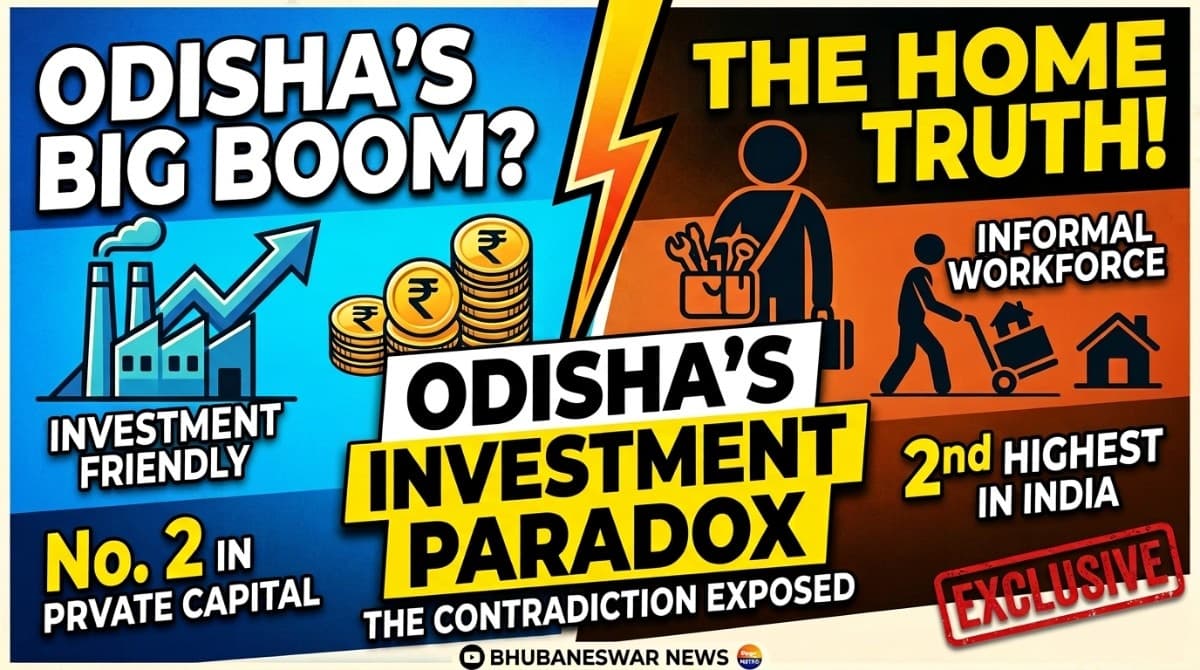
Odisha Paradox: No.2 in Private Capital Investment, Yet India's Second Highest Informal Workforce Among Large States| Exclusive
Key Points
Odisha secured Rs3.41 lakh crore (15.1% share) in domestic private industrial investments during FY25, ranking second nationally behind Andhra Pradesh.
Fresh Lok Sabha data reveals that 1.37 crore e-Shram registrations account for nearly 29% of Odisha's population, marking the second-highest informal labor density among large states.
Heavy capital concentration in steel, mining, and metals drives high state output but creates limited organised employment compared to diversified sectors.
Bhubaneswar: Odisha's economy appears to be writing two sharply contrasting stories at the same time.
Only days after the NITI Aayog's Investment Friendliness Index placed Odisha among India's top investment friendly destinations, fresh data tabled in the Lok Sabha has exposed an uncomfortable paradox.
While the state last year has emerged as the country's second-largest destination for domestic private investments, it also has the second-highest proportion of unorganised workers among India's large states, behind only Uttar Pradesh.
The contradiction is striking.

📱 Get Argus News App
✨On one hand, Odisha attracted Rs3.41 lakh crore, accounting for 15.1 per cent of India's domestic private industrial investments during FY25, narrowly behind Andhra Pradesh's Rs3.45 lakh crore.
On the other, the state's 1.37 crore e-Shram registrations account for nearly 29 per cent of its projected population of 4.72 crore (2026), indicating that nearly one in every three Odias continues to depend on informal livelihoods.
The figures suggest that while investment capital is pouring into Odisha at an unprecedented pace, organised employment has not expanded at a similar rate.
Grey Economy: Odisha Punches Above Much Larger States
The Lok Sabha data, when analysed against projected state populations, presents an even more revealing picture. Although Uttar Pradesh, Bihar and West Bengal have far larger populations and economies, Odisha's informal workforce remains disproportionately high.
|
State |
Projected Population (2026)
e-Shram Registrations
Unorganised Workers as % of Population
Uttar Pradesh
24.35 crore
8.45 crore
35%
Odisha
4.72 crore
1.37 crore
29%
West Bengal
10.06 crore
2.67 crore
26%
Bihar
13.28 crore
3.24 crore
24%
The table underlines Odisha's structural anomaly.
Unlike Uttar Pradesh, whose huge informal workforce is largely explained by its enormous population, Odisha has only about 3.3 per cent of India's population. Yet nearly 29 per cent of its residents are registered as unorganised workers, giving it the country's second-highest informal labour density among large states.
This means Odisha's informal economy is not merely large in absolute terms; it is exceptionally large relative to the size of its population.
Where Odisha's Informal Workers Earn Their Livelihood
The composition of Odisha's informal workforce further explains why industrial growth has not translated into widespread organised employment.
|
State |
Dominant Informal Occupations |
|
Odisha |
Agriculture, agricultural labour, construction, forest produce collection, handloom, artisans, domestic work, transport, loading workers |
|
Uttar Pradesh |
Agriculture, MSMEs, leather, handloom, construction, cottage industries |
|
West Bengal |
Retail trade, informal manufacturing, transport, agriculture, domestic work |
|
Bihar |
Agriculture, migrant labour, construction, informal services, seasonal work |
In Odisha, agriculture and allied activities account for over 55-60 per cent of the registered informal workforce. Construction forms the second-largest employer, followed by domestic workers, transport workers, traditional artisans, weavers, bamboo workers and forest produce collectors.
The occupational profile reflects an economy where informal livelihoods continue to dominate despite rapid industrial expansion.
How 'More' Investment Is Delivering 'Less' Organised Employment
The contrast becomes sharper when Odisha is compared with Andhra Pradesh – the only state that attracted more domestic private investment during FY25.
|
Indicator |
Andhra Pradesh |
Odisha |
|
Domestic Private Investment (FY25) |
Rs3.45 lakh crore |
Rs3.41 lakh crore |
|
National Share |
15.3% |
15.1% |
|
Principal Investment Sectors |
Electronics, Renewables, AI Hubs |
Steel, Green Energy, Metals |
|
Unorganised Workers |
85.86 lakh |
1.37 crore |
|
Informal Workers as % of Population |
16-18% |
29% |
Despite attracting almost identical volumes of domestic private investment, Odisha's informal labour intensity is nearly twice that of Andhra Pradesh.
The explanation lies in the nature of investments.
Andhra Pradesh's investment basket is increasingly diversified towards electronics manufacturing, renewable energy equipment, AI hubs and advanced manufacturing, sectors capable of generating broader organised employment across skill levels.
Odisha's investment pipeline, although expanding into green energy, continues to be dominated by steel, mining, metals, ports and heavy industries – sectors that require enormous capital but relatively fewer workers.
Economists describe this as high capital formation with low employment elasticity.
Bottom Line: Odisha's Growth Story Needs More Jobs Than Capital
Odisha's latest investment success is undeniable.
The state has successfully positioned itself as one of India's preferred destinations for domestic private capital, thanks to policy reforms, improved infrastructure and a proactive industrial promotion strategy. The new government has also begun broadening the investment portfolio beyond mining by pursuing semiconductors, textiles, electronics, food processing, tourism and renewable energy.
Yet the Lok Sabha data exposes a deeper structural challenge.
First, Odisha's industrial engine continues to rely heavily on mining, steel, metals and other capital-intensive sectors, which contribute significantly to Gross State Value Added (GSVA) and government revenues but create relatively limited organised employment.
Second, there appears to be a persistent skill mismatch. The emerging industries that Odisha seeks to attract increasingly demand technicians, engineers, electronics workers, machine operators and digitally trained manpower. Much of the state's existing workforce, however, remains concentrated in low-skilled agriculture, manual construction and traditional occupations.
The result is a paradox where investment is rising faster than employment formalisation.
For the Mohan Charan Majhi government, therefore, the next phase of Odisha's economic transformation will not be measured merely by how many lakh crores of investment it attracts. It will be judged by whether those investments can shift millions of workers from the grey economy into formal, productive and socially protected jobs.
Because in
Odisha today, the challenge is no longer attracting capital – it is ensuring
that capital creates enough quality jobs.
Also Read: Investment Friendliness Index 2026: Odisha Sits Among India's Top Five, But NITI Aayog Flags Single-Window, Institutional Gaps| Exclusive