



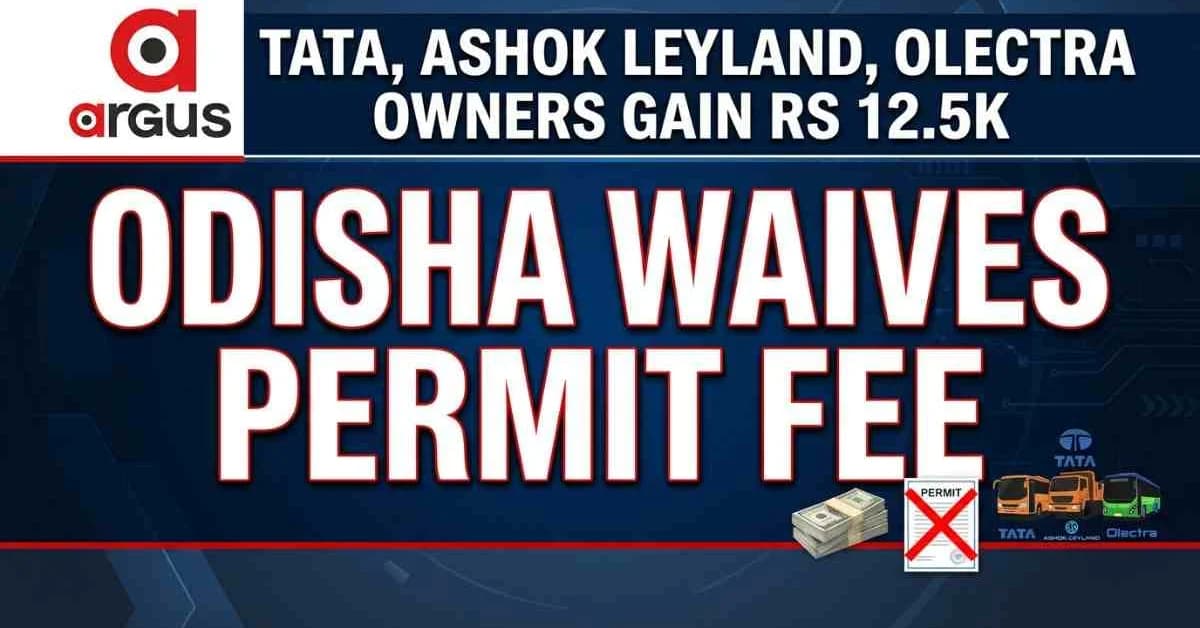
Tata, Ashok Leyland, Olectra Owners Among Those Set to Gain Rs 12.5K as Odisha Waives Permit Fee for Green Commercial Vehicles| Special Report
Key Points
Bhubaneswar: In tandem with the Ministry of Road Transport and Highways’ (MoRTH) July 6 notification, Odisha on Wednesday became the sixth state to adapt the central guideline waiving permit fees for green commercial vehicles.
The policy could benefit owners and fleet operators of qualifying electric, ethanol and methanol-powered commercial vehicles, particularly in the heavy goods and passenger transport segments.
The biggest potential beneficiaries include commercial vehicle owners using eligible models from brands such as Tata Motors, Ashok Leyland, Eicher, Olectra Greentech, JBM Auto and Switch Mobility, provided the vehicles meet the prescribed fuel and weight conditions.
Sixth State to Move: How States Have Followed the MoRTH Route

📱 Get Argus News App
✨Odisha is now among a small group of states that have moved to operationalise the central permit exemption framework for green commercial transport.
|
State/UT |
Status of Permit Fee Waiver |
|
Odisha |
Active; notification issued on August 20, 2026 |
|
Telangana |
Active alignment
Andhra Pradesh
Active alignment
Maharashtra
Active alignment
Delhi
Active alignment
Haryana
Active alignment
The policy is significant because the MoRTH’s revised framework has expanded the earlier EV-focused exemption to include ethanol and methanol-fuelled commercial vehicles and provides for a seven-year exemption window under the central framework.
Nearly 19,400 Commercial Vehicles Could Be in the Beneficiary Zone
The immediate beneficiary base in Odisha, however, appears concentrated overwhelmingly in the electric vehicle segment. The state's commercial fleet is estimated at around 4.5 lakh vehicles, of which about 19,400 clean-fuel commercial vehicles could potentially fall within the policy's beneficiary universe, subject to the notification's conditions.
|
Commercial Vehicle Segment |
Estimated Clean-Fuel Vehicles |
Eligibility Outlook |
|
Commercial 3-wheelers |
~19,000 |
Potentially eligible, subject to applicable permit and vehicle conditions |
|
Electric buses/stage carriages |
~250 |
Eligible |
|
Heavy goods carriages above 3,000 kg GVW |
~150 |
Eligible |
|
Methanol/ethanol commercial fleets |
~0 |
Eligible in principle, but negligible current fleet |
|
Total potential clean commercial fleet |
~19,400 |
Subject to policy conditions |
The larger policy objective appears to be the heavy commercial transport segment, where diesel still overwhelmingly dominates Odisha's industrial, mining and logistics economy. At present, green vehicles account for only a tiny share of the heavy goods carriage market, giving the waiver the character of an investment incentive for future fleet conversion rather than merely a subsidy for the existing market.
Which Tata, Ashok Leyland, Eicher and Bus Models Are Eligible?
The Odisha notification covers commercial transport vehicles powered by battery-operated electric systems, ethanol or methanol. But there is an important filter: goods vehicles with a gross vehicle weight below 3,000 kg are excluded from the exemption.
This means the biggest beneficiaries are likely to be larger electric trucks, heavy goods carriers and electric buses.
|
Brand/Manufacturer |
Models/Vehicle Category Likely to Qualify* |
|
Tata Motors |
Ultra/heavier electric commercial truck range |
|
Ashok Leyland |
AVTR/BOSS electric commercial truck range |
|
Eicher |
Pro series electric commercial trucks |
|
IPL Tech Electric |
Rhino heavy-duty electric tippers |
|
Olectra Greentech |
K9, C9 and CX2 electric buses |
|
JBM Auto |
EcoLife electric buses |
|
Switch Mobility |
EiV series electric buses |
*Eligibility will ultimately depend on the exact vehicle specifications, registration details, fuel classification and the applicable GVW threshold.
The policy, therefore, is not a blanket waiver for every electric commercial vehicle.
Popular smaller electric cargo vehicles and mini-trucks falling below the 3,000-kg GVW threshold would remain outside the exemption.
The distinction could make the policy especially relevant for large fleet operators in mining, steel, logistics, passenger transport and inter-city freight.
How Vehicle Owners Can Claim the Permit Fee Waiver
Eligible operators will still have to obtain a valid commercial permit. What the policy waives is the permit fee, not the requirement to hold a permit itself.
The application is expected to be processed through the Parivahan/Vahan permit system. Operators should:
1. Ensure that the vehicle's RC correctly records the eligible fuel type – battery-operated, ethanol or methanol.
2. Ensure compliance with applicable AIS-140 tracking and other statutory requirements.
3. Apply for a new permit or permit renewal through the designated Parivahan permit portal.
4. Upload the required documents, including RC, fitness certificate and insurance.
5. Select the relevant commercial permit category.
6. At the fee stage, the eligible permit fee should be waived under the green vehicle category, subject to system and regulatory verification.
What Owners Save
The permit fee waiver could translate into meaningful savings for Odisha’s green commercial vehicle owners over a standard five-year permit cycle.
Based on the current fee structure, a stage carriage bus owner can save Rs12,500, a contract carriage operator Rs7,500 and a goods vehicle owner above the 3,000-kg GVW threshold Rs5,000.
This works out to an average saving of Rs8,333 across the three core eligible heavy commercial vehicle categories.
The waiver, however, applies only to the recurring grant/renewal fee, while the non-refundable application processing fee of Rs100-Rs750 will still have to be paid upfront.
The key
point for fleet owners is clear: the permit does not disappear; the cost of
obtaining or renewing the qualifying permit does. Other statutory
requirements – including registration, fitness, insurance and applicable
compliance conditions – remain in force.
Also Read:ETI 2026: Modi Govt Green Push Pips China, Japan in Asia; Odisha Emerges Key Player| Exclusive
Related Topics
Explore more stories