



ETI 2026: Modi Govt Green Push Pips China, Japan in Asia; Odisha Emerges Key Player| Exclusive
Key Points
* Odisha is emerging as a major green-energy hub with investments in solar manufacturing, energy storage and renewable infrastructure.
* WEF ETI 2026 shows India's energy transition increasingly powered by large-scale infrastructure creation and industrial capacity building.
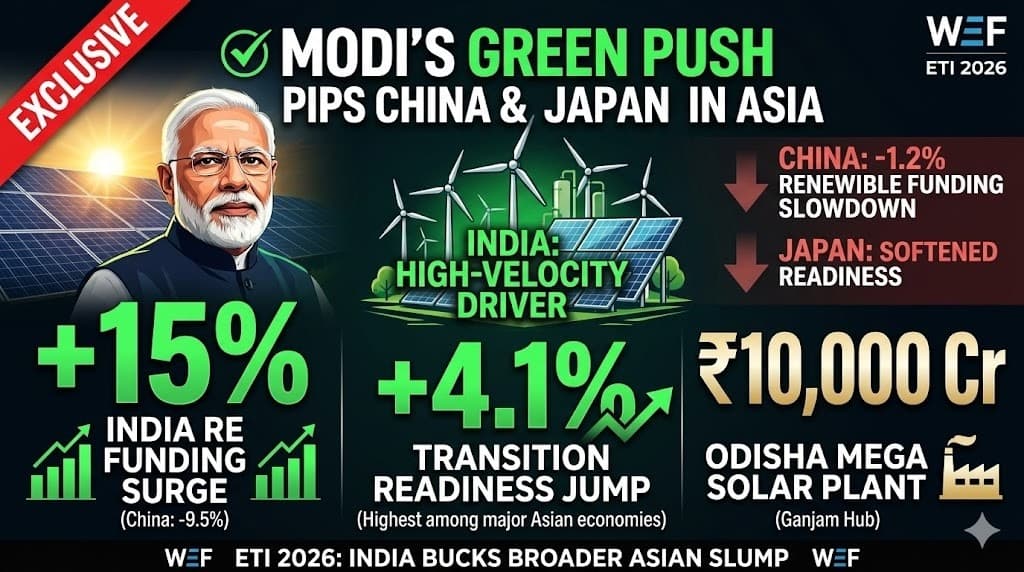
Bhubaneswar: In a major endorsement of Prime Minister Narendra Modi's green-energy push, the Energy Transition Index (ETI) 2026 released by the World Economic Forum (WEF) places India among Asia's fastest-rising energy-transition economies.
Significantly, the index highlights a distinct trend: while several major economies are grappling with structural bottlenecks, India is emerging as a high-velocity driver of clean-energy infrastructure expansion.
While India remains ranked 70th globally, reflecting the scale of its legacy fossil-fuel infrastructure and development challenges, the index reveals a far more significant trend beneath the headline ranking. India secured a 1.9% increase in its overall ETI score and a remarkable 4.1% jump in Transition Readiness, bucking the broader stagnation seen across Emerging Asia.
The Emerging Asia region as a whole witnessed a largely flat transition trajectory in 2026, registering a marginal decline of 0.1% amid sharp contractions in finance (-7.7%) and innovation (-3.4%).

📱 Get Argus News App
✨Yet, this improvement mirrors the infrastructure-led clean-energy strategy pursued by the Narendra Modi-led government, with states such as Odisha emerging as important pillars of the country's evolving green-energy architecture.
Global Context: India vs Asia's Giants
To understand the scale of India's progress, ETI 2026 places the country alongside major Asian energy players, revealing sharply contrasting trajectories in balancing current system performance with future readiness.
|
Indicator |
China |
Japan |
India
Global ETI Rank
14
24
70
ETI Score
66.9
65.5
54.9
System Performance Score
65.3
67.2
60.5
Transition Readiness Score
69.4
62.9
46.4
YoY ETI Score Change
-1.2%
+0.8%
+1.9%
Renewable Energy Funding Trend
-9.5%
Stable
+15%
Transition Readiness Change
Softened
-0.8%
+4.1%
Key ETI Narrative
Funding slowdown amid regulatory uncertainty
Benefited from lower gas prices
Fastest improvement in readiness and clean-energy momentum
What the Numbers Show
- China remains Asia's highest-ranked energy-transition economy, but its overall ETI score declined amid a slowdown in renewable-energy investment.
- Japan improved its overall ranking, helped largely by lower energy costs that boosted industrial affordability.
- India posted the strongest momentum, recording the highest score growth among the three major Asian economies and a sharp rise in transition readiness, reflecting rapid expansion in clean-energy infrastructure, manufacturing and grid investments
|
Who Leads In... |
Country |
|
Overall ETI Rank |
China |
|
System Performance |
Japan |
|
Transition Readiness |
China |
|
Annual Score Growth |
India |
|
Renewable Investment Growth |
India |
|
Transition Readiness Improvement |
India |
The Capital Surge & Odisha's Strategic Pivot
One of the clearest messages from ETI 2026 is India's ability to attract and deploy clean-energy capital even as investment momentum weakened across much of the region. While China witnessed a 9.5% decline in funding, India expanded renewable-energy funding by 15% year-on-year to reach $68 billion in 2025.
This influx of capital has been supported by structural policy measures aimed at de-risking green investments, including the Production-Linked Incentive (PLI) schemes for high-efficiency solar PV modules and advanced chemistry cell batteries.
While the ETI evaluates national performance rather than individual states, Odisha's recent investments in solar manufacturing, energy storage and green-hydrogen infrastructure offer a compelling example of the sub-national capacity expansion underpinning India's improving readiness indicators.
Rather than
relying on broad projections alone, project-level data shows Odisha rapidly
positioning itself as a major destination for green-energy investment,
transitioning from a mining-dependent economy to an emerging hub for renewable
manufacturing and storage infrastructure.
- Ganjam Cell & Wafer Plant: In June 2026, Odisha’s High-Level Clearance Authority (HLCA) approved a Rs10,000 crore mega-investment by Tata Power Renewable Energy Limited to set up an ingot, wafer, and Solar PV Cell manufacturing unit in the Ganjam district.
- The Solar Value Chain Boost: Simultaneously, Saatvik Solar Industries received clearance to invest Rs1,709 crore for a separate Solar PV Cells manufacturing plant, feeding directly into India’s national push to increase domestic supply chain resilience.
- Odisha Investor Conclave 2026: At the state's Renewable Energy Investor Conclave, the state-owned power trading utility GRIDCO locked in massive investment commitments totaling Rs67,000 crore for 6.8 GW of renewable projects, including large-scale hybrid solar-wind installations integrated with Battery Energy Storage Systems (BESS).
Infrastructure Scaling: Grid Upgrades & Pumped Storage
Grid capacity remains a critical determinant of any successful energy transition. ETI 2026 highlights India's improving physical readiness, including a 12.3% increase in infrastructure expansion. At the national level, this reflects initiatives such as the Green Energy Corridor project, which is building dedicated transmission infrastructure to connect renewable-energy hubs with major demand centres.
To address the intermittent nature of solar and wind power while maintaining grid stability, Odisha has accelerated development of large-scale pumped-storage projects, creating a reliable balancing mechanism for future renewable deployment.
Cultivating a Green Workforce
One of India's strongest performances in ETI 2026 came in human capital and talent development, where the country led regional peers with a 12.8% increase. The report notes that low-carbon employment expanded sharply, with renewable-energy jobs reaching approximately 1.3 million nationwide.
Odisha has emerged as a significant contributor to this trend. The major investments cleared by the state during 2026 are projected to generate more than 50,000 jobs across multiple districts, while new solar manufacturing projects alone are expected to create thousands of direct high-skill employment opportunities.
The state's existing renewable-energy base, including hydroelectric assets such as Balimela and Upper Indravati, continues to support a growing pool of specialised engineering and technical talent that aligns closely with the workforce metrics highlighted in ETI 2026.
The Bottom Line
ETI 2026 suggests that India's energy transition is increasingly being driven by large-scale infrastructure creation and industrial capacity building rather than policy declarations alone. From solar manufacturing and transmission corridors to pumped-storage assets and green-hydrogen ecosystems, states such as Odisha are emerging as critical building blocks in India's effort to convert climate ambition into measurable economic and energy-system outcomes.
As the
country seeks to accelerate its clean-energy transition, the combination of
national policy support and state-level execution appears to be providing the
momentum reflected in the latest WEF rankings.
Also Read: As Gujarat, Maharashtra, West Bengal Join Coal Gasification Race, How Odisha Is Emerging India's Front-Runner| Special Story
Related Topics
Explore more stories