



SPECIAL REPORT| The Twin-City Festive Ticking Time Bomb — Why Bhubaneswar and Cuttack Are Sitting on a Kolkata-Style Pandal Powder Keg
Key Points
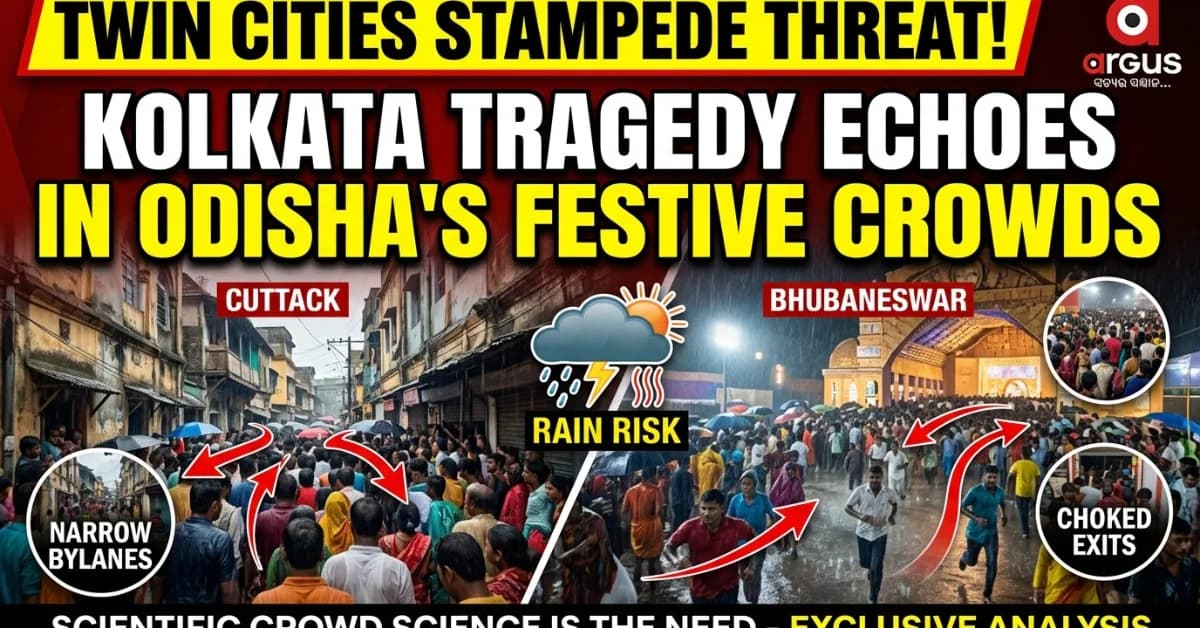
Kolkata Tragedy Parallel: Spatial mapping shows key pandal and Ravan Podi venues in Cuttack and Bhubaneswar face the same narrow-lane and exit-bottleneck risks that caused Kolkata's fatal stampede.
Unpredictable Weather Vulnerability: Rain or dust storm forecasts, combined with high temperatures, present a sudden panic trigger that could cause crowds to surge toward narrow exits.
Call for Dynamic Crowd Management: Experts urge Twin City Police to move beyond static platoon deployments and adopt proactive flow metering, emergency PA protocols, and strict exit channelizing.
Bhubaneswar: In the wake of the catastrophic Chorbagan Sarbojanin Durga Puja stampede in North Kolkata, which left 19 dead and dozens asphyxiated in a rain-triggered claustrophobic bottleneck, a chill has swept through the administrative corridors of Odisha’s Twin Cities.
Officially, the Twin City Commissionerate Police, led by Police Commissioner Dr. Suresh Dev Datta Singh, has issued stern advisories, deployed around 140 platoons of police personnel across Bhubaneswar and Cuttack, and promised stringent legal action against structural or safety violations.
Yet, a granular, field-level spatial analysis reveals a terrifying reality: underneath the glossy veneer of bureaucratic compliance, multi-layered regulatory paperwork, and public relations assurances, multiple mega-pandals and Ravan Podi (effigy-burning) arenas across Bhubaneswar and Cuttack are currently sitting on a structural and crowd-engineering powder keg that directly mirrors the fatal vulnerabilities of the Kolkata disaster.
The threat is further compounded by a precarious atmospheric trap.

📱 Get Argus News App
✨While the India Meteorological Department (IMD) seven-day forecast officially carries a green-coded "No Warning" label for the festive window, the fine print of the meteorological bulletin explicitly forecasts a "possibility of rain or Thunderstorm or Duststorm" coinciding with high daytime temperatures peaking between 33°C and 34°C.
In the volatile theater of crowd psychology, an official meteorological warning is irrelevant; it takes less than fifteen minutes of an unpredicted, sharp downpour or a sudden dust storm to turn a highly dense, un-metered gathering into a stampeding mass of humanity fleeing for structural shelter.
MAPPING THE TWIN-CITY POWDER KEGS
Crowd disasters are rarely caused by a single malicious act; they are the mathematical consequence of compressing a fluid mass of human beings into a restrictive physical geometry.
The Kolkata stampede was fundamentally an operational flow crisis: a sudden rainstorm forced a mass inward surge into a narrow residential lane, encountering a dead-stop blockage of people refusing to exit into the rain, which ultimately caused a fatal crush down an exit staircase.
When evaluating the Twin Cities through this exact geographical lens, the festive map breaks down into three distinct high-risk zones.
1. Cuttack’s Historic Core: The Absolute Spatial Bottleneck
Cuttack, a millennium-old urban expanse, possesses an old-city topography that is almost identical to the cramped, residential gridlock of North Kolkata. Here, the built environment offers zero buffer capacity.
·
Choudhury Bazar Durga Puja Mandap & Balu Bazar: These iconic venues
represent the most severe spatial vulnerabilities in the state. Devotees
seeking a glimpse of the famous silver filigree (Chandi Medha) must
navigate intensely tight, historic commercial corridors and residential bylanes
flanked closely on both sides by old masonry buildings. The approach paths are
so narrow that horizontal dispersal is physically impossible. If a sudden,
sharp downpour occurs during the peak evening rush, thousands of visitors will
naturally try to force their way forward into the covered mandap area to escape
the rain. Simultaneously, those inside will halt, refusing to step out into the
downpour. This creates a classic, dual-directional pressure trap. Without open
staging grounds, a localized panic can trigger an immediate, fatal crush.
· Binod Behari Mandap: Tucked deep within a dense, high-congestion trading hub, this mandap operates on an incredibly constricted urban footprint. During peak Ashtami and Navami nights, pedestrian traffic slows to a crawl, creating a state of critical crowd density (exceeding 4 to 5 people per square meter). At this threshold, individual physical autonomy is completely lost; the crowd behaves like a fluid shockwave. If a sudden dust storm or localized weather disruption causes a panic, the lack of an immediate, open holding area means the crowd has nowhere to vent its pressure.
2. Bhubaneswar’s Mega-Pandals: The Artificial Enclosure Trap
In contrast to Cuttack, the capital city of Bhubaneswar benefits from wide roads and modern planning. However, its hazard is artificial. Organizers here erect massive, immersive themed structures on open grounds, but then inadvertently choke the perimeters with commercial installations, food stalls, and complex barricade funnels.
· Jharpada Durga Puja Ground: Renowned for drawing some of the highest festive footfalls due to its extravagant, high-budget themes, Jharpada represents a classic "enclosure trap." While the primary field is large, the installation of extensive fairground attractions, commercial stalls, and heavy perimeter fencing drastically reduces the net exit width. When tens of thousands of people gather inside the fairground, the actual space available for movement is severely compromised. A sudden, unpredicted weather shift will cause thousands to bolt simultaneously toward a few designated, narrow boundary gates. This turns open fields into high-pressure crush zones right at the exit perimeter.
· Saheed Nagar Durga Puja Ground: Situated deep within a bustling, high-density commercial and residential district, this venue funnels its exiting crowds into secondary commercial alleys and traffic intersections. The internal pathways within the festive zone are tightly lined with temporary stalls, creating artificial bottlenecks. Should an emergency evacuation become necessary, these commercial structures act as physical blockades, severely restricting the safe outflow of panic-stricken visitors.
3. The Ravan Podi Arenas: High-Velocity Explosive Risks
While pandals present a static structural risk, the Ravan Podi (effigy-burning) events on Dussehra introduce a high-velocity dynamic threat where massive crowd density directly coexists with heavy, high-decibel pyrotechnics.
·
Nayapalli Durga Puja & Ravan Podi Ground: This site is arguably
the most volatile explosive-crowd flashpoint in the Twin Cities. The massive
60-foot effigy attracts audiences that easily scale toward one lakh people.
Geographically, the ground is tightly bordered by commercial structures,
residential quarters, and the high-speed service roads of the National Highway
(NH-16). The audience is compressed into a highly restricted viewing rectangle.
If a high-intensity firework shell misfires horizontally – a direct structural
risk demonstrated during the Rourkela Sector-13 Ravan Podi mishap – thousands
of people will instantly flee away from the explosion zone. This massive wave
of humanity will surge toward the narrow NH-16 service road exits, creating an
immediate stampede trap against traffic barricades and oncoming highway
traffic.
· Balijatra Padia / Mahanadi River Bank (Cuttack): This expansive open-air venue hosts a staggeringly vast congregation for its Ravan Podi fireworks. While the field itself is wide, its primary exit topography introduces a lethal hazard: the steep, sloping embankments leading up to the main Cuttack Ring Road. When the display concludes, or if a sudden weather disruption occurs, the entire mass of humanity attempts to scale these dark, inclined access paths simultaneously. This configuration introduces the dangerous "staircase or incline effect" seen in Kolkata. In a high-density, rushed exit, if a single individual trips or stumbles on the slope, it triggers an immediate domino-effect crowd collapse, where trailing rows of people fall over each other, leading to rapid compressive asphyxiation.
WHERE THE COMMISSIONERATE POLICE ARE LACKING
An objective evaluation of the public statements and deployments by the Twin City Commissionerate Police reveals a profound disconnect between traditional policing and scientific crowd management. The current security blueprint displays three critical, systemic failures that leave the cities deeply vulnerable to a snap crisis.
|
Commissionerate Police Focus(Reactive) |
Critical Crowd Science Need(Proactive) |
|
• Heavy deployment of static platoons |
• Dynamic Inflow Metering & Perimeter Taps |
|
• Fire, electrical, & structural certificates |
• Weather Contingency & Real-Time Flow Ratios |
|
• Plainclothes personnel targeting theft |
• Public Address System Control Protocols |
|
• Warning against "law & order" violations |
• Scientific One-Way Routing & Ramp Controls |
1. The Fallacy of Static Force vs. Dynamic Flow
The police administration has heavily publicized the deployment of nearly 140 platoons across the Twin Cities. However, in crowd dynamics, sheer numbers do not equal control. Deploying static rows of police personnel at major intersections or inside the pandals handles vehicle parking and basic law-and-order, but does nothing to regulate pedestrian fluid dynamics.
If a crowd crush begins inside a narrow lane in Cuttack, stationary police personnel can actually worsen the situation by occupying valuable physical walking space, reducing the effective width of an already choked escape route. The police are treating the festive crowd as a static assembly to be watched, rather than a dynamic fluid mass that must be continuously metered.
2. Regulatory Compliance Over Operational Resilience
The police have placed immense emphasis on organizers obtaining mandatory fire safety, electrical safety, and structural stability certificates.
While vital to prevent fires or stage collapses, these documents offer a false sense of security regarding crowd pressures.
A pandal can be 100% structurally sound, yet still become the site of a horrific stampede if the rate of human inflow exceeds the physical capacity of the exit gates.
The current police strategy completely fails to account for real-time operational resilience – such as how to manage flow when an unpredicted 15-minute thunderstorm strikes and changes human behavior instantly.
3. A Criminal vs. Behavioral Approach to Crowd Control
By focusing heavily on deploying plainclothes officers to prevent petty theft and issuing stern warnings against "law and order violations," the administration is operating under an outdated paradigm.
Stampedes are almost never caused by "bad actors" or criminals actively breaking the law; they are caused by normal, predictable human behavior under stress. When a person runs to avoid a flying firework splinter or pushes forward to seek shelter from heavy rain, they are acting on basic survival instincts. Presenting a reactive law-and-order posture does absolutely nothing to manage the physical shockwaves that rip through a dense crowd when panic strikes.
THE REQUIRED BLUEPRINT: A SCIENTIFIC SOP FOR THE TWIN CITIES
To systematically dismantle the festive powder kegs in Bhubaneswar and Cuttack, the Commissionerate Police must immediately move past standard policing and enforce a highly technical, data-driven Dynamic Crowd Engineering Standard Operating Procedure (SOP).
The following four pillars form the definitive blueprint required to guarantee public safety:
1. Implementation of Real-Time Perimeter "Inflow Metering"
The police must stop managing crowd density at the pandal gates and instead control the "tap" hundreds of meters away.
· The Protocol: For high-risk, narrow-lane zones like Cuttack’s Choudhury Bazar or Balu Bazar, the police must calculate the maximum safe carrying capacity of the street (holding a safe baseline of no more than 2 people per square meter). Interlocking holding barricades must be established at an outer perimeter 300 to 500 meters away from the mandap.
· The Flow Mechanism: Police personnel at the outer perimeter must dynamically meter the crowd – releasing a fresh batch of 100 devotees only when automated counters or field spotters confirm that 100 individuals have successfully exited the other side of the zone. If a sudden downpour occurs, the outer tap must be shut instantly to prevent additional pressure from stacking against the choked inner core.
2. Absolute Police Takeover of Public Address (PA) Systems
The Kolkata tragedy was severely accelerated when a panicking organizer made a rogue announcement over the microphone regarding a potential structural collapse.
· The Protocol: Pandal committees and private organizers must be stripped of their authority to make ad-hoc emergency announcements during peak hours. The main audio console of every major pandal’s PA system must be physically co-occupied by a trained police communications officer.
· The Execution: In the event of a sudden downpour, power failure, or firework mishap, the police must enforce absolute microphone silence from organizers. Only pre-recorded, low-frequency, calm, and instructional audio messages directed by the police should be broadcast to guide the crowd in a structured, orderly fashion, preventing mass acoustic panic.
3. Scientific Explosion-to-Exit Scaling for Ravan Podi
The current 100-meter safety radius mandated for fireworks is a static fire-prevention rule that ignores flight-panic speeds.
· The Protocol: The total width of available exits at grounds like Nayapalli, Jharpada, and Baramunda must be mathematically scaled to the explosive payload of the fireworks detonated. If high-decibel, high-intensity pyrotechnics are used, the exit gates must be widened proportionally to handle an accelerated evacuation speed.
· The Geometry: Temporary commercial installations, food trucks, and fun-fairs must be banned within a 150-meter radius of the main exit funnels. Furthermore, at the Mahanadi riverbank in Cuttack, all sloping access paths leading to the Ring Road must be heavily terraced, floodlit with high-intensity halogen arrays, and lined with continuous physical handrails to completely eliminate the risk of a domino-effect stumbling collapse.
4. Mandatory Anti-Rain "Keep Moving" Corridors
Since the IMD forecast explicitly identifies a persistent risk of rain and thunderstorms across the festive period, a dedicated weather-contingency flow protocol is non-negotiable.
· The Protocol: Inside any indoor or covered mandap structure, the police must install solid, one-way pedestrian channelizers (heavy-duty zig-zag barricades) that make it physically impossible for a visitor to stand still or backtrack.
· The Execution: Even if a sudden thunderstorm hits, field police must strictly enforce a "Keep Moving" directive within the covered zone. Visitors must not be permitted to anchor themselves inside the structure to stay dry, as doing so creates a deadly physical wall against the thousands of people still pushing inward from the rain outside.
THE BOTTOMLINE
The festive season across Bhubaneswar and Cuttack represents a live theatre of culture, art, and community fusion. However, as the tragic lesson from Kolkata demonstrates, a celebration can transform into a mass-casualty crime scene in less than two minutes if spatial geography is ignored.
The Twin City Commissionerate Police cannot afford to rely on the luck of the past twenty years, nor can they hide behind the shield of a green-coded IMD "No Warning" forecast.
The latent structural risks are mapped, the atmospheric triggers are clearly stated in the forecast print, and the crowd physics are unyielding. It is time for the administrative machinery to abandon outdated, reactive policing methods and aggressively implement dynamic, scientific crowd engineering.
Until the police transition
from counting platoons to engineering fluid human flow, the magnificent pandals
and roaring Ravan Podi arenas of the Twin Cities will remain a series of tragic
disasters waiting to happen.
Also Read: EXCLUSIVE | With 86K New Vehicles on Road, Will Bhubaneswar CP’s 2025 Durga Puja Traffic Playbook Still Work in 2026?
Related Topics
Explore more stories