



EXCLUSIVE | With 86K New Vehicles on Road, Will Bhubaneswar CP’s 2025 Durga Puja Traffic Playbook Still Work in 2026?
Key Points
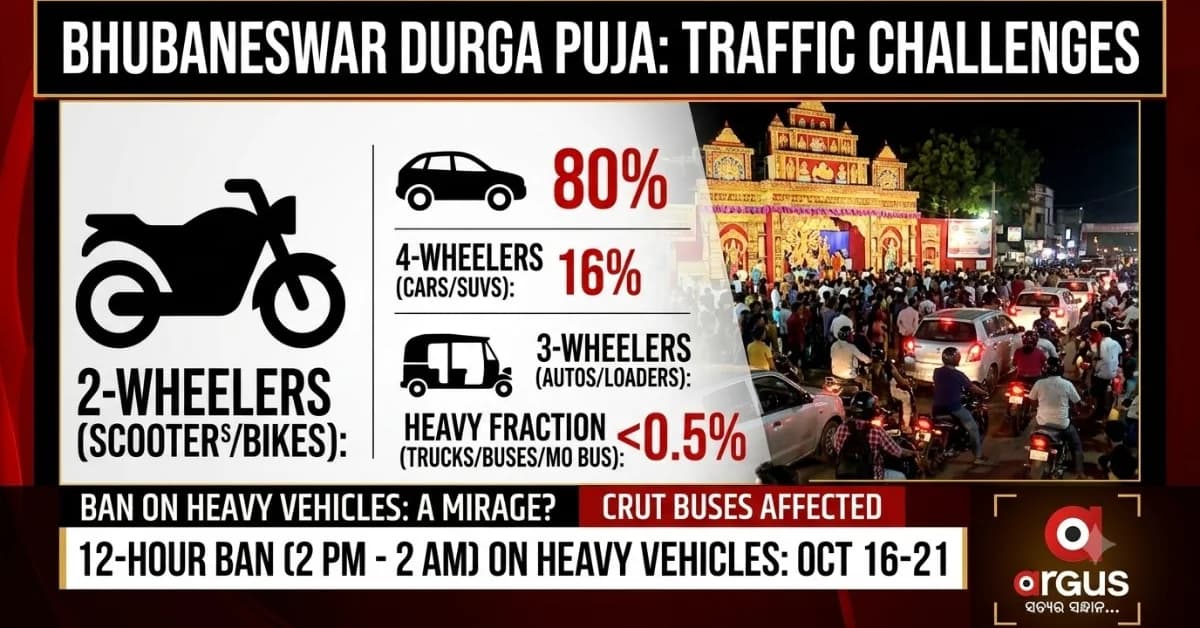
Strict 12-Hour Ban: Heavy vehicles banned from 2:00 PM to 2:00 AM across major Bhubaneswar corridors from October 16 to 21.
The 0.5% Paradox: Banning heavy vehicles targets less than 0.5% of traffic, leaving over 14.7 lakh private cars and two-wheelers unchecked.
Metro Strategy Gap: Experts suggest Bhubaneswar needs Kolkata-style one-way circuits and Mumbai-style parking management to truly prevent festive gridlock.
Bhubaneswar: With the capital city of Bhubaneswar having added over 14 thousand new four-wheelers and 72 thousand new two-wheelers to its streets since 2025, alongside 90 new CRUT buses joining the city’s arterial roads by 2026, the road network faces unprecedented pressure. Given this surge and the looming pedestrian bombardment on the asphalt base, the Commissionerate Police has reimplemented its sweeping 2025 regulatory framework for Durga Puja.
Running from October 16 to 21, the directive enforces a strict 12-hour comprehensive ban on heavy vehicles from 2:00 PM to 2:00 AM daily over these six consecutive days
The directive was clear, targeting major arterial corridors from Rasulgarh Square to Lingipur, and Vani Vihar to Sishubhavan. Outstation passenger buses and multi-axle freight trucks were strictly ordered onto peripheral bypasses like the Chandaka-Baranga and Lingipur-Hi-Tech stretches.
Yet, as the city braced for the festive surge, an underlying question loomed over the traffic control room: Will a blanket ban on heavy vehicles truly make traffic flow smoothly in Bhubaneswar, or is it a surface-level fix for a deeper structural crisis?

📱 Get Argus News App
✨The Mathematical Mirage: Deconstructing Bhubaneswar’s Fleet
To understand why a heavy vehicle ban might not deliver a completely seamless commute, one must look at the hard, unforgiving data characterizing Bhubaneswar’s roads.
As of mid-October 2026, the active vehicle baseline registered within the Bhubaneswar Municipal Corporation (BMC) limits reached a staggering 15.4 lakh vehicles.
Spread across the city's 186 square kilometer area, the overall infrastructure features a commendable road density of roughly 11.82 kilometers per square kilometer, totaling about 1,600 kilometers of available asphalt.
On paper, this grid appears robust. In reality, the proportional distribution of the vehicle population creates an extreme structural imbalance:
· Two-Wheelers (The Scooty/bike Fleet): Accounting for a massive 80% share of the total volume, approximately 12.32 lakh motorcycles and scooters swarm the city streets.
· Four-Wheelers (Private & Cabs): Private cars, SUVs, and app-based cabs make up roughly 16%, translation to 2.46 lakh units competing for lane space.
· Three-Wheelers & Intermediate Transit: Auto-rickshaws and commercial loaders comprise about 3.5% of the fleet.
· The Targeted "Heavy" Fraction: Heavy freight trucks, inter-city buses, and the urban Mo Bus public fleet combinedly represent less than 0.5% of the total vehicle population.
On any given day, the active inter-city bus fleet moving between the Puri, Cuttack, and Bhubaneswar golden triangle numbers fewer than 100 coaches.
This distribution exposes the core paradox of the 12-hour ban.
By restricting the 0.5% fraction represented by large-chassis vehicles, the CP successfully eliminates localized bottlenecks caused by wide turning radiuses and long deceleration times at critical junctions like Jayadev Vihar or CRP Square.
However, it leaves the remaining 99.5% of the vehicle population – the 14.78 lakh private cars, Autos and scooters – completely unchecked. When hundreds of thousands of local residents take to the streets simultaneously to visit the 195+ mega-pandals, the sheer physical volume of these low-occupancy vehicles is more than enough to trigger widespread gridlock, even without a single truck on the road.
Metro Blueprints: How Kolkata, Delhi, and Mumbai Manage the Surge
Bhubaneswar’s strategy relies heavily on peripheral displacement – pushing large vehicular masses away from the city center.
To evaluate if this protocol can achieve a truly snarl-free festive season, it helps to compare it with the sophisticated urban blueprints deployed by older, more congested Indian metros during major cultural events.
Kolkata: The One-Way Show
Kolkata handles the massive crowds of Durga Puja – an event that draws millions of pedestrians onto the streets – by completely overriding standard traffic behavior. The Kolkata Police do not merely ban large vehicles; they fundamentally re-engineer the city's geographic layout.
Major parallel arterial avenues are converted into a synchronized network of one-way circuits.
By eliminating right-hand turns and cross-intersection conflicts, traffic flows continuously in a single direction, effectively preventing head-on bottlenecks.
Furthermore, Kolkata backs its vehicular restrictions with a massive mass-transit cushion, running its underground Metro rail network 24/7 during the festival. This provides an efficient alternative that encourages citizens to leave their personal vehicles at home.
New Delhi: Concentric Gate Cordoning
In New Delhi, festival traffic management during peak events like Dussehra or major trade expositions operates on a system of concentric radial restrictions.
Rather than implementing blanket bans based solely on vehicle size, the Delhi Traffic Police enforce strict geo-fenced boundaries around high-density zones like Connaught Place or Old Delhi.
As crowds swell, outer cordons are progressively closed to all non-residential private vehicles, creating forced pedestrian zones blocks away from the event epicenters. Additionally, Delhi utilizes data-driven "Metro Skip-Station" orders, shutting down passenger exits at specific gateway stations to systematically disperse pedestrian density across wider outer avenues.
Mumbai: Lane Saturation and Transit Priority
Mumbai’s approach during high-footfall events like Ganesh Chaturthi focuses intensely on maximizing available asphalt.
The Mumbai Traffic Police recognize that parked vehicles pose a major threat to traffic flow, often reducing a three-lane road down to a single bottleneck. Consequently, they enforce zero-tolerance "No-Parking Saturation Zones" across entire transit corridors, towing static four-wheelers immediately.
Crucially, Mumbai rarely displaces its public transit buses; instead, it sets up barricaded, dedicated bus lanes on major expressways, allowing high-capacity carriers to bypass lines of private cars and moving more people per square meter of road space.
The Grey Areas in Bhubaneswar’s Protocol
When mapped against these metropolitan strategies, several structural grey areas emerge in Bhubaneswar’s current traffic protocol, casting doubt on its ability to deliver a completely seamless traffic flow.
The first major vulnerability is the lack of strict, localized pedestrian-vehicular separation.
While banning inter-city buses from entering the core via Lingipur Chhak prevents large vehicles from blocking junctions, it does not address the chaotic mixing of pedestrian crowds and private vehicles at the doorsteps of mega-pandals like Rasulgarh, Bomikhal, or Saheed Nagar.
Because these high-budget pandals sit directly adjacent to major arterial roads and National Highway 16, thousands of visitors step off the median directly into lanes packed with moving scooters and cars.
Without Kolkata-style absolute one-way walking districts, this friction slows traffic down to a crawl.
The second grey area lies in static infrastructure encroachment and parking management.
Bhubaneswar’s vehicle-to-asphalt ratio spikes dramatically during festive weeks due to a large floating population from neighboring districts like Khordha, Cuttack, and Puri.
When these incoming thousands arrive in private four-wheelers, the lack of designated multi-level park-and-ride hubs outside the city perimeter forces drivers to park haphazardly along the shoulders of major roads. This effectively neutralizes the lane capacity gained by removing heavy trucks, narrowing vital arterial passages down to single lanes.
Finally, there is an operational tension regarding public transit priority.
By restricting the movement of public carriers like the Mo Bus within core zones after 2:00 PM to accommodate crowds, the strategy inadvertently discourages the use of highly efficient mass transit. When public bus routes are truncated or diverted to the outskirts, commuters are left with little choice but to use their private two-wheelers or cars to reach the pandals, directly contributing to the volume of vehicles on the road.
The Bottomline: Moving Beyond the Heavy Vehicle Ban
The Commissionerate Police’s 12-hour ban on heavy vehicles is a necessary and highly effective tool for crowd safety; it eliminates the severe risks and major junction blocks that large multi-axle vehicles cause. However, declaring it a comprehensive solution that ensures entirely smooth traffic flow remains an overstatement.
As long as the city's expanding fleet of 14.78 lakh private cars and scooters converges on the inner ring roads without strict route one-way zoning, dedicated festive parking networks, and prioritized mass-transit corridors, the holiday season will continue to experience significant traffic slowdowns.
For Bhubaneswar to achieve a truly snarl-free festive
blueprint, its urban transport strategies must evolve from simply displacing
heavy vehicles to actively managing the volume and movement of its private
vehicle population.
Also Read: Crime Special| Two Sword Acts In a Single Day Challenges Bhubaneswar’s Commissionerate Police Festive Bandobust
Related Topics
Explore more stories