



SPECIAL REPORT | The Great GST Vanishing Act: CAG Exposes Odisha’s Tax Enforcement Failure, ₹1,165 Crore Revenue Loss
Key Points
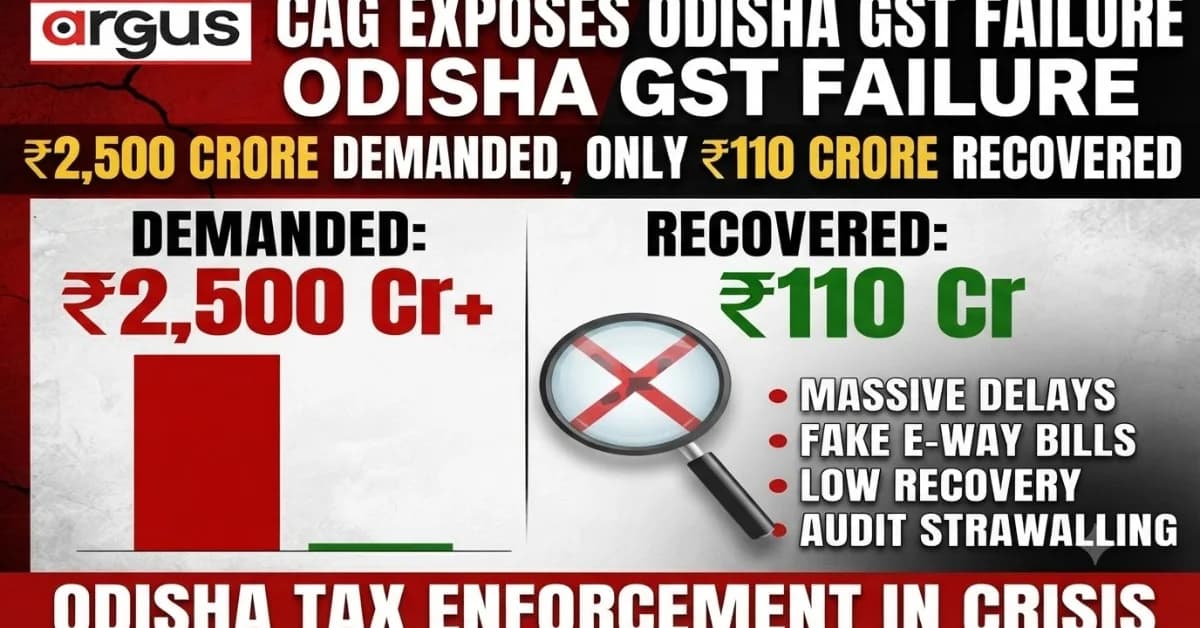
Staggering Recovery Gap: The Commercial Tax and GST Department raised over ₹2,500 crore in demands but recovered only ₹110 crore (around 4.4%).
Severe Administrative Delays: CAG flagged delays of up to 1,257 days in posting tax collections and years of inaction against suspicious taxpayers.
Widespread Digital & Audit Loopholes: Exploitation of E-Way Bill loopholes via fake vehicles and corporate stonewalling left ₹2,528 crore unexamined.
Bhubaneswar: Odisha’s GST enforcement system is facing a serious test, with the Comptroller and Auditor General (CAG) exposing delayed action against suspected tax evaders, weak monitoring of E-Way Bills, poor recovery of tax demands and substantial gaps in corporate audit compliance.
The performance audit tabled in State Assembly Monday reveals how administrative delays and inadequate coordination have created vulnerabilities in the state’s tax administration, leaving significant revenue discrepancies unresolved.
The findings point to a troubling gap between identifying tax irregularities and converting them into actual revenue for the state.
While the Commercial Tax and GST Department has raised substantial demands through return scrutiny and enforcement proceedings, the recovery figures remain low. In several cases, action against suspicious taxpayers came years after transactions had taken place, making the recovery of outstanding liabilities increasingly difficult.

📱 Get Argus News App
✨The 1,257-Day Delay: When Enforcement Loses Its Purpose
One of the most striking findings concerns delays in recording tax and penalty collections in the electronic liability ledger. The CAG found that the department took between six and 1,257 days to post liabilities collected during the interception of non-compliant vehicles.
Such delays undermine the effectiveness of digital tax administration. Although enforcement officers intercepted vehicles and collected applicable taxes or penalties, the corresponding entries were not always recorded promptly. This created reconciliation gaps and delayed the proper accounting of government revenue.
The audit also identified cases involving suspected fake taxpayers who generated large volumes of E-Way Bills, moved goods and failed to file returns. Instead of taking timely action when warning signals emerged, the department reportedly took two to three years to respond in several cases. By the time registrations were cancelled or notices issued, some entities had disappeared, leaving outstanding liabilities difficult to recover.
E-Way Bill Manipulation: Exploiting Digital Loopholes
The CAG audit identified multiple methods through which suspicious operators allegedly exploited weaknesses in the E-Way Bill monitoring system.
Vehicle database discrepancies: The audit detected 1,113 E-Way Bills involving goods worth ₹80.30 crore, generated using 235 questionable vehicles, including two-wheelers, stolen vehicles and scrapped trucks. Gaps in synchronisation between the VAAHAN database and the GST portal reportedly created opportunities for suspicious vehicle details to pass validation.
Inflated transportation distances: Some operators declared transportation distances as much as 630% higher than actual distances, potentially extending E-Way Bill validity and enabling multiple cargo movements using the same invoice documentation.
Invoice recycling: Multiple E-Way Bills were also generated using identical or slightly altered invoice numbers, raising concerns about the effectiveness of transaction validation and monitoring.
These cases highlight the limitations of digital systems when real-time data integration, automated alerts and timely field-level enforcement are inadequate.
₹2,500 Crore Demanded, Only ₹110 Crore Recovered
The tax recovery gap
Statewide demands
₹2,500 Cr+
Amount recovered
₹110 Cr
Approximately 4.4% of the demands were realised.
Between 2020-21 and 2022-23, scrutiny of approximately 1.77 lakh GST returns generated demands exceeding ₹2,500 crore, but the department recovered only around ₹110 crore.
The situation was even more pronounced in eight sampled circles. Against ₹1,078 crore demanded through show-cause notices, just ₹19.94 crore was realised, representing a recovery rate of approximately 1.85%.
Although tax demands may remain subject to assessment, appeals and legal proceedings, the figures raise questions about the department’s ability to pursue recoverable dues and resolve outstanding cases efficiently.
Corporate Stonewalling: ₹2,528 Crore Remains Unexamined
The audit also encountered substantial difficulties in examining financial records of selected high-value taxpayers. Of 79 taxpayers selected across 24 circles, 43 (54.43%) failed to provide the requested books of accounts, financial statements and invoices.
Consequently, potential tax mismatches worth ₹2,528.12 crore could not be examined in detail.
Among the taxpayers whose records were available, the audit identified ₹1,228.31 crore in excess or unverified input tax credit claims involving 52 taxpayers. It also reported ₹530.65 crore in undischarged tax liabilities involving 46 taxpayers across 79 instances.
The findings underline the importance of securing financial records and strengthening invoice verification. While non-cooperation alone does not establish tax fraud, the department’s ability to enforce statutory audit requirements is essential to resolving significant tax discrepancies.
Ground Zero: Bhubaneswar, Cuttack and Rourkela
The circle-level findings reveal how weaknesses in monitoring translated into specific cases of suspected evasion.
In Bhubaneswar-III, the CAG identified a taxpayer generating multiple high-value E-Way Bills while reporting zero turnover in GSTR-1. Another taxpayer declared ₹0.63 crore in outward taxable supplies without generating corresponding E-Way Bills.
In Cuttack-II, multiple non-filing entities generated 136 E-Way Bills involving goods worth ₹7.21 crore, resulting in identified tax leakage of ₹1.30 crore.
In Rourkela-II, two operators generated 1,803 E-Way Bills covering goods valued at ₹56.58 crore, with an associated tax liability of ₹7.94 crore. Delayed action complicated the recovery process after the entities reportedly ceased operations.
These cases point to shortcomings in cross-verification of returns, transaction records and physical goods movement.
GSTR-10: Thousands Exit Without Final Returns
The audit found that 3,921 of 4,730 taxpayers, or 82.9%, whose registrations were cancelled across nine selected circles failed to file their mandatory final returns, GSTR-10. Enforcement action was initiated in only 53 cases.
Failure to file final returns can leave outstanding liabilities, closing inventory and input tax credit adjustments unresolved. The findings indicate a need for stronger monitoring of cancelled registrations and time-bound follow-up against persistent non-compliance.
The Reform Imperative: From Digital Data to Actual Recovery
The CAG’s findings point to the need for stronger integration between VAAHAN and GST databases, automated alerts for high-risk non-filers, timely action against suspicious registrations and effective monitoring of outstanding tax demands.
The department also needs a structured mechanism to pursue taxpayers who withhold audit records and ensure that registration cancellation is followed by final-return compliance and financial reconciliation. Circle-level performance monitoring should measure not only notices issued and cases scrutinised, but also the time taken to resolve discrepancies and recover legally established dues.
The audit identified ₹10,267 crore in data inconsistencies and revenue mismatches, ₹2,528.12 crore in potential mismatches that could not be examined and ₹1,165 crore in quantified underassessment, short levy and other revenue losses during the 2022-23 local audit period. These are distinct categories and should not be added together as a single estimate of revenue loss.
The
bottom line: Odisha’s GST challenge is no longer confined to
detecting tax irregularities. It lies in ensuring that digital
warnings trigger timely investigations, audit objections receive
effective follow-up and legally recoverable demands translate into
actual revenue. The CAG has identified significant gaps in this
enforcement chain. Closing them will be critical to protecting public
revenue and strengthening compliance across the state’s tax system.
Also Read: EXCLUSIVE | Odisha’s Tobacco Trap Sucks Cash out of Economy: How West Bengal Profits While the State Faces a Massive Net Loss