



EXCLUSIVE | Odisha’s Tobacco Trap Sucks Cash out of Economy: How West Bengal Profits While the State Faces a Massive Net Loss
Key Points
Odisha’s reported decade-long tobacco and pan masala imports of ₹11,205.62 crore exceed cumulative tax collections of ₹7,346.31 crore.
West Bengal accounts for a reported ₹668-crore supply link in gutkha and pan masala shipments to Odisha.
Rising tobacco tax revenue masks wider questions over healthcare costs, productivity losses and the economic value retained within Odisha.
Bhubaneswar: Odisha’s tobacco economy presents a striking financial paradox. While the state treasury is collecting record revenues from tobacco and pan masala, billions of rupees are flowing out of the state to procure these products from other parts of the country, with West Bengal emerging as a major supplier.
The result is a widening economic imbalance in which Odisha pays for consumption, collects taxes on sales, but bears the wider economic and public health costs of tobacco addiction.
An analysis of the state’s decade-long tobacco trade and revenue figures points to a massive outflow of money from Odisha.
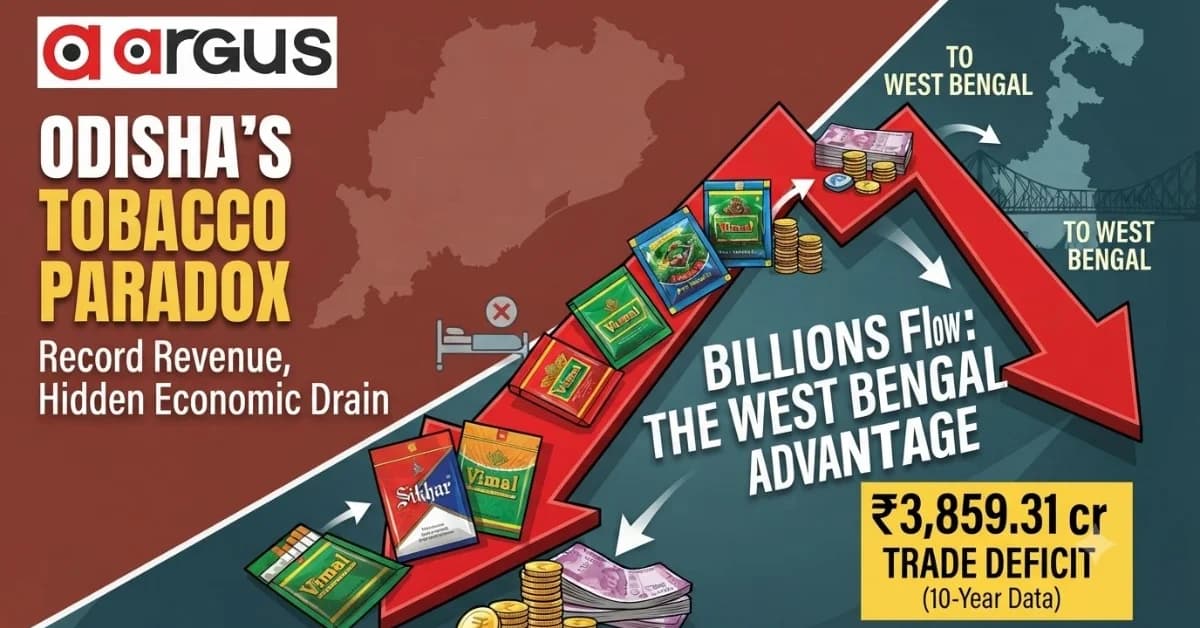
Against cumulative tobacco and pan masala tax collections of Rs7,346.31 crore, the state’s reported expenditure on inward shipments of tobacco products stands at Rs11,205.62 crore. The difference of Rs3,859.31 crore highlights the scale of the trade imbalance, even before accounting for healthcare expenditure, productivity losses and the financial burden on households.

📱 Get Argus News App
✨West Bengal, meanwhile, has a significant commercial advantage in this cross-border trade. With manufacturing, packaging and distribution networks supplying Odisha’s consumer market, the neighbouring state captures a substantial share of the money spent on tobacco products.
Gutkha and pan masala shipments alone account for an estimated Rs668 crore flowing from Odisha to West Bengal, according to the figures provided.
The economic question, therefore, extends beyond how much Odisha earns in tobacco taxes. It is about how much wealth the state retains, how much it transfers to external suppliers and what it ultimately spends on the consequences of tobacco consumption.
Odisha’s Tobacco Balance Sheet: Revenue Fails to Offset the Outflow
Odisha’s tobacco tax collections have increased sharply over the past decade. Revenue from tobacco and pan masala reportedly rose from Rs174.71 crore in 2014-15 to a record Rs1,234.88 crore in 2024-25, reflecting the scale of the consumer market and the government’s growing tax receipts.
However, the cumulative revenue figure needs to be viewed alongside the value of tobacco products entering the state. The reported Rs11,205.62 crore in inward shipments over the decade exceeds the cumulative tax collection of Rs7,346.31 crore by Rs3,859.31 crore.
|
Economic Indicator |
Amount (₹)
Cumulative Tax Revenue
₹7,346.31 cr
Inward Shipments Value
₹11,205.62 cr
Deficit (Shipments vs. Tax)
₹3,859.31 cr
Trade with West Bengal
₹668.00 cr
Source: Based on Figures supplied in Odisha Assembly data.
The
distinction is crucial. The value of imported products is not the
same as a net economic loss, just as tax revenue is not the same as
the total economic benefit retained by the state.
However, the gap
illustrates how tobacco consumption can generate substantial tax
receipts without necessarily creating equivalent local manufacturing
value, employment or wealth.
The figures also reveal Odisha’s dependence on external supply chains. Over the decade, the state reportedly sourced tobacco products from 16 to 19 other states, leaving a significant portion of the commercial value of consumption outside its own production economy.
West Bengal’s ₹668-Crore Advantage: How Odisha’s Consumer Market Fuels Its Neighbour
West Bengal’s position in Odisha’s tobacco trade reflects a structural difference between a manufacturing and supply base and a largely consuming market. The figures show West Bengal as a major source of gutkha and pan masala, with products worth an estimated Rs668 crore moving into Odisha.
This represents more than a cross-border commercial transaction. The money spent by Odisha’s consumers supports manufacturing, packaging, wholesale distribution and associated commercial activities in the supplying state. A substantial share of the value generated along that supply chain may therefore accrue outside Odisha.
West Bengal’s advantage is also linked to its established industrial and corporate ecosystem. Kolkata is the headquarters of ITC Limited, one of India’s major tobacco and consumer goods companies. However, corporate headquarters alone do not establish where products are manufactured or where all associated taxes and economic value are recorded. The Rs668-crore figure, rather than the location of a corporate office, is the more direct indicator of the trade relationship highlighted in the supplied data.
The cross-border tobacco trade
Odisha
₹668 crore
Reported expenditure on gutkha and pan masala sourced from West Bengal
West Bengal
₹668 crore
Corresponding value of products supplied to Odisha
One side’s reported purchase value is the other side’s corresponding sales value. This does not represent West Bengal’s net profit or the full value added within the state.
The scale of the trade is particularly relevant because Odisha has a population of around 4.7 crore, compared with West Bengal’s approximately 10.2 crore, according to latest population data. The figures point to a substantial market for tobacco products in Odisha, despite its smaller population.
For Odisha, the concern is whether its domestic industrial ecosystem is capturing enough of the value generated by this demand. The state’s tobacco market supports local retailers, transporters and distributors, but the reported dependence on external suppliers suggests that a large part of the upstream manufacturing value remains outside its borders.
Record Tax Collections: A Revenue Bonanza with a Hidden Cost
The sharp rise in tobacco revenue offers the Odisha government a substantial source of tax receipts. The state’s reported collection increased more than sevenfold between 2014-15 and 2024-25, from Rs174.71 crore to Rs1,234.88 crore.
Yet, the rise in tax collection should not be mistaken for an equivalent increase in the state’s net economic gain. Tobacco taxation captures only a part of the financial activity surrounding consumption. It does not, by itself, account for the cost of treating tobacco-related diseases, loss of working days, premature deaths or household expenditure diverted from other essential needs.
An analysis referring to a national estimate shows that, for every Rs 100 cected in tobacco taxes, India incurs approximately Rs816 in health and economic costs.
Applying this ratio mechanically to Odisha’s Rs1,234.88-crore collection in 2024-25 produces a theoretical estimate of more than Rs10,000 crore in associated costs.
The estimated economic burden
Reported annual tobacco tax revenue
₹1,234.88 cr
Illustrative cost at the 8.16:1 ratio
₹10,077 cr
This distinction matters. It is to state here that a national estimate cannot automatically be treated as Odisha’s actual annual economic loss. A state-specific calculation would require data on tobacco-attributable illnesses, treatment expenditure, productivity losses, mortality and the applicable cost methodology. Nevertheless, the ratio illustrates why looking at tax receipts alone can provide an incomplete picture of tobacco’s economic impact.
|
year |
revenue |
|---|---|
|
2014-15 |
174.71 |
|
2024-25 |
1,234.88 |
The Healthcare Drain: When Tobacco Revenue Returns as Public Expenditure
The economic imbalance becomes more complex when the health consequences of tobacco consumption are taken into account. Tobacco use is associated with cancers, cardiovascular diseases and chronic respiratory illnesses, creating long-term pressure on public healthcare infrastructure and household finances.
The data places tobacco use among adult men in Odisha at 48.3%. Tobacco-related illness can reduce the working capacity of individuals, increase absenteeism and lead to premature exits from the workforce.
For low-income households, the financial consequences can be particularly severe. Regular spending on tobacco reduces the money available for nutrition, education and other essential needs. When a family member develops a serious tobacco-related illness, treatment expenses and the loss of household income can compound the financial burden.
The public health cost is not confined to government hospitals. It also includes household expenditure on private treatment, unpaid caregiving and lost earnings. These indirect costs are often difficult to capture in conventional government revenue accounts.
The broader economic implication remains significant: tax receipts are collected at the point of sale, while many of the costs associated with tobacco consumption emerge gradually and are distributed across public institutions, employers and households.
The Bottom Line: Odisha’s Tobacco Revenue Cannot Hide the Wider Economic Imbalance
Odisha’s reported tobacco figures expose a critical economic question for a state seeking to expand its manufacturing base and retain more value within its economy.
A decade-long inward shipment value of Rs11,205.62 crore, against cumulative tax collections of Rs7,346.31 crore, indicates a substantial gap between the value of products entering the state and the revenue collected by its treasury.
West Bengal’s reported Rs 668-crore supply relationship with Odisha illustrates how a neighbouring state’s manufacturing and distribution networks can benefit from Odisha’s consumer demand.
The larger concern is the economic cost of sustaining a high-consumption market. Even when tobacco generates substantial government revenue and supports commercial activity, the associated health risks, productivity losses and household financial strain can erode the benefits.
For Odisha, the challenge is not simply to collect more revenue from tobacco. It is to reduce the economic dependence on a product that carries substantial social costs, strengthen enforcement against prohibited products and create opportunities for local industries that generate employment and value without imposing a comparable public health burden.
The
central finding is that a rising tobacco tax collection does not
necessarily mean a stronger state economy. Odisha’s tobacco balance
sheet must be assessed not only by the money entering its treasury,
but also by the value leaving its markets and the long-term costs
borne by its people.
Also Read: EXCLUSIVE| NSO Survey on Odisha Healthcare: Cross-District Medical Travel Highlights Hidden Out-of-Pocket Expenses
Related Topics
Explore more stories