



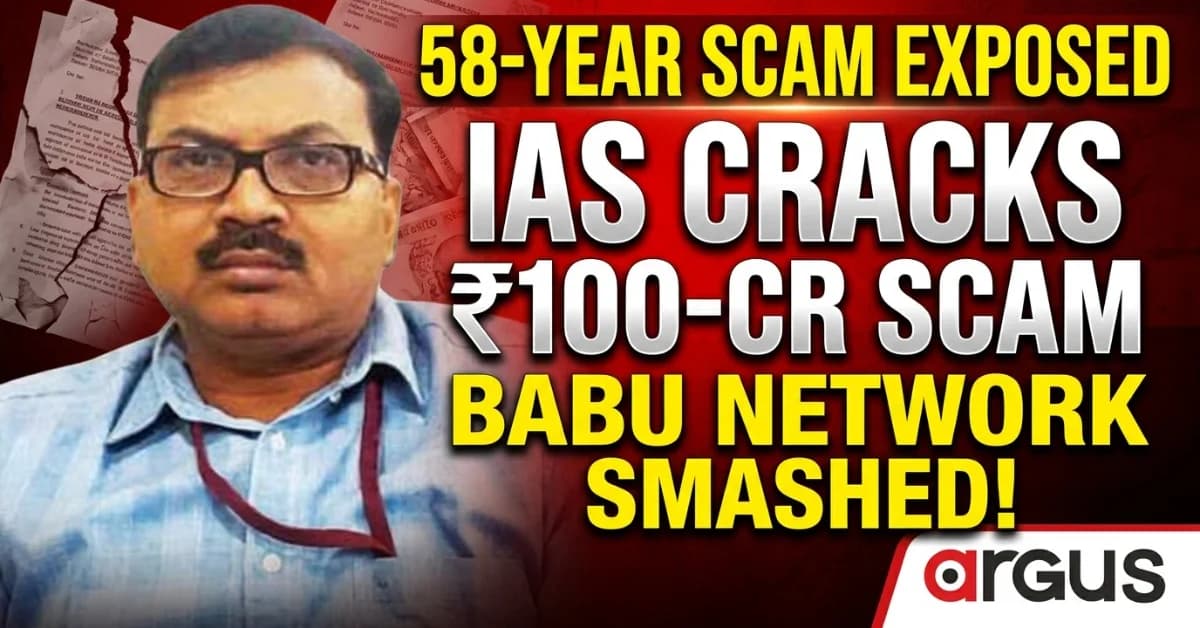
Special Report| The 58-Year Paper Trail: How an IAS Officer Dismantled Odisha’s 100-Crore Highway Land Scam Perpetrated by Babudom
Key Points
Land Scam Uncovered: Odisha's Board of Revenue successfully blocked a mutation application, saving a prime 4.24-acre highway plot valued over Rs 100 crore.
Decades-Old Fraud Foiled: Exposed a 1968 illegal lease originally granted to an administrative officer in violation of the OGLS Act.
Systemic Crackdown: Triggered a deep-dive departmental investigation into missing archives and widespread public land encroachments across Khordha.
Bhubaneswar: For nearly six decades, a lucrative 4.24-acre parcel of land sitting adjacent to the high-density Bhubaneswar-Khordha National Highway remained a quiet monument to systemic exploitation.
On paper, it morphed seamlessly from a state-owned agricultural asset into a multi-crore private real estate prize.
In reality, it was a ticking financial time bomb, protected by intentionally vanished archives, altered maps, and the historical shadow of administrative privilege.
The multi-crore land scam finally met its end in October 2026.

📱 Get Argus News App
✨The definitive roadblock came from the apex of the state’s revenue system, delivered by a bureaucrat known across administrative circles for his strict, non-compromising stance on regulatory enforcement: Shri Satyabrata Sahu, IAS.
Serving as the Member of the Board of Revenue for Odisha, Sahu –a highly distinguished officer of the 1991 batch – refused to let complex historical paperwork quietly slide by.
By combining a rigorous application of civil service rules with an analytical background in applied geology and revenue systems, Sahu intercepted a modern ownership transfer application, unravelling a 58-year-old web of institutional corruption in Odisha’s headquarter district of Khordha.
The Genesis: A 1968 Abuse of Power
The anatomy of this mega land scam dates back to 1968. The location was Ogalapada Mouza under the Jatani Tahasil, an area that would eventually evolve into a prime real estate hub due to its proximity to the national highway expanding outward from Bhubaneswar.
Under the Odisha Government Land Settlement (OGLS) Act of 1962 and its accompanying 1963 Rules, the allocation of state property is bound by strict statutory priorities.
The law was explicitly designed as a socio-economic equalizer, reserving public plots for landless agricultural laborers, low-income marginal ryots, cooperatives, and ex-servicemen.
However, in 1968, these statutory priorities were entirely bypassed. The prime 4.24-acre plot was leased out under the guise of "agricultural purposes" to an active officer of the Odisha Administrative Service (OAS).
In a stark conflict of interest, the officer in question was deployed on active land settlement duty within the very same region at the time of the allocation.
Instead of cultivating the soil as the lease mandated, the property was subsequently integrated into the private real estate market.
The officer sold the prime acreage to private buyers, initiating a chain of custody that artificially transformed public property into a highly liquid commercial asset.
Over the decades, as the Bhubaneswar-Khordha corridor grew into an economic lifeline, the value of this single plot skyrocketed, eventually breaching the Rs 100-crore mark.
The Perfect Crime Sabotaged by Missing Archives
For decades, the scam survived because the institutional memory required to expose it was systematically erased.
When the transaction history was recently pulled into a formal legal forum, case records exposed a glaring act of institutional sabotage: the original 1968 lease file had completely vanished from the physical archives of the Jatani Tahasil office.
In the traditional landscape of land administration, a missing foundational file often acts as a shield for fraudulent buyers.
Without the initial application papers, local circle officers and tahasildars lacked the immediate documentation required to verify eligibility, trace signature trails, or challenge the legitimacy of subsequent private sale deeds.
As the land repeatedly changed hands through private transactions, the state’s underlying ownership became an abstract legal footnote, buried under layers of registered sale documents.
The scam relied entirely on the assumption that no senior official would expend the energy required to reconstruct an unrecorded history from 1968.
The 2026 Turning Point: Enter Satyabrata Sahu
The decades-old strategy collapsed when a private buyer attempted the final step of land acquisition: official mutation.
Seeking to permanently formalise their ownership, the buyer filed an application to alter the state’s Record of Rights (RoR), attempting to substitute the state government's name with their own on official titles.
The application triggered a revision hearing that eventually reached the desk of Satyabrata Sahu in his quasi-judicial capacity as Member, Board of Revenue.
Rather than treating the case as a routine bureaucratic sign-off, Sahu deployed a highly analytical approach to governance. Leveraging an M.Tech in Applied Geology alongside 35 years of rigorous administrative experience, Sahu recognized that the physical realities of land administration must strictly align with statutory history.
Sahu initiated an aggressive forensic review of the property. When local authorities reported that the original 1968 lease file was missing, the Board did not pause.
Instead, Sahu ordered field verification surveys and historical map alignments to test the validity of the private sale deeds.
The findings were stark.
The physical field measurements of the land showed significant, unexplainable discrepancies when compared against the entries written into the private deeds.
Furthermore, Sahu attacked the legal roots of the transaction, questioning how a serving administrative officer on settlement duty could legally qualify as a beneficiary under the OGLS Act.
Recognizing that the initial lease violated the statutory mandate prioritizing vulnerable, landless populations, Sahu ruled that every transaction built upon that 1968 allocation was inherently invalid.
In a landmark ruling, the Board of Revenue firmly rejected the buyer's mutation application. Sahu issued strict directives prohibiting any alterations to existing revenue records, ensuring the Rs 100-crore highway plot remained explicitly listed as property of the state government.
Exposing a Wider Network: The Deep-Dive Inquiry
Sahu’s intervention extended beyond a single plot of land. Realizing that a missing file in a local tahasil office points to a wider administrative failure, he ordered a comprehensive status report from the Jatni Tahasildar. The resulting field report confirmed that this scam was part of a larger pattern, revealing that over 20 acres of prime government land in Ogalapada Mouza alone were under active, illegal encroachment.
To dismantle the local networks enabling these transfers, Sahu ordered all surviving records – including mutation files, historical maps, private sale deeds, and field verification reports – to be seized and transferred to the state's Revenue and Disaster Management Department for a deep-dive investigation.
The mandate of this departmental inquiry leaves no room for administrative cover-ups, focusing heavily on:
- Establishing the exact legal basis and officer eligibility under which the 1968 lease was granted.
- Pinpointing the role and accountability of the settlement officials involved in the initial allocation.
- Launching a targeted probe into how foundational files disappeared from the Jatani Tahasil archives.
- Rectifying the physical discrepancies discovered between field realities and official map records.
- Quantifying the total financial loss caused to the state exchequer through the illegal chain of transfers.
This decisive action directly reinforces the anti-corruption, asset-recovery agenda pushed by Revenue and Disaster Management Minister Suresh Pujari, signaling a zero-tolerance approach toward the theft of public property.
The Broader Crisis: The CAG Exposes a Systemic Pattern
While the recovery of the Rs 100-crore Jatani land is a major victory, recent state-wide investigations show that this specific case is symptomatic of a much larger, systemic crisis.
The recently released a damning audit report that exposes the true scale of public asset leaks across Odisha, painting a grim picture of unchecked land hoarding and regulatory failure.
The CAG audit unearthed vast vulnerabilities across multiple sectors of Odisha's land administration:
- Idle Industrial Land: The audit revealed a staggering 12,393.65 acres of public land, allocated to various industrial projects between 1981 and 2021, sitting completely idle. Despite clear legal requirements for companies to begin development within 3 to 5 years, revenue officials consistently failed to monitor progress or exercise the state’s right to reclaim the properties.
- Encroachment of Protected Forests: In Puri’s ecologically sensitive Sipasarubali area, 97.18 acres of protected forest land were illegally recorded under private names, cleared, and developed into luxury hotels, spas, and multi-story apartment complexes.
- Wildlife Sanctuary Exploit: The audit exposed how 13.65 acres of land inside a protected wildlife sanctuary were illicitly subdivided into 156 residential plots and sold off to private buyers. State-wide, over 568 acres of forest land were diverted for commercial use without mandatory approvals from the central government.
- Public Asset Leakage: A massive 668.89 acres of prime government land, valued at ₹597.87 crore, had slipped into unauthorized private hands due to the state’s total failure to set up mandated village-wise land banks.
- Bypassing Urban Protections: To avoid the strict statutory layout approvals required by the Odisha Development Authorities Act, real estate operators sliced 21.88 acres of agricultural land into 321 tiny sub-plots. Another 504.76 acres of rural fields were converted to non-agricultural use without proper state oversight.
A Precedent for the Future
The CAG’s state-wide findings illustrate exactly why Satyabrata Sahu’s unyielding stance in the Jatani case is so critical for the state. For decades, weak enforcement, administrative silence, and missing institutional archives allowed hundreds of crores of public assets to slip quietly into private hands.
By refusing to let a 58-year-old paper trail legitimize a modern land grab, Sahu’s ruling sets a powerful precedent for field-level revenue officers across Odisha.
It signals an era where
historical land fraud will no longer be protected by the passage of time, and
where the rules governing public real estate will be enforced to the letter.
Also Read: EXCLUSIVE | Odisha’s Great Land Scam: CAG Audit Exposes 12,393 Acres of Idle Industrial Land, Forest Encroachments, ₹597-Crore Public Asset Leak
Related Topics
Explore more stories