



Special Report| Puri Beach to Get 25 Female Lifeguards as Odisha Follows Goa Model of Women Lifesavers Ruling Riptides, but State Needs 80
Key Points
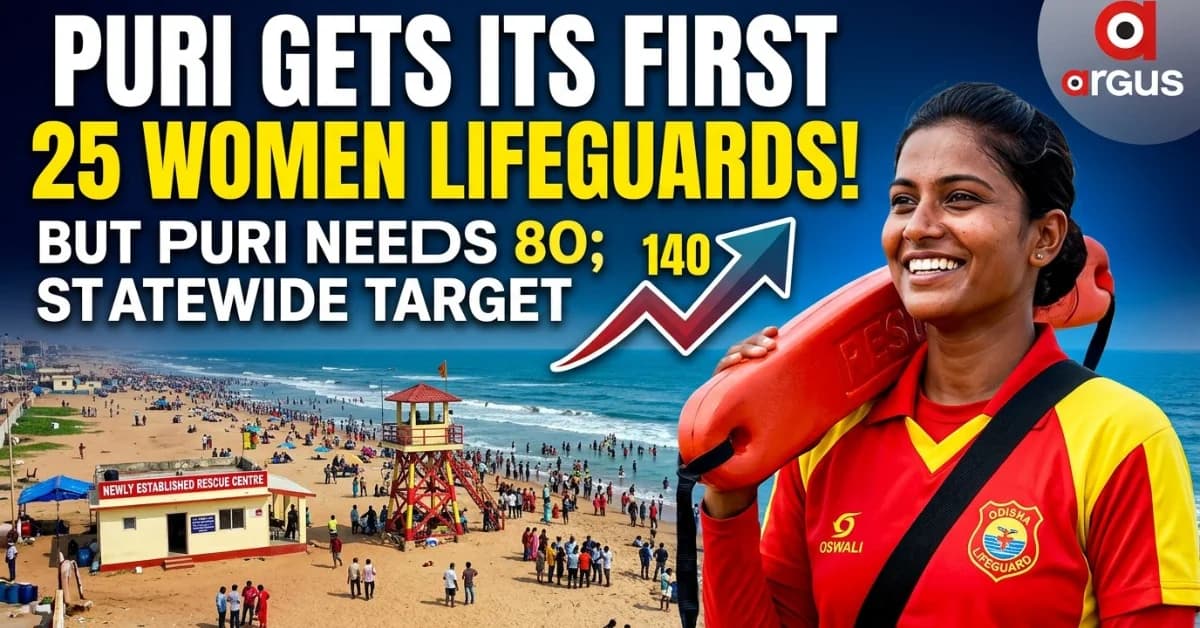
Odisha has introduced its first dedicated batch of 25 women lifeguards in Puri, adopting a Goa-style gender-inclusive beach safety model.
Experts estimate Puri alone requires 70–80 female lifesavers across its 9-km stretch, with a statewide expansion target of 120–140 personnel.
Trainees undergo rigorous surf and open-water rescue training at OSWALI, Chandrabhaga, to eliminate tourist hesitation during water emergencies.
Bhubaneswar: Odisha is preparing to put its first dedicated batch of 25 women lifeguards on the sands of Puri, marking a significant shift in the State’s beach-safety strategy and bringing a Goa-style gender-inclusive lifesaving model to one of India’s busiest pilgrimage-tourism beaches.
The first batch, however, is only a beginning. With Puri’s main tourist beach stretching around 9 km from Sterling to Penthakata, and the State planning 24 watchtowers and 20 rescue centres along the stretch, the present strength of 25 women lifesavers is unlikely to be enough for sustained, round-the-clock coverage.
An assessment based on the planned rescue infrastructure suggests that Puri alone could require around 70–80 female lifeguards to create a meaningful women-led rescue presence across its major bathing and high-risk zones. The requirement rises further when other major coastal destinations such as Chandrabhaga, Gopalpur and Chandipur are brought into the picture.
Why the 25-Woman Batch Is Bigger Than a Pilot
The women selected for the programme are undergoing specialised training at the Odisha State Watermanship and Lifeguard Institute (OSWALI), Chandrabhaga, where they are being trained in surf rescue, open-water and underwater rescue, CPR, first aid and emergency medical response.

📱 Get Argus News App
✨Following successful completion of training, they will be licensed by the National Institute of Watersports.
The significance of the move lies not merely in increasing the number of lifeguards. It seeks to address a specific gap in beach safety – the hesitation among some women tourists to seek physical assistance from male rescuers during emergencies.
The deployment of female lifesavers is therefore being positioned as a gender-inclusive safety intervention, particularly at a destination where women and families constitute a substantial part of the tourist population.
But the numbers indicate that the first 25-member squad cannot by itself provide comprehensive coverage.
Puri Needs Around 70–80 Women Lifeguards
Puri currently has around 99 male lifeguards operating across Puri and Chandrabhaga, while the State is simultaneously strengthening physical safety infrastructure with watchtowers and rescue centres.
The main Puri tourist stretch covers approximately 9 km, making deployment strength, shift rotation and location of personnel crucial to the effectiveness of the new women-lifeguard programme.
The requirement can be assessed as follows:
|
Location / Zone |
Stretch Length / Scope |
Target Female Lifeguard Requirement |
Rationale |
|---|---|---|---|
|
Puri Beach |
Main 9-km tourist zone; 24 planned watchtowers / 20 rescue centres |
70–80 |
Allows roughly two women lifesavers per active watchtower/rescue post across dual shifts, creating a dedicated female response capability at family and women bathing zones |
|
Chandrabhaga / Konark |
2–3 km high-risk surf zone |
15–20 |
High-tide vulnerability requires a permanent rotational squad; Chandrabhaga also serves as the State's specialised training hub |
|
Other Odisha Hotspots — Gopalpur, Chandipur |
Secondary coastal tourism hubs |
30–40 |
Around 10–15 female lifesavers per major secondary destination would help extend the inclusive safety model |
|
Total projected requirement |
State-wide initial expansion |
120–140 |
Expansion beyond the first 25 to create a sustainable roster capable of handling shifts, leave and attrition |
The immediate takeaway is clear: 25 women can launch the programme, but they cannot constitute the final strength needed for a statewide women-lifesaver network.
For Puri itself, the target of 70–80 female lifeguards would be the more meaningful benchmark.
Odisha Is Looking At Goa's Playbook
The move brings Odisha closer to the model followed in Goa, where professional beach-safety management has evolved beyond traditional male-dominated lifeguard deployment.
Goa's Drishti Marine operates a large professional lifesaving network, with more than 450–490 lifesavers deployed across roughly 58 beach stretches, providing Odisha with a useful benchmark for how a major tourism destination can build a specialised beach-safety ecosystem.
The comparison also shows why Odisha's first 25-member squad should be viewed as the beginning of a larger institutional framework rather than the final deployment strength.
|
State / Destination |
Lifeguard Management Model |
Female Lifeguard Status |
Key Focus & Training Standard |
|---|---|---|---|
|
Odisha — Puri & Coastal Beaches |
Managed jointly by Odisha Fire and Emergency Services and Tourism Department |
First batch of 25 women undergoing intensive training |
Specialised training at OSWALI, Chandrabhaga; licensing through National Institute of Watersports; surf rescue, CPR, first aid and emergency response |
|
Goa — Calangute, Baga, etc. |
Outsourced professional agency — Drishti Marine |
Established precedent for women lifesavers and trainers |
Integrated commercial beach-safety model with regular recruitment and specialised rescue training |
|
Maharashtra — Juhu, Chowpatty, Mumbai |
Municipal corporation / local associations |
Nominal/low presence, largely male-dominated |
Focus on crowd-heavy urban safety and high-tide management |
|
Tamil Nadu — Marina, Besant Nagar, Chennai |
Greater Chennai Corporation & Coastal Security Group |
Restricted/limited to specific zones |
Shoreline surveillance and restricted bathing boundaries because of rip-current risks |
The Big Shift: From Rescue After the Incident to Prevention
The female-lifeguard programme is being introduced alongside a wider overhaul of beach safety.
The State is working on clearly demarcated safe bathing zones, elevated watchtowers and dedicated rescue centres. The plan also includes modern rescue equipment such as speedboats, water scooters and inflatable rescue boats, along with oxygen-equipped first-aid facilities.
The proposed use of retired police and defence personnel as beach wardens adds another layer to the strategy. Their role would be to ensure that tourists comply with safety restrictions and do not enter dangerous stretches during high tide or rough-sea conditions.
This effectively creates a three-layer system:
|
Safety Layer |
Proposed Intervention |
Objective |
|---|---|---|
|
Prevention |
Safe bathing zones, warning systems and beach wardens |
Stop tourists from entering dangerous waters |
|
Surveillance |
Watchtowers and dedicated rescue centres |
Detect distress situations quickly |
|
Rescue |
Male and female lifeguards, boats, water scooters and rescue equipment |
Reduce response time and improve survival chances |
Why Women Lifesavers Matter
The argument for female lifeguards is not simply about representation.
For women tourists, particularly in situations involving physical assistance, having a female rescuer available can remove a psychological barrier to seeking help.
A woman caught in distress in the water may have only seconds or minutes to respond. A dedicated female rescue presence can make the difference between hesitation and immediate intervention.
It also gives the administration an opportunity to build women-specific safety teams at crowded family bathing zones, rather than treating female lifeguards as occasional additions to an otherwise male-dominated system.
But the Job Comes With Its Own Challenges
Women lifesavers entering the profession will face demanding operational conditions.
Beach rescue requires considerable physical endurance, particularly when rescuing panicked swimmers in rough surf or strong currents. Long hours under intense sun, humidity, salt water and shifting tides add to the physical burden.
There are also institutional challenges – from the availability of appropriately designed rescue equipment and protective gear to dedicated changing and rest facilities.
Another challenge is authority on the beach.
Female lifeguards have reported situations in which unruly or intoxicated tourists ignore instructions from women rescuers. For Odisha, this means the success of the programme will depend not merely on recruitment but also on giving female lifesavers institutional authority and ensuring tourists comply with their directions.
From 25 to 80: The Real Test for Puri
The first batch of 25 women is therefore significant, but its real test will be what follows.
If Odisha wants to genuinely replicate the more professional and gender-inclusive aspects of Goa's beach-safety model, it will have to move beyond a one-time induction and create a permanent recruitment, training and deployment pipeline.
For Puri, that means scaling up towards 70–80 women lifeguards, rather than treating 25 as the final requirement.
And if the model is eventually extended across Chandrabhaga, Gopalpur, Chandipur and other tourism destinations, Odisha's overall requirement could reach 120–140 female lifesaving personnel in the initial expansion phase.
Bottomline
The deployment of 25 women lifeguards at Puri is historic for Odisha. But the numbers tell a larger story.
Twenty-five can start the experiment. Around 80 are needed to give Puri meaningful female lifesaving coverage. And a truly statewide women-lifesaver network could require 120–140 personnel.
The
success of the programme will ultimately depend not on how many women
are inducted for the first time, but on whether Odisha turns that
first batch into a permanent,
adequately staffed professional beach-rescue force.
Also Read: Puri Is Naturally Dangerous, Yet Its Rescue Net May Be India’s Strongest: How Odisha’s Beach Outperforms Mumbai, Chennai &Vizag | Special Story