



Puri Is Naturally Dangerous, Yet Its Rescue Net May Be India’s Strongest: How Odisha’s Beach Outperforms Mumbai, Chennai & Vizag| Special Story
Key Points
Bhubaneswar: One person dead, another critically injured – and yet three lives saved.
That is the paradox at the heart of Puri’s beach safety story.
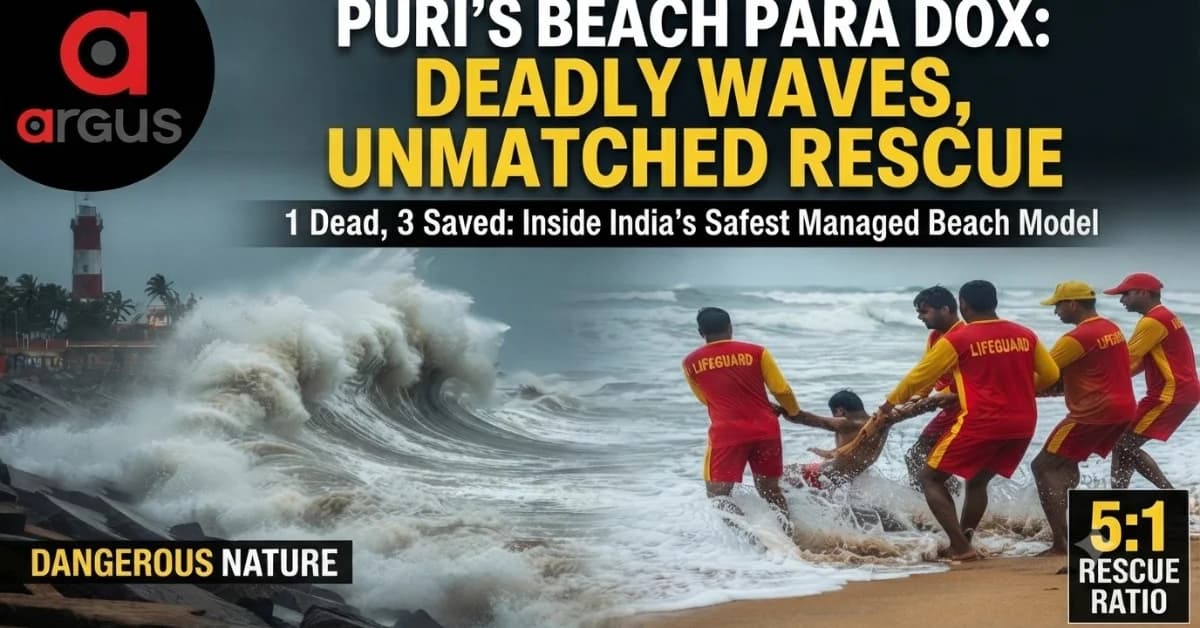
A major mishap near the Lighthouse on Monday afternoon once again exposed the dangerous side of Puri’s coastline when five persons were swept away while bathing in the sea. Three were rescued safely, while two were rushed to the District Headquarters Hospital in critical condition. Sumit Gupta of Ranipur in Uttar Pradesh was declared dead, while Anish Singh of Bihar, whose condition remained critical, was shifted to Bhubaneswar for advanced treatment.
The day's numbers tell a grim story – five people swept away, four survivors and one death, translating into a 5:1 rescue-to-death outcome.

📱 Get Argus News App
✨But viewed against Puri’s much larger rescue record, the incident also throws up another, less obvious question:
Can a beach that is naturally hazardous nevertheless be one of India’s safest managed beaches?
The answer, based on the available rescue, fatality and beach-management indicators, appears to be yes – with an important caveat.
Puri cannot be described as a naturally safe beach. Its open-ocean exposure, powerful breakers, steep beach face, shifting currents and sudden rip-current formation make the water inherently dangerous.
What makes Puri different is the human safety layer built over that dangerous natural environment.
Puri’s paradox: dangerous water, unusually strong rescue system
The available figures indicate that Puri recorded around 416 rescues in 2024 and 445 in 2025, while reported drowning deaths stood at six and 10 respectively.
That translates to an indicative rescue-to-death ratio of about 69:1 in 2024 and 45:1 in 2025.
Taken together, the two-year figure works out to roughly 55 rescues for every reported death.
That is an extraordinary number but it needs to be interpreted correctly.
It does not mean that a tourist entering Puri's sea has a 55-times better statistical chance of survival than at another beach. Rescue reporting practices, tourist footfall, definitions of a rescue and coverage of different beach stretches vary from city to city.
What it does demonstrate is something more practical:
When people get into trouble in Puri’s monitored bathing zones, the probability of a rescue intervention appears exceptionally high.
And that is where Puri’s real advantage lies.
The beach itself is not the hero – the lifeguard system is
Puri's coastline presents several natural hazards.
The beach faces the open Bay of Bengal, allowing substantial wave energy to reach the shore. Plunging and spilling breakers can knock bathers off their feet, while the backwash can make it difficult for a person to regain balance.
|
Factor |
Puri's Natural Hazard |
Puri's Human Countermeasure |
|
Wave Energy |
Heavy open-ocean plunging breakers that knock swimmers down. |
Proactive Lifeguards: Over 300+ local community lifeguards (Nolia community members) who read the waves perfectly and stand directly in the surf zone. |
|
Beach Slope |
A steep gradient causing a powerful, gravity-driven backwash. |
Zone Segmentation: The beach is strictly zoned, separating casual bathers from dangerous currents and concentrating rescue personnel where the risk is highest. |
|
Crowd Dynamics |
Massive religious and holiday crowds (millions during Rath Yatra) entering the water simultaneously. |
Mass Mobilization: Rapid escalation of rescue personnel, jet skis, and continuous megaphone warnings during peak festival seasons. |
This is precisely where Puri's safety architecture becomes important.
The city's beach-management model relies heavily on community-based lifeguards, particularly members of the traditional Nolia fishing community, whose familiarity with local sea conditions provides an important first-response advantage.
Instead of depending entirely on a distant emergency response, lifeguards are positioned close to the surf zone – where a drowning emergency actually begins.
That difference can determine whether a swimmer is rescued within seconds or discovered only after disappearing beneath the waves.
Puri vs Vizag: Same rip-current danger, different survival story
Visakhapatnam provides perhaps the closest comparison.
RK Beach, Rushikonda and other beaches around Vizag also face strong currents and hazardous nearshore conditions. But the available figures show a substantially higher drowning burden.
Data available for Visakhapatnam indicate 165 drowning deaths between 2021 and 2025, with RK Beach alone accounting for 42 deaths over the five-year period.
Against this, reported rescues were around 63 in 2023, 65 in 2024 and 71 in 2025.
The contrast is important.
Both Puri and Vizag have beaches where rip currents can suddenly overpower bathers. But Puri's principal tourist stretches have developed a much more visible and intensive lifeguard presence.
One of the biggest vulnerabilities in Vizag is also the geography of the rescue problem: people frequently enter the sea away from supervised zones or during hours when lifeguard deployment is reduced.
The lesson is not that Puri has safer water. It is that Puri has a tighter safety net around the water.
Mumbai: strong infrastructure, but an unforgiving coastline
Mumbai has a considerably more institutionalised beach-rescue system, including municipal lifeguards and emergency equipment.
Yet beaches such as Aksa remain notoriously difficult environments.
Available figures for Aksa indicate around 445 rescues over a 12-year period against 47 deaths.
The city's beaches also face intense monsoon conditions, tidal fluctuations, shifting sandbars and rapidly changing water behaviour.
Mumbai therefore demonstrates another important principle:
Even a professionally managed beach can record fatalities when the underlying marine environment is highly dynamic and crowds are massive.
Puri's distinction lies in the combination of local wave-reading expertise, concentrated lifeguard deployment and active monitoring of tourist bathing zones.
Chennai's Marina: the crowd problem at another scale
Marina Beach presents a different challenge.
Its enormous length and massive daily footfall make comprehensive supervision extremely difficult.
The available historical data point to around 580 drowning cases along the 14-km urban stretch between 2010 and 2020.
The sheer size of Marina creates a safety-management problem that Puri's more concentrated tourist bathing zones can address more effectively.
A lifeguard system can be highly efficient when personnel are concentrated around known bathing areas.
The same model becomes substantially harder to implement when people enter the sea across a vast urban coastline.
Summary of Natural Hazards Across
|
Beach |
Primary Oceanographic Hazard |
Underwater Structure |
Danger Accentuator |
|
RK Beach (Vizag) |
Structural Rip Currents |
Abrupt shelf drop-off |
Artificial rock barriers & groynes |
|
Aksa Beach (Mumbai) |
Migrating Sandbars & Undertow |
Shifting underwater gullies |
Extreme monsoon tidal ranges |
|
Puri Beach |
Heavy Surf Energy & Backwash |
Steep beach slope |
Open-ocean swells with no buffer |
|
Marina Beach (Chennai) |
Immediate Deep Slope |
Steep, sudden drop-off |
High-velocity lateral drift |
The hidden advantage: Puri knows where the danger is
Puri's safety model has another advantage – risk concentration.
The principal tourist areas, including the Golden Beach/Blue Flag Beach and Lighthouse-side stretches, are the locations where beach safety resources are most visible.
The system can therefore concentrate personnel, warnings and rescue equipment around areas where the probability of an emergency is highest.
During peak periods, the deployment expands further.
For Rath Yatra 2026, the Puri Beach Lifeguard Mahasangha reportedly deployed around 350 lifeguards across 24 beach sectors, reflecting the scale of the preventive operation during one of India's largest annual pilgrim gatherings.
That is more than a rescue strategy.
It is a crowd-risk management strategy.
The 5:1 ratio on Monday tells an important story
The Monday incident near the Lighthouse is therefore significant beyond the tragedy itself.
Five people were swept away.
Three were rescued safely.
Two reached hospital in critical condition.
One died.
In other words, the rescue machinery appears to have intervened successfully in four of the five cases – even though the sea conditions were capable of overwhelming all five.
The incident therefore demonstrates both sides of Puri.
The sea remains dangerous. The safety system remains active.
And the death of one person is also a warning against interpreting Puri's high rescue rate as a guarantee of survival.
A lifeguard can reach a person only if the emergency is detected in time. A swimmer who enters an unmonitored stretch, ignores warnings, ventures into rough water or goes into the sea outside supervised hours can effectively step outside the safety system.
The biggest threat to Puri's safety record may actually be complacency
This is the paradox policymakers need to confront.
As Puri develops a reputation for having a strong beach-rescue system, visitors may develop a false sense of security.
The argument that "lifeguards are there" can encourage people to take risks they would otherwise avoid.
The first three months of 2026, when six drowning deaths were reportedly recorded, underline that vulnerability.
No lifeguard network – however sophisticated – can completely neutralise dangerous ocean conditions and reckless behaviour.
The objective therefore cannot be zero risk.
It has to be zero preventable deaths.
Puri's real competition is not safer seas – but better beach management
The comparison with Mumbai, Chennai and Vizag consequently needs to be reframed.
Puri does not win because its sea is calmer.
It does not win because its seabed is inherently safer.
It does not even necessarily win on every raw fatality metric.
Its strongest claim is different:
Puri appears to have built one of India's most intensive safety nets around a naturally hazardous tourist beach.
That distinction matters.
|
Beach |
Dominant Natural Risk |
Management Challenge |
What Puri Does Differently |
|---|---|---|---|
|
Puri |
Powerful breakers, backwash, temporary rip currents |
Massive pilgrim/tourist crowds |
Dense community lifeguard deployment and sector-based monitoring |
|
Vizag |
Rip currents, hazardous nearshore formations |
Unmonitored stretches and night-time bathing |
Puri concentrates safety resources around major tourist bathing zones |
|
Mumbai |
Tides, shifting sandbars, monsoon swells |
Huge urban coastline and extreme crowding |
Strong municipal system, but marine conditions remain highly dynamic |
|
Chennai |
Sudden depth changes, strong lateral currents |
Extremely long and crowded shoreline |
Puri has a more concentrated monitored bathing footprint |
The final verdict: safest managed, not safest natural beach
The evidence therefore supports a carefully worded conclusion.
Puri should not be branded India's "safest beach" in absolute terms.
Its water can be extremely dangerous.
But if the metric is how effectively a major tourist beach detects, reaches and rescues people who get into trouble, Puri has a strong case for being among India's safest managed beaches.
The distinction is crucial.
Nature makes Puri dangerous. Human intervention makes it comparatively survivable.
Monday's tragedy near the Lighthouse is a reminder that the first half of that equation has not changed.
But the four survivors out of five swept away also demonstrate why the second half — Puri's lifeguard and rescue architecture — deserves closer national attention.
The challenge now is to ensure that Puri's reputation for effective rescue does not become an invitation for tourists to test the sea.
Because the safest beach is ultimately not the one with the most lifeguards.
It
is the beach where the lifeguards are needed least because visitors
respect the sea the most.
Also Read: 15 Earthquakes in 24 Hours: After Nepal Disaster, Is India’s Seismic Activity Sending a Warning to Odisha? | Exclusive