



SPECIAL REPORT| No Data, No SIM, Free Streaming: Modi Govt’s D2M Broadcast to Bring FM-Style HD Video to Rural Odisha by 2027
Key Points
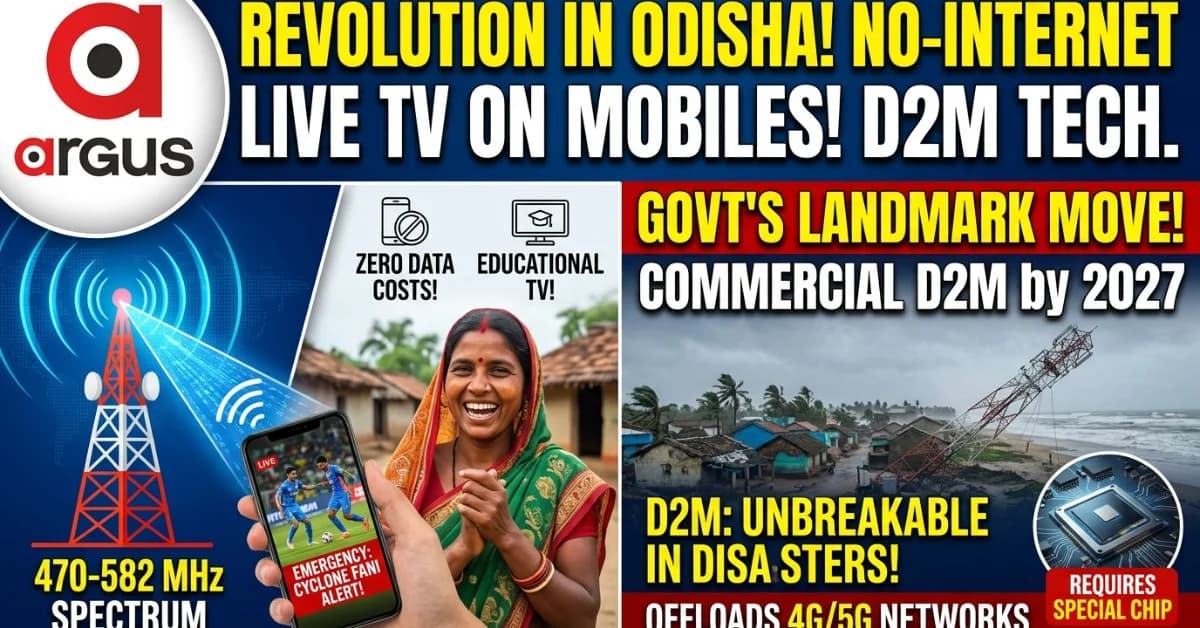
Internet-Free Streaming: Stream live TV, news, and sports directly on compatible mobile devices using broadcast airwaves—no SIM card, Wi-Fi, or mobile data required.
Cyclone & Disaster Resilience: Ensure uninterrupted, real-time emergency safety alerts in coastal districts like Puri and Kendrapara even during total cellular network blackouts.
Decongesting Telecom Networks: Offload massive live broadcast traffic to dedicated D2M spectrum (470–582 MHz), easing network strain during mega-events like the Puri Rath Yatra.
Bhubaneswar: In what could be described as a revolutionary shift to address the data divide and high data costs in the country – especially in states like Odisha, Chhattisgarh, and Jharkhand, as well as other hilly regions with a significant poor rural populace – the Modi Government, through public broadcaster Prasar Bharati, is finalizing a landmark move that will redefine how millions consume information.
With the upcoming rollout of the official Request for Proposal (RFP), the machinery is officially in motion to commercialize Direct-to-Mobile (D2M) broadcasting technology by late 2027.
By leveraging terrestrial broadcast airwaves in the 470–582 MHz spectrum band, D2M allows users to stream live television, breaking news, sports, and emergency alerts directly onto compatible mobile devices without requiring an active internet connection, Wi-Fi, mobile data, or even a SIM card – functioning fundamentally like an FM radio, but for high-definition video.
For a geographically diverse state like Odisha, characterized by long stretches of remote tribal terrain and vulnerable coastal belts prone to severe cyclonic storms, this technological leap promises to rewrite the rules of digital inclusion, emergency responsiveness, and network resilience.

📱 Get Argus News App
✨1. The Technology: How D2M Works and Why it Matters
At its core, D2M marries broadcast and broadband technologies. Developed indigenously via public-private collaboration—with hardware validation cleared by firms like Tejas Networks and cutting-edge receiver chips engineered by Tata’s Saankhya Labs – the technology broadcasts multimedia content directly from high-power terrestrial transmitters to specialized internal antennas inside mobile devices.
Unlike traditional cellular networks that rely on individual data packets routed through congested cell towers, D2M uses a one-to-many broadcast architecture. A single broadcast tower can simultaneously beam a live cricket match or breaking news feed to millions of screens without experiencing latency or network choking.
The Strategic Value Proposition:
Zero Data Costs: Viewers can access public service broadcasts, educational content, and live news completely free of data expenses.
Network Relief: Offloading massive video traffic from cellular networks drastically reduces strain on 4G and 5G infrastructure, resulting in faster internet speeds for everyday tasks like digital payments and web browsing.
Mission-Critical Reliability: Operates independent of commercial telecom infrastructure, making it virtually unshakeable during emergencies.
2. Panning Out in Odisha: Bridging the Rural-Urban Divide
While major metropolitan centers across India have enjoyed rapid digital expansion, Odisha presents a complex socio-geographic canvas where standard cellular connectivity remains patchy. The D2M revolution, slated to hit commercial airwaves by 2027 following the late October RFP launch, addresses three distinct regional vulnerabilities in the state:
|
Operational Scenario |
Traditional Framework |
Post-D2M Implementation (2027) |
|
Remote & Tribal Hinterlands
(Koraput, Malkangiri, Mayurbhanj) |
Frequent buffering/blackouts due to weak cellular coverage. |
Seamless live audio-visual delivery via 470-582 MHz spectrum, independent of data packs. |
|
Disaster Management & Cyclones
(Puri, Kendrapara, Jagatsinghpur) |
Tower collapse during storms cuts off vital evacuation warnings. |
Failsafe, instant emergency alerts broadcasted directly to devices even in total blackouts. |
|
Mega-Cultural Events (Rath Yatra)
(Puri) |
Severe network choking and call drops due to tourist traffic. |
Offloading massive live feeds to D2M spectrum frees up crucial 4G/5G bandwidth. |
A. Disaster Resilience and Cyclone Management in Coastal Districts
Odisha’s coastal geography makes it a recurring target for devastating cyclones such as Fani and Amphan. Historically, these violent weather events knock out cellular towers and sever fiber-optic lines in vulnerable districts like Kendrapara, Jagatsinghpur, and Puri, plunging entire regions into communication blackouts during critical evacuation windows.
D2M acts as a failsafe lifeline. Because the signals ride on robust terrestrial broadcast waves, government agencies can beam real-time safety feeds, weather tracking, and evacuation updates straight to citizens' screens, ensuring public safety messages get through even when telecom towers have collapsed.
B. Overcoming Isolation in Tribal Hinterlands
In remote, undulating, and hilly terrains across districts like Koraput, Malkangiri, and Mayurbhanj, high-speed mobile broadband remains expensive or sporadically available. This digital exclusion has historically hindered remote learning. D2M transforms this dynamic by delivering free-to-air educational broadcasts directly to households, creating an equitable digital pipe that empowers rural students without putting financial pressure on low-income families.
C. Decongesting Infrastructure During Mega-Events like Rath Yatra
Massive cultural gatherings such as the annual Rath Yatra in Puri strain local telecom infrastructure to its breaking point. Millions of pilgrims and visitors attempting to stream video or upload media simultaneously routinely cause call drops and network freezes. By shifting massive live telecasts of the chariot pulling onto dedicated D2M broadcast airwaves, telecom networks will experience immediate relief, preserving vital bandwidth for emergency services and voice communication.
3. The Roadmap: From October Tenders to 2027 Commercial Airwaves
Prasar Bharati's movement toward commercial deployment follows successful multi-ministry technology-validation tests across more than 19 Indian cities. The projected timeline unfolds across key strategic phases:
Late October 2026 (The RFP Milestone): Prasar Bharati opens the official bidding process via its Tenders Portal to onboard private infrastructure partners, broadcasters, and technology vendors, establishing baseline commercial investments and spectrum guidelines.
Early to Mid-2027 (Infrastructure Scalability): Transmitter networks will be scaled up across existing terrestrial towers, utilizing the 470–582 MHz frequency band with hardware support from domestic manufacturers.
Late 2027 (Commercial Go-Live): Full commercial broadcast services are anticipated to launch nationwide and across Odisha, marking a new era in public broadcasting.
4. The Hardware Catch: Overcoming the Handset Barrier
While the transmission towers will soon be ready, a critical prerequisite remains: hardware compatibility.
Existing standard smartphones cannot receive D2M signals through a simple software update. Users will need devices equipped with specialized baseband receiver chips (such as Saankhya Labs' SL3000 series) and internal antennas. To ensure this does not become an elite-only luxury, domestic brands like Lava International and HMD Global have already prototyped affordable D2M-compatible feature phones and devices priced accessibly between Rs 2,000 and Rs2,500.
Ultimately, the speed at which Odisha's rural and interior populations embrace these chip-enabled devices will determine how rapidly the digital divide closes. As Prasar Bharati prepares to drop its watershed RFP this October, the promise of internet-free, high-definition mobile broadcasting is no longer speculative science fiction – it is India’s digital destiny, set to go on air by 2027.
Related Topics
Explore more stories