



Jio Rules Both India's Mobile and Data Markets; Airtel Emerges Strongest Challenger as 5G Broadband Race Intensifies
Key Points
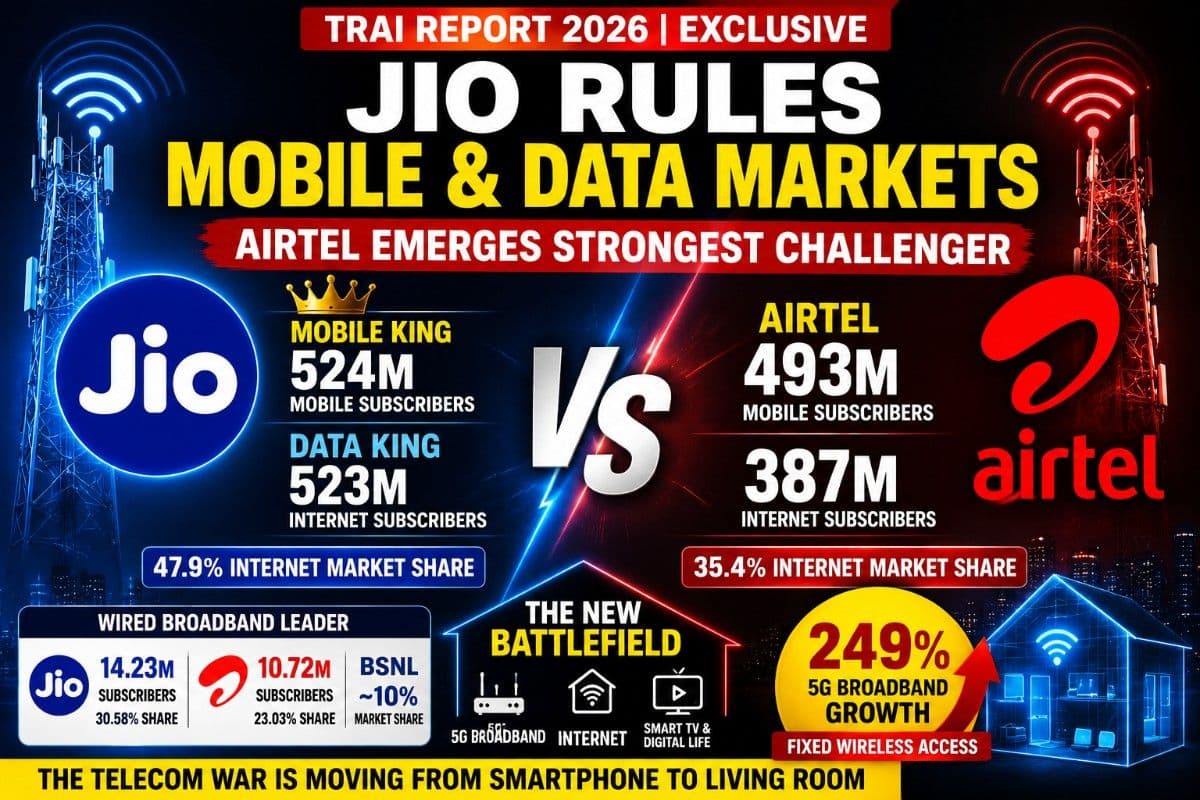
* Beyond its 524 million mobile users, Jio dominates the data economy by commanding 47.90% of the internet services market and leading wired broadband with a 30.58% market share.
* Traditional mobile competition is giving way to household data capture, fueled by an unprecedented 249.4% Year-on-Year explosion in 5G Fixed Wireless Access (FWA) connections reaching 17.11 million.
Bhubaneswar: India's telecom industry has entered a decisive new phase.
For years, operators fought for mobile subscribers. Today, they are battling for something far more valuable: internet users, broadband households and data consumption.
Fresh data released by the Telecom Regulatory Authority of India (TRAI) for the quarter ending March 2026 reveals that while Reliance Jio remains India's largest telecom operator, it has also established itself as the country's undisputed "Data King", commanding nearly half of India's internet subscriber market.
The numbers suggest that the future of telecom competition may increasingly be determined not by who owns the most SIM cards, but by who controls the country's digital traffic.

📱 Get Argus News App
✨The Mobile Market: Jio and Airtel Pull Away
India's telecom market continues to be dominated by two giants.
Reliance Jio ended March 2026 with more than 524 million telecom subscribers, giving it a market share of around 39.4%.
Bharti Airtel followed with nearly 493 million subscribers and a market share exceeding 37%.
Together, the two companies now account for more than three-fourths of India's telecom market.
Vodafone Idea, once part of a three-way battle for supremacy, has slipped to below 200 million subscribers, while BSNL remains a distant fourth.
On the surface, the rankings appear familiar.
But the internet market tells a more revealing story.
Jio Is Not Just the Mobile King. It Is the Data King.
According to TRAI's latest ISP rankings, Reliance Jio commands 523.44 million internet subscribers, giving it 47.90% market share of India's internet services market.
In simple terms, nearly one out of every two internet connections in the country belongs to Jio.
The gap between Jio and the rest of the market remains substantial.
Bharti Airtel occupies second place with 387.24 million internet subscribers, translating into 35.44% market share.
Together, Jio and Airtel account for more than 83% of India's internet subscriber base, effectively creating a duopoly in the country's digital economy.
The dominance becomes even more striking when compared with Vodafone Idea, which has 135 million internet subscribers and a market share of 12.35%.
The numbers show that India's internet economy is becoming significantly more concentrated than its traditional telecom market.
The Hidden Battle: Wired Broadband
While mobile internet grabs headlines, TRAI's data points to another battlefield that could shape the future of the sector.
India had 46.54 million wired internet subscribers as of March 2026.
Jio leads this segment too.
The company commands 30.58% of India's wired broadband market, supported by a subscriber base of 14.23 million.
Airtel follows with 10.72 million wired broadband subscribers, accounting for 23.03% market share.
BSNL remains a significant player in this segment with nearly 10% market share, despite its much weaker position in mobile services.
The data reveals that India's broadband market is more diversified than its mobile market, with regional players such as Atria Convergence Technologies and Kerala Vision Broadband retaining meaningful footprints.
Why the Real War Is Moving Beyond Mobile
The latest TRAI report contains one statistic that explains the industry's future direction.
Fixed Wireless Access (FWA) subscriptions — broadband delivered through 5G networks rather than fibre cables — surged by 249.4% year-on-year, reaching 17.11 million subscribers.
This growth rate is among the highest recorded in any telecom segment.
The implication is significant.
For decades, telecom companies focused on individual users carrying mobile phones.
The next phase is about connecting households.
Instead of competing only for mobile subscribers, operators are increasingly competing for home broadband customers, smart-TV users, remote workers, gamers and AI-powered digital services.
This transition fundamentally changes the economics of the industry.
Broadband customers typically consume more data, generate higher revenues and remain more loyal than traditional mobile users.
Airtel's Biggest Opportunity
While Jio remains the clear market leader, the data suggests Airtel has emerged as the strongest challenger in the broadband and internet era.
The company continues to gain subscribers aggressively while maintaining a strong presence in both wireless internet and wired broadband.
Its strategy appears increasingly focused on attracting higher-value digital users rather than merely expanding scale.
As 5G services mature and broadband adoption deepens, Airtel's ability to monetise premium customers could become one of the most important variables in India's telecom competition.
The Future: From Telecom Companies to Digital Utilities
The TRAI data suggests India's telecom operators are undergoing a transformation.
They are no longer merely providers of voice calls and mobile connectivity.
They are becoming digital infrastructure companies.
The next winners will not necessarily be determined by who sells the most SIM cards. They will be determined by who controls internet access, broadband connections, household data consumption and emerging 5G services.
On current trends, Jio remains firmly in command.
But Airtel is closing ranks, the broadband market is becoming strategically important, and 5G-powered home internet is creating an entirely new battleground.
The telecom wars are far from over.
They are simply moving from the smartphone to the living room.
Related Topics
Explore more stories