



Special Report| Mahanadi Water Dispute: On September 28, Will Odisha’s Long-Running River Row Go the Sone-Kishau Way?
Key Points
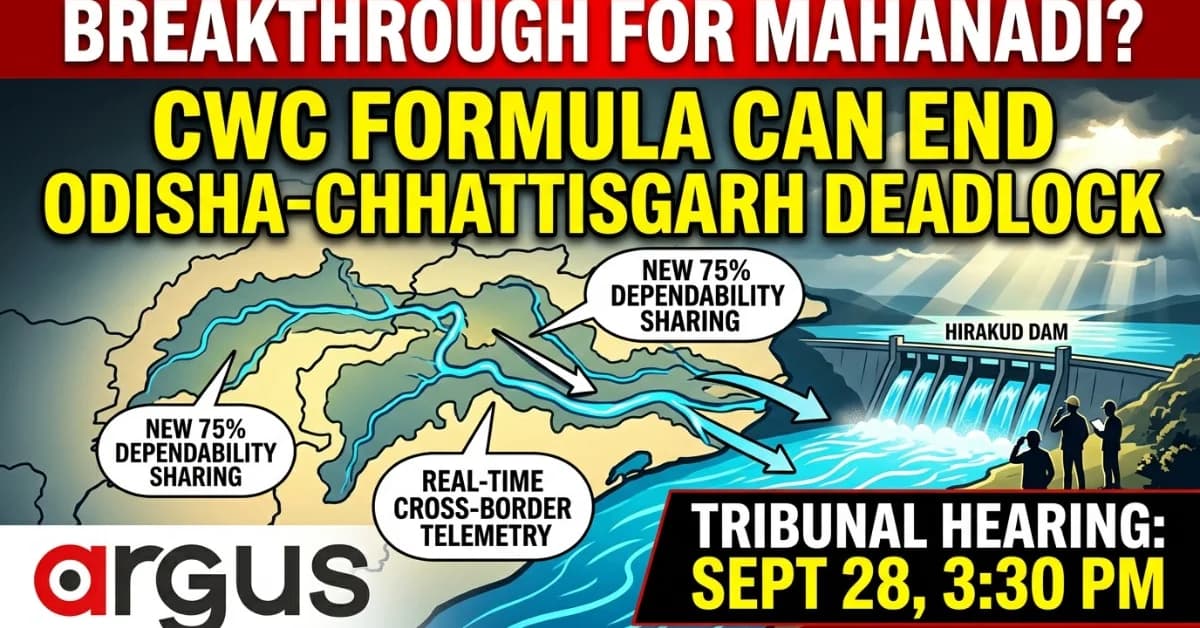
Crucial Hearing Ahead: The CWC has submitted a dynamic, data-backed water-sharing formula to the Mahanadi Tribunal ahead of a pivotal hearing on September 28.
Real-Time Solutions: The proposed framework replaces rigid annual targets with 10-daily operational windows, proportional distress sharing, and automated cross-border telemetry.
A Proven Blueprint: Mirroring successful 2026 agreements like the Sone River Pact, the new approach shifts the focus from adversarial litigation to shared engineering and operational consensus.
Bhubaneswar: In a significant development that could alter the course of Odisha’s decades-old Mahanadi water dispute, the Central Water Commission (CWC) has submitted a potential water-sharing formula to the Mahanadi Water Disputes Tribunal, based on what sources describes as the “positive approach” of the Chief Ministers of Odisha and Chhattisgarh; the tribunal is scheduled to hear the matter on September 28 at 3:30 PM.
The development assumes significance because the Mahanadi dispute has remained locked in a cycle of competing water data, upstream projects, political differences and litigation. But this time, the Centre’s intervention comes against the backdrop of a series of interstate water agreements in 2026 – including the Sone River Sharing Agreement and Kishau Multipurpose Project Pact – raising a larger question: can a formula that has helped unlock other long-pending interstate water conflicts provide a pathway for Mahanadi too?
Why Has the Mahanadi Dispute Lingered For Decades?
The Mahanadi conflict is not merely a disagreement over a single number of cubic feet of water. At its core is a dispute over how the river’s available water should be measured, how much the upstream state can consume, and what minimum flow Odisha should receive during the lean season.
One of the biggest stumbling blocks has been the existence of conflicting datasets. Odisha and Chhattisgarh have historically relied on different assessments of water availability and consumption, creating a basic problem: before deciding how to share the river, the two sides have had to agree on what the river actually has to share.

📱 Get Argus News App
✨The dispute has also been complicated by the use of average annual flow as a reference point. Such averages can be heavily influenced by enormous monsoon flows, whereas Odisha's vulnerability is particularly acute during the non-monsoon period, when downstream availability becomes critical.
Then came litigation. Following the constitution of the Mahanadi Water Disputes Tribunal in 2018, the dispute increasingly acquired a legal and adversarial character, with both sides concentrating on establishing their respective positions rather than finding a mutually workable operational mechanism.
At the same time, upstream irrigation and industrial infrastructure altered the operational dynamics of the basin. The construction of barrages, including Kalma and Amora, became an important part of Odisha's concern over downstream flows.
That combination – data disagreement + lean-season scarcity + upstream infrastructure + political standoff + litigation – helped keep the dispute alive.
2026: Why the Centre’s Mediation Is Suddenly Important
The timing of the CWC's Mahanadi formula is significant because 2026 has seen four major interstate water agreements listed below.
|
Date |
|---|
Interstate water agreement/project
States involved
Core issue
June 29, 2026
Yamuna Water Pipeline Pact
Rajasthan & Haryana
Routing Rajasthan’s allocated water through a specialised conveyance system
July 7, 2026
Narmada Award Financial Settlement
MP, Gujarat, Maharashtra & Rajasthan
Financial and rehabilitation-related issues
August 30, 2026
Sone River Sharing Agreement
Bihar & Jharkhand
Long-running water-sharing deadlock linked to the Sone system
September 15, 2026
Kishau Multipurpose Project Pact
Himachal Pradesh, Uttarakhand, UP, Haryana, Rajasthan & Delhi
Unlocking a long-stalled multi-state Tons/Yamuna basin project
The Kishau pact was described by Union Home Minister Amit Shah as the 10th major interstate water dispute resolved under the Union government's cooperative-federalism approach.
The Centre has also pointed to the Yamuna Water Project, Ken-Betwa, Renukaji and Lakhwar agreements as examples of how long-standing disputes can be addressed by shifting attention from purely adversarial litigation towards shared infrastructure, mediated agreements and technical mechanisms.
For Mahanadi, therefore, the important change may not simply be that another meeting is taking place. The bigger change is the emergence of a negotiation architecture in which engineering data, operational rules and political consensus can work alongside the formal tribunal process.
Why Odisha Can See a Sone-Kishau Parallel
The strongest reason for cautious optimism lies in the similarity of the underlying problem.
An analysis of the Mahanadi imbrogilo identifies the Sone River Basin Accord and Kishau Multipurpose Project Pact as comparable models for Mahanadi.
The Sone breakthrough is particularly relevant because it involved Bihar and Jharkhand and a 25-year-old conflict over water sharing associated with making the Indrapuri Dam/Sone Barrage system operational.
That resembles Mahanadi in one crucial respect: the dispute is not simply about ownership of water. It is about how a shared river system can actually be operated when upstream and downstream interests are different.
The emerging Mahanadi formula attempts to address precisely that operational problem.
|
Core Metric |
Application Strategy |
Mahanadi Adaptation |
|
75% Flow Dependability |
Used water volume available 3 out of 4 years, ignoring flood distortions. |
Locks baseline availability at 62.11 MAF for reliable drought-cycle sharing. |
|
Non-Monsoon Storage Caps |
Placed hard limits on upstream lean-season water storage and diversion. |
Restricts Chhattisgarh's dry-season extraction to protect Hirakud inflows. |
|
10-Daily Inflow Windows |
Calculated water releases in 10-day intervals instead of yearly totals. |
Tracks real-time flows every 10 days to adjust upstream gates (March–May). |
|
Consumptive Ratios |
Differentiated permanent water loss from water returned to the river. |
Validates industrial data, accounting for water flowing back into the channel. |
|
Automated Border Telemetry |
Replaced manual logs with independent, automated sensor networks. |
Uses gauge stations at borders (Kalma/Sukma) to stop data disputes. |
The technical approach described is particularly important. Instead of fighting over competing historical datasets, the CWC framework links permissible extraction to real-time telemetry from cross-border gauge stations.
For Odisha, that could be significant because one of the historical barriers has been precisely the disagreement over actual upstream consumption and downstream availability.
Formula That Could Change Mahanadi Equation
The proposed mechanism also seeks to replace a rigid, one-number-fits-all annual allocation with a more dynamic system.
As per reports, the CWC is examining Odisha’s demand for a minimum 1.74 MAF non-monsoon inflow into Hirakud, while simultaneously assessing Chhattisgarh’s upstream irrigation and industrial consumption, estimated in the material at 9–12 MAF.
The proposed approach includes 10-daily operational windows, allowing upstream releases to be adjusted according to actual conditions rather than treating the river as a static annual account.
Another important component is distress sharing. Under the formula, if basin yield falls below the stated 62.11 MAF benchmark, the deficit would be shared proportionally rather than placing the entire burden on one side.
The proposal also envisages environmental-flow considerations and automated monitoring, potentially creating a system in which the argument moves from “whose data is correct?” to “what does the independent river data show?”
How CWC Formula Takes Care of Odisha Concerns? Read the table below.
|
Odisha's Core Concern |
How New CWC Formula Solves It |
What Makes It Different |
|
Upstream Blockages in Lean Season |
10-Daily Inflow Guarantees: Requires dynamic releases from upstream barrages to maintain steady Hirakud inflows. |
Replaces rigid annual targets with real-time, 10-day operational windows. |
|
Unfair Deficits During Droughts |
Pro-Rata Distress Sharing: Deficits are shared proportionally if basin yield drops below the 62.11 MAF benchmark. |
Moves away from fixed-volume rules to a flexible percentage-based model. |
|
Saltwater Intrusion & Delta Collapse |
Mandatory Environmental Flows: Reserves a non-negotiable 20% of baseline lean-season flow for the ecosystem. |
Prioritizes ecological preservation and delta safety over water quotas. |
|
Manipulated or Biased Data |
Automated Border Telemetry: Water flow is verified via CWC-controlled sensors at interstate border nodes. |
Replaces self-reported state data with neutral, real-time logs. |
|
Bypassing Endless Court Delays |
Bilateral Political Consensus: Uses an expanded Technical Committee to build mutual political agreements. |
Shifts focus from a legal verdict to a cooperative, data-backed settlement |
September 28: The Real Test
The September 28 hearing is therefore more than another date on the tribunal calendar.
The CWC has already placed its potential formula before the tribunal, and the supplied report says the next stage will involve examining the Chief Ministers’ consensus and the technical framework submitted by the Commission.
But one distinction remains crucial: submission of a formula is not the same as final settlement.
The September 28 proceedings will show whether the technical framework can command sufficient agreement from both sides and whether the tribunal can translate that consensus into a legally enforceable arrangement.
That is why the Mahanadi story has entered a potentially different phase.
For years, the central question was how much water Odisha would receive and how much Chhattisgarh could use. The new approach attempts to change the question itself: what measurable river conditions should trigger how much upstream use and how much downstream release?
If the Sone and Kishau experiences demonstrate anything, it is that a decades-old interstate water conflict can move when the dispute is converted from a purely political and legal confrontation into a shared engineering and operational problem.
For
Mahanadi, September 28 will indicate whether that formula has finally
reached the point where a long-running dispute can move from
competing claims towards an implementable settlement.
Also Read: Special Report| Sambalpur’s New Eye in Sky: How Odisha’s Doppler Radar Changes the Weather Equation for Its Interior