



Special Analysis| Curtains Down for the 10-Year Mahanadi Water Dispute? Why Amit Shah’s October 1 Presence Signals a Final Deal
Key Points
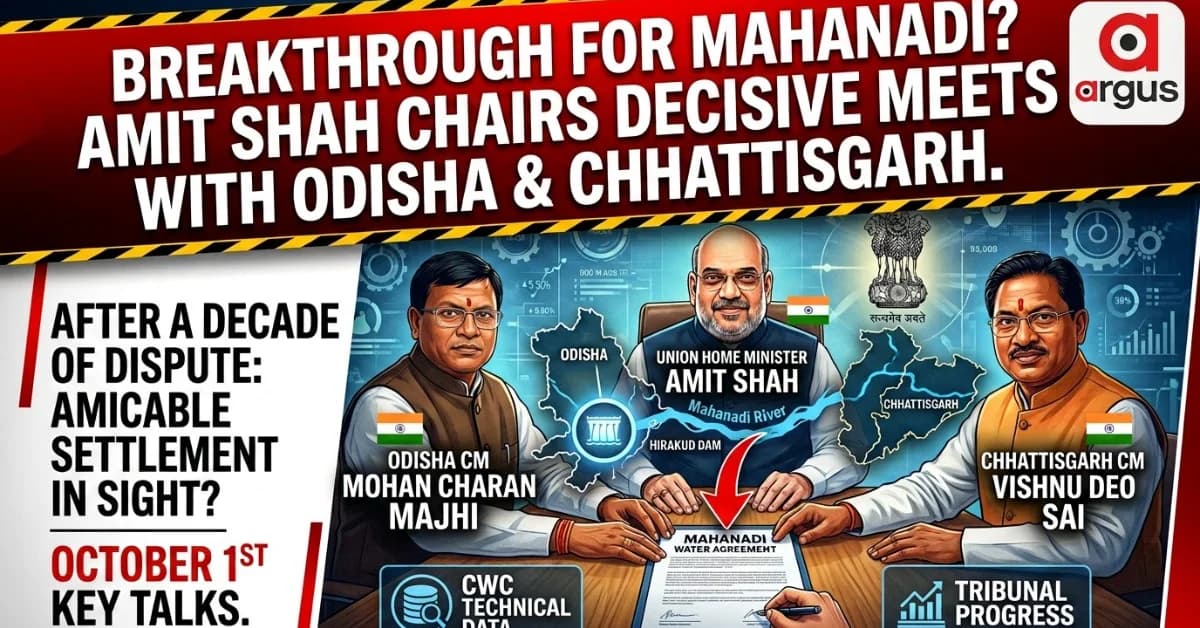
High-Level Intervention: Union Home Minister Amit Shah will chair a decisive meeting on October 1 between the Chief Ministers of Odisha and Chhattisgarh to resolve the decade-long Mahanadi water dispute.
Technical Groundwork Complete: The Central Water Commission (CWC) has successfully consolidated previous technical discussions and submitted the records to the Mahanadi Water Disputes Tribunal.
Replicating the Sone Blueprint: Backed by a rare "triple-engine" political alignment, the meeting is structured to mirror the swift single-session resolution seen in the Sone River pact.
Bhubaneswar: After nearly a decade of political confrontation, legal battles and prolonged technical negotiations over the sharing of Mahanadi waters, Odisha and Chhattisgarh appear to be approaching a potentially decisive moment.
Union Home Minister Amit Shah is scheduled to chair a high-level meeting on October 1, bringing Odisha Chief Minister Mohan Charan Majhi and his Chhattisgarh counterpart Vishnu Deo Sai to the negotiating table in a renewed push for an amicable settlement.
The timing and political composition of the meeting have raised expectations that the long-standing interstate water dispute could finally move towards a mutually acceptable resolution.
More significantly, the meeting comes at a stage when the Central Water Commission (CWC) has already submitted details of previous bilateral technical discussions to the Mahanadi Water Disputes Tribunal, indicating that the technical groundwork is being consolidated even as political negotiations continue.

📱 Get Argus News App
✨Odisha's Advocate General Pitambar Acharya has officially confirmed the proposed meeting and the ongoing negotiations under the technical guidance and mediation of the CWC. His statement offers an important indication that the October 1 talks are not an isolated political intervention but part of a wider process aimed at finalising a water-sharing formula acceptable to both states.
The central question now is whether Amit Shah's presence will provide the final political impetus needed: The timing, executive authority, and rare political alignment of this meeting are delivering some big hints indiacting that is this long-standing interstate water dispute is moving toward an immediate, definitive breakthrough?
Significantly, the meeting comes as the Central Water Commission (CWC) has consolidated the details of previous bilateral technical discussions and submitted them to the Mahanadi Water Disputes Tribunal. Odisha's Advocate General (AG) Pitambar Acharya officially confirmed the upcoming summit, underscoring that the October 1 talks represent the final political closer of a comprehensive, technically vetted water-sharing formula.
Why October 1 is the Turning Point
The true significance of the October 1 meeting lies in its position as the final piece of a meticulously planned executive sequence. Three major indicators point toward an imminent settlement:
Consolidated Technical Groundwork: The CWC has finalized its technical assessments on seasonal water availability, reservoir volumes, and downstream flow requirements.
The Path of Escalation: On July 30, Union Jal Shakti Minister C.R. Patil hosted both Chief Ministers to secure a baseline political commitment. Following subsequent technical refinements, the file has now been escalated to the Union Home Minister to iron out any final political wrinkles.
Executive Decision Power: By entering the room with full state executive authority, both Chief Ministers are positioned to bypass the typical bureaucratic stagnation that technical consultations alone cannot resolve.
The Sone River Precedent: The One-Meeting Blueprint
The recent resolution of the Sone River water-sharing agreement between Bihar and Jharkhand on August 31 provides the exact template for what to expect on October 1.
In the Sone River dispute, years of complex sub-surface technical negotiations were compiled quietly behind the scenes. Union Home Minister Amit Shah stepped into the process only on the final day to act as the executive mediator, executing the final Memorandum of Understanding (MoU) in a single session.
While the Centre previously navigated multi-party friction across six states for the Kishau Multipurpose Project Pact, the Mahanadi dispute involves only two states. Because the foundational flow data has already been transmitted by the CWC, Amit Shah’s presence on October 1 is heavily optimized to replicate the Sone model – serving as a signing ceremony rather than a prolonged debate.
Double Engine Alignment: Erasing Historical Friction
Historically, Chhattisgarh’s upstream position – marked by the construction of industrial and irrigation barrages – directly clashed with Odisha’s downstream dependence, sparking fears of dry non-monsoon riverbeds at the Hirakud Dam.
The decisive catalyst for change is the current "triple-engine" political alignment: the Bharatiya Janata Party (BJP) now governs Odisha, Chhattisgarh, and the Centre.
While shared party lines do not instantly erase the competing ecological and agricultural needs of either state, they completely remove the partisan friction that blocked communication for a decade. Chhattisgarh CM Vishnu Deo Sai’s recent public declaration that "the dispute is no longer a major issue" signals that a mutual political understanding has already been achieved. For Odisha, the final text will focus strictly on ironclad legal guarantees safeguarding its long-term downstream irrigation and drinking water quotas.
From Tribunal Logjams to Executive Action
Established in 2018, the Mahanadi Water Disputes Tribunal spent eight years gridlocked by pandemic delays and extension requests. In July, realizing the limitations of judicial delays, the tribunal explicitly encouraged both states to pursue parallel, conciliatory talks mediated by the Ministry of Jal Shakti and the CWC.
The submission of previous bilateral records to the tribunal by Odisha’s AG confirms that the legal and political tracks are now operating in tandem. Rather than abandoning their legal positions, both states are using the technical data validated by the tribunal as the foundation for their political compromise.
If
the October 1 meeting achieves its expected consensus, the immediate
next steps will involve formalizing the water-sharing text, securing
swift state cabinet ratifications, and establishing a joint
implementation and monitoring mechanism to officially bring down the
curtain on the decade-long conflict.
Also Read: Special Report| Mahanadi Water Dispute: On September 28, Will Odisha’s Long-Running River Row Go the Sone-Kishau Way?
Related Topics
Explore more stories